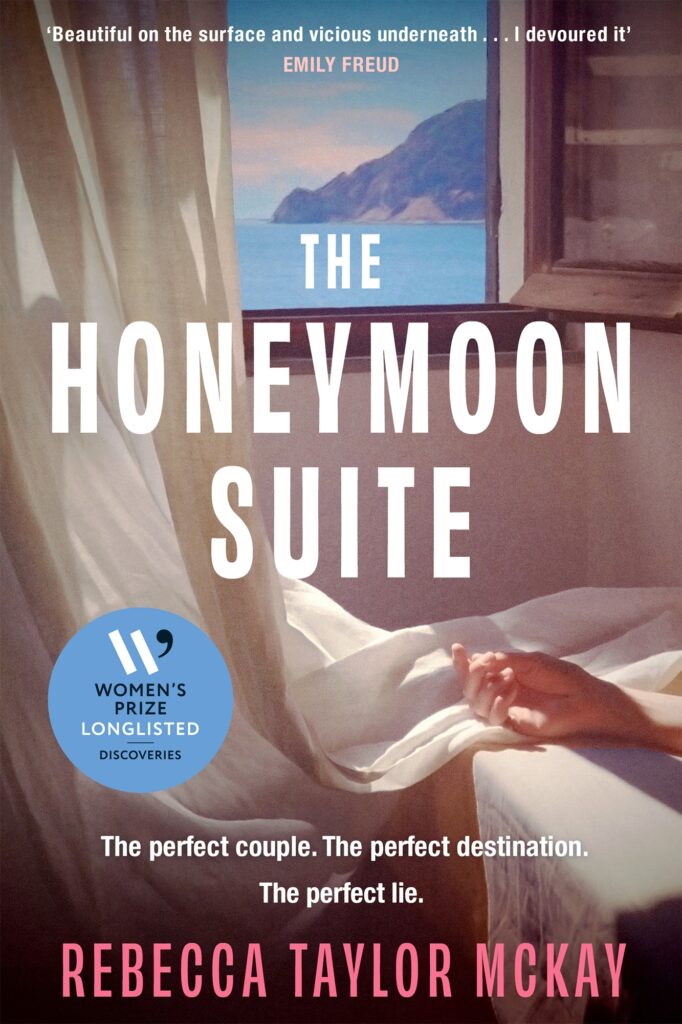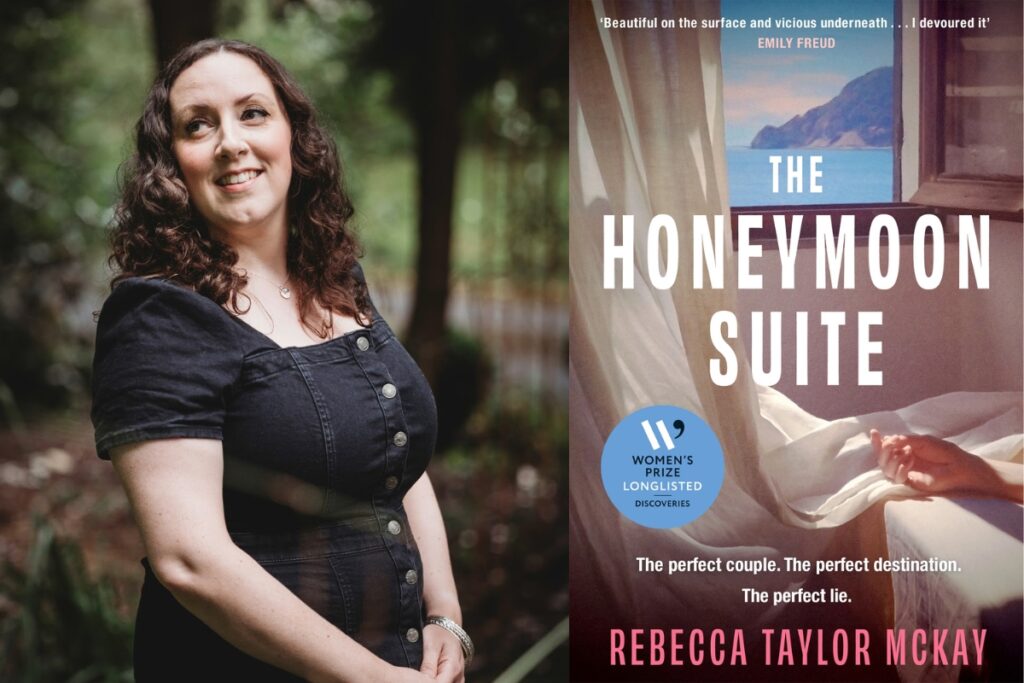
As Rebecca Taylor McKay – longlisted for Discoveries 2022 – publishes her debut novel The Honeymoon Suite (18 June 2026), she shares with us how she came to choose the Amalfi Coast, the power of fictional wanderings and her longstanding love of settings as characters.
Looking back over my reading life, it’s clear that I have always loved stories where the setting is a character in itself. From Daphne du Maurier’s sublime descriptions of the Cornish coast, and the house that inspired one of the most iconic lines in literature: ‘Last night I dreamt I went to Manderley again…’ to the rugged Yorkshire Moors tufted with heather where I make my annual pilgrimage to Top Withens – the crumbling ruins that once inspired Emily Brontë’s Wuthering Heights.
As a young reader I visited, again and again, the creepy fictional town of Derry, Maine through Stephen King’s novels, and later, via Sarah Moss’s Night Waking, I travelled to the Outer Hebrides alongside Anna, a fellow sleep-deprived mother-of-two trying to juggle all that modern life demands of women while her husband counts puffins.
I marvelled at the snowy wilderness to be found between the pages of The Tenderness of Wolves by Stef Penney, and to my surprise, I learned that the author, suffering from agoraphobia at the time, wrote the novel entirely from her home in Scotland, having never visited the Canadian landscape she captured so vividly. A fact that stuck with me through the years, and one I’d end up coming back to when writing my own novel, The Honeymoon Suite.
People are often surprised to learn that I haven’t visited the Amalfi Coast where The Honeymoon Suite is set. Something I take as an enormous compliment, and (I hope) a testament to how hard I worked to get it right.
The truth is, when I first started writing the book, I didn’t know where the story was taking place. All I had were two images in my mind, like holiday snapshots I’d seen in an old photo album. Startlingly vivid, but without the handwritten annotations to fill in the blanks: Who are these people and where is this place?
In the first, a couple walked hand-in-hand through a narrow street with whitewashed stone buildings to either side, and warm cobbles underfoot, the sun glinting between sloping rooftops. The claustrophobia of the narrow streets forcing them shoulder-to-shoulder, their closeness only highlighting the vast emotional chasm yawning between them.
And then, a second image – no people in this shot – only a dizzying view from a high clifftop, turquoise sea stretching away in all directions, frothing waves crashing against the slick grey rocks far below, and to one side, a cluster of Mediterranean pines, top heavy and arching towards a vast blue sky. The type of image you can almost smell. Close your eyes and you’re there.
Having travelled so little myself – outside of my fictional wanderings – it was a place I could feel but didn’t know.
A few weeks later, I happened to be watching a travel documentary on the BBC – Write Around the World, in which Richard E. Grant tours famous literary locations. In the very first episode he visits Italy, and describes Patricia Highsmith’s 1952 trip to Positano, the romantic jealousy that plagued her personal life, and the scene that inspired perhaps her most well-known novel, The Talented Mr Ripley.
The moment I saw the Amalfi Coast on the screen, I knew immediately this was it. This was where Clara and Spencer would spend their honeymoon.
It’s a place so achingly perfect it might be a dream, while all the while Clara exists in the foggy haze of having just woken from a nightmare; everything slightly off-kilter, a dark film creeping in at the edges of her vision, as she turns her head toward something just slithering out of sight.
I still haven’t been to the Amalfi Coast – am now slightly afraid to, in case I stumble across some geographical error or cultural faux pas that it’s far too late to correct. But I dream of one day standing in place of my characters – my toes curling into the ashy sand of the spiaggia grande, or looking back at the rainbow buildings tumbling down the hillside from a small boat carving a streak of white foam through the blue, or, perhaps, peering over a balcony draped with the heavy scent of wisteria.
Whether I’ll dare to go very much higher than that, climbing the endless steps to Sentiero degli Dei – The Path of the Gods, I can’t yet say.
What I am sure of, is that The Honeymoon Suite wouldn’t – couldn’t – have been the same story set anywhere else. That the Amalfi Coast is as much a character as any other in the novel, if not more so. I also feel enormously thankful that I’m able to travel across the world in the pages of a book, whether that happens to be one I’m reading, or writing.
Learn more about Discoveries, the Women’s Prize’s programme and prize for unagented and unpublished women fiction writers in the UK and Ireland, here.