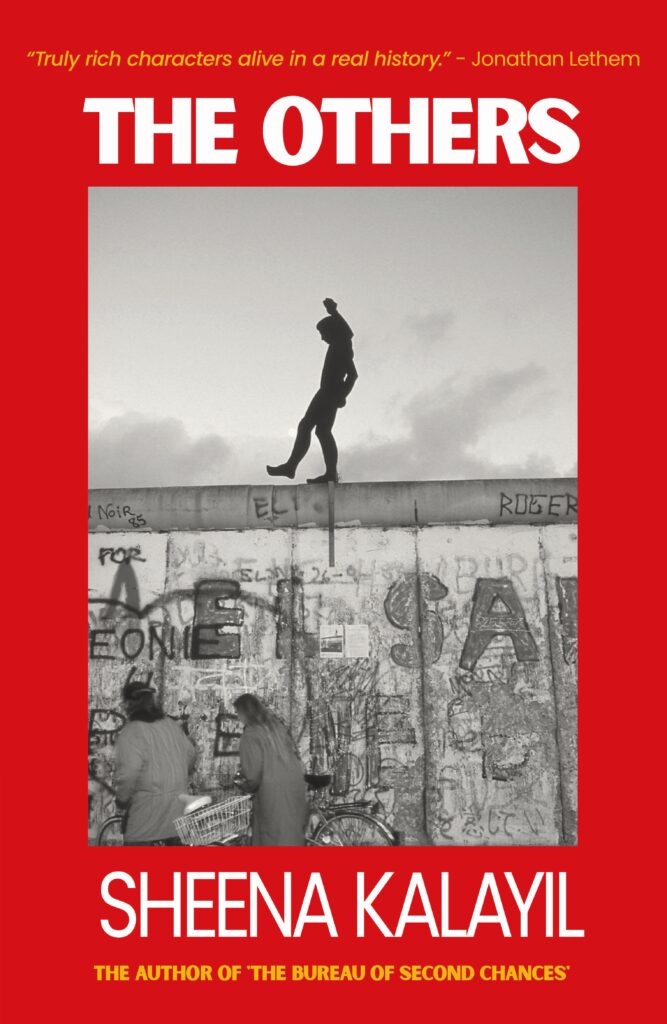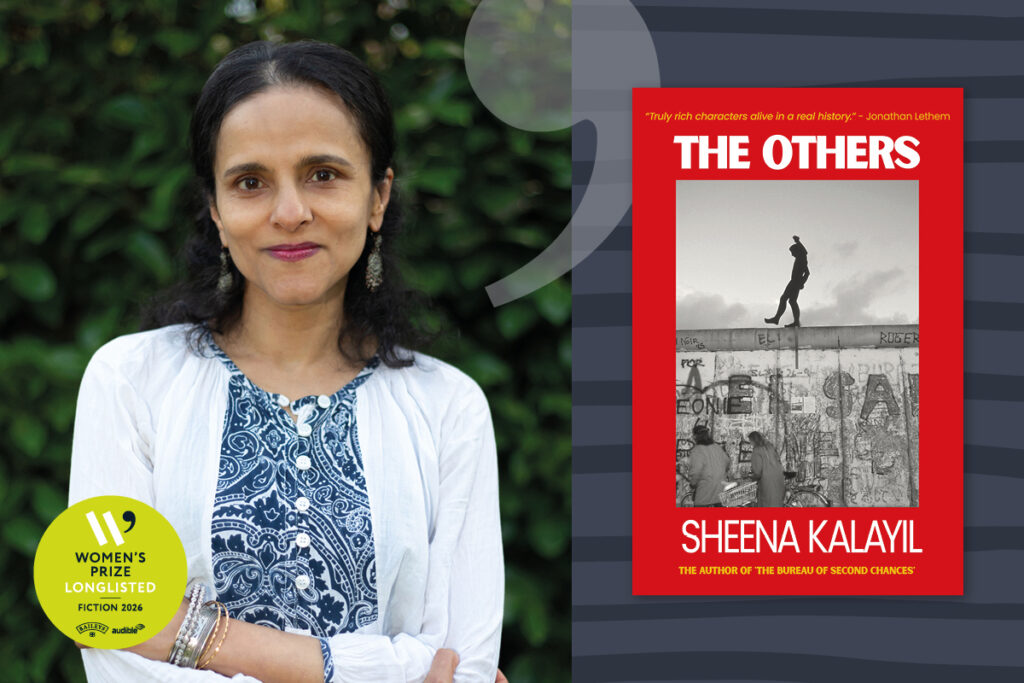
Set against the background of the fall of the Berlin Wall, The Others by Sheena Kalayil follows the journey of three friends whose lives are bound together in a web of love, lies and fears, leaving each irrevocably changed.
2026 Women’s Prize for Fiction judge, Cariad Lloyd, said: “Set in 1989 in East Germany, The Others by Sheena Kalayil follows three friends experiencing the taste of freedom in very different ways. Full of compelling characters, it is a gripping story of love and immigration.”
To learn more, we spoke to Sheena about her inspirations, creative process, favourite authors and more:
Congratulations on being longlisted for the 2026 Women’s Prize for Fiction; how does it feel to be longlisted and what does it mean to you?
Being longlisted, and joining the ranks of brilliant women, writers and thinkers… well, it means everything to me. I am honoured, humbled and grateful. By the time my debut novel was published, I was 47 years old and had survived neglect, abuse, estrangement, loss – as well as found love and joy. So, I do not feel defined by my writing. But, at the same time, I have never felt I deserve to call myself a writer! I am also so happy for my editor: a young woman who has set up an independent press and who took a gamble on me. It’s a wonderful moment in my life, a wonderful feeling of validation – and I am bowled over by the vision of the judging panel holding my novel in their hands.
How would you describe your book to a new reader?
The Others speaks to contemporary themes of migration and belonging, through the very personal dilemmas we will all recognise. Set in East Germany in 1989, it follows three young people of vastly different backgrounds caught up not only in a love triangle, but at the heart of a revolution in Eastern Europe, which will see the fall of the Berlin Wall.
What was the idea that sparked your novel?
I realise that all my writing explores migration: they are stories where migration is non-linear, governed by chance, and a manifestation of our humanity. This reflects my own life, as a child of migrants who became a migrant herself. But what has impacted me the most as a writer and as a human, is the adverse experience of my childhood. So, it is the human story within the grander theme of migration which interests me.
I had two strong memories, filed away for further deliberation, which began to gnaw away at me as my daughters reached the age I was then – when they were entering adulthood, moving into their twenties.
The first was from when I was nineteen years old, the night the Berlin Wall fell, 9 November 1989. I was walking around in the packed, jubilant centre of Budapest, not fully understanding what people were saying, finally understanding the news. I had a strong sensation that I was living through something momentous, but I also felt somewhat removed. I was renting a room from a lovely Hungarian woman, whose English husband had left her and their son during the Hungarian Revolution against the Soviets in 1956. When I got back to the apartment late that night, she greeted me with tears running down her face. Everything will change now, she said. I felt torn, because I had been happy in Budapest. The feeling of joy and liberation I was feeling, living in Budapest, did not match with the citizens’ revolt against authoritarian rule. The other Indian, Angolan and Nigerian students who I knew in the city, were all worried as well, about what the future held for us, caught up in this European revolution. Fast forward a few years, and I was living in Maputo in Mozambique – the civil war had not long ended. Every weekend in the park in the centre, near the market where I shopped for fruit and vegetables, the Madgermanes held a protest, demanding the payment withheld from them on their return from the DDR. I had kept these two strong memories, letting them hibernate, but now I wanted to write something that would connect them.
What did the writing process, from gathering ideas to finishing your book, look like?
There were many stop-starts: I tried at first to write about a worker returned from the DDR, living in Mozambique. But it didn’t work, it didn’t feel like it was my story to tell.
My research into the Madgermanes had led me to many academic articles and books about their life after leaving the DDR, but also about their life in the DDR. That was when I wondered whether I could set the story in the DDR at that period of change, and whether I could draw on my personal experiences of being in Eastern Europe at that time, my memories of 9 November 1989. I knew that the Eastern Bloc countries had always offered scholarships and work permits to people from what we now call the ‘Global South’. Kerala, having a Communist state government through most of my childhood, had strong links with the Soviet Union and the Eastern Bloc. Could I write a novel set in the DDR, where I had never lived? Could I evoke the sense of place and time, and the linguistic landscape? It was a challenge to myself, it was exciting!
I started reading more and more about the DDR and that period of history, the late 1980s, and I came across the startling fact that about 5000 people had tried to escape from the DDR by swimming or sailing across the Baltic Sea to Denmark. With contemporary reports of migrants crossing seas, with more polarised debates about migration, the jigsaw pieces started to fall into place. A small city on the Baltic Sea, modelled on Rostock, was the perfect place for three young people to meet, their lives to entangle, to face dilemmas brought on by momentous political change not of their making.
Red Love by Maxim Leo and Stasiland by Anna Funder were particularly helpful. There is an essay in Stasiland about a woman who was attacked by a prisoner who was mistakenly released during the chaos which ensued as the Stasi disintegrated, and a colleague at work pointed me to a documentary made in Germany some years ago which discussed this issue. Tanja Müller’s academic research and monograph Legacies of Socialist Solidarity: East Germany in Mozambique helped me flesh out my memories of the Madgermanes in Maputo and imagine their lives in the DDR. Most of my colleagues at work are ‘West’ German, and I very quickly picked up on the persistent rivalry between Wessis and Ossis, also referred to by Maxim Leo! There were some academic articles, but not many, which wrote of the xenophobia and racism against the African workers in the DDR, which increased during the last years before Die Wende.
I knew the novel would be about Lolita, Armando and Theo, and Clara immediately made her presence felt. I sometimes had tears in my eyes writing the scenes between Armando and Clara. My own, late father – deeply flawed and scarred by his own brutal, impoverished upbringing – makes an appearance in some form in all my novels. He wasn’t particularly proud of my later-life literary career – he wanted me to be an engineer – and dementia meant that he did not read my second and third novels before he died. But ironically, this, my fourth would be the one he might have enjoyed – he was a History teacher.
I wrote the first three or so chapters quite quickly; I wrote the final chapter, halfway through the first draft. I knew that there was not going to be a ‘happy’ ending, but I knew an adult Clara would be our redemption.
In between, however, there was a lot of agonising. About tenses – I compared about 30,000 words in both present and past tense – but the present tense felt right, somehow, more urgent, which suited the underlying tension in the novel. About first person versus third person – should each part be ‘voiced’ by one of the trio? But with such a diverse cast of characters, I wasn’t comfortable with how authentic I could make a first-person voice sound, and as I wrote more and more, the close, third person began to work, better and better. About language – this is the first novel I’ve written when I don’t speak one of the languages (German). I had to rely on Google Translate, and check with colleagues – but that loss of ‘control’ over the linguistic authenticity was a surprisingly hard lesson to learn!
I knew I wanted this novel to be character-led – but there was so much detail (about life under the Stasi, the foreign students and workers and their different experiences, how East Germans themselves had such diverse perspectives on their country, this was all happening a mere 45 years after the Nazis had been defeated…) that I feared I would get bogged down, write a novel which read like an academic monograph. Also, as with all my novels, there is a cast of characters with cultural and linguistic diversity. It takes care to avoid the ‘White is the norm’ narrative we have all been socialised as readers with; I knew I would be throwing readers into a complex network of peoples from different backgrounds, and I needed to show confidence and authority in navigating this landscape. But I trust the reader – I remember myself as a voracious reader from a very young age, devouring books written by American and Russian and British writers, never having visited those countries, never having learned all the details of their long histories, but still feeling drawn into those worlds. I wanted the novel to feel real and true and present and immersive, and the humanity of my characters to be the core of the story.
Which female author would you say has impacted your work the most?
Very difficult to answer, and not stylistically, but I would say Arundhati Roy has had a huge impact. Reading The God of Small Things – reading Malayalam written into the text, reading about the Syrian Christian family in Kerala with all the jealousies and pettiness laid bare, the bruised childhoods – it was so close, so personal, compared to all the reading I had done before, that I started to wonder whether there might well be an audience for what I wanted to write about.
What is the one thing you’d like a reader to take away from reading your book?
That life is a combination of circumstance and choice, and that you are lucky if the balance for you is more in favour of choice.
Could you reveal a secret about your creative process? This could be where you like to write, a unique writing ritual you have to unlock creativity, or how you go about writing.
I have a day-job, and so my writing takes place at snatched moments. But a secret? When they were teenagers, my daughters took an inordinate amount of time having showers in the evening (we have one bathroom in the house). Never mind how much I banged on the door, shouting, ‘Don’t waste water!’, they had long luxurious showers. To manage my stress levels, I would do my writing while they were in the bathroom – I could escape to my own world. It helped my productivity no end and got me into a habit of shutting out what is around me when writing. I should say that my daughters are both very environmentally conscious now!
Why do you feel it is important to celebrate women’s writing?
Celebrating women’s writing addresses the longstanding deficit of prestige and value faced by women in any walk of life, not least in the competitive and commercial world of the literary industry. Books are social, cultural and intellectual artefacts, reflecting and contributing to humanity, helping us understand and solve the problems of our condition: without half of those voices, we only have half the story. But celebrating women’s writing also opens the door to a better understanding of the diversity within a woman’s perspective, ability and creativity. We are shaped by so much more than being a woman – we are also shaped by our childhoods, class, health, education, sexuality, wealth, race and faith. The more books written by women we celebrate, the more we will realise that every woman is different and every book she writes is different.