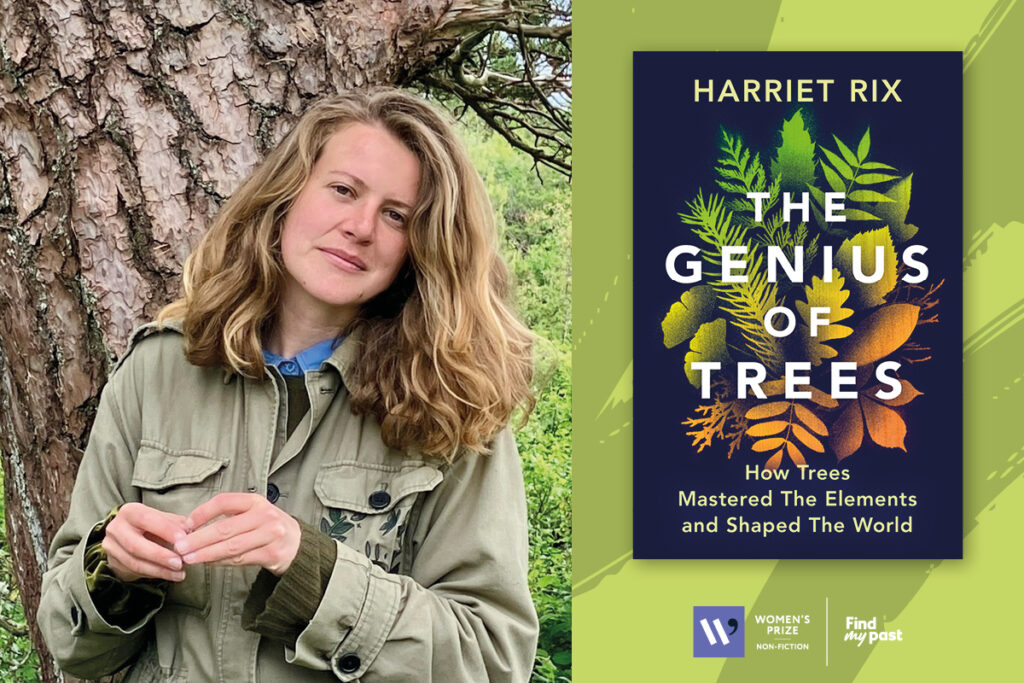
The Genius of Trees by Harriet Rix tells the mind-expanding global story of the inventive and astonishing ways trees learned to shape our natural world, presenting a powerful new vision of nature’s capacity for change and offering an image of hope for the future.
Longlisted for the 2026 Women’s Prize for Non-Fiction, judge Roma Agrawal says: “This is a great example of a science book that anyone can pick up and enjoy. The Genius of Trees made me realise on many different levels how trees interact with parts of our environment and lives which completely surprised me. You can feel Rix’s real passion for trees, and you’ll suddenly never look at them in the same way again.”
To learn more, we asked Harriet about her research, writing process, inspirations and more.
Congratulations on being longlisted for the 2026 Women’s Prize for Non-Fiction; how does it feel to be longlisted and what does it mean to you?
It is an honour and a magical surprise to be longlisted for this award; like seeing the bark of a tree through the forest and going over to it and looking up and up and being confounded by just how huge it is! The book is dear to my heart and is a result of many years of study and research. It means a lot that the jury resonated with its message and I’m very humbled by this recognition.
When I was writing my book I tried to side-step humans and keep trees centre stage as much as possible, but I worried that this would make it hard for readers to relate to what was going on. To be longlisted for this prize feels like an endorsement of this approach – yes, people can empathise with trees strongly enough that they don’t need to anthropomorphise them! And that is a wonderful thing.
This Prize is particularly dear to me because I feel that it is sometimes easier for women to fictionalise their accounts than go face to face with the disproportionately loaded criticisms they often face. In science and maths at school, most of all in landmine clearance, and even in arboriculture, I’ve been in a female minority. As a result I’ve often come up against an extraordinary devaluing of women’s perspectives and experience, whether this manifests itself as gentle denigration or outright aggression. I wish more women wrote non-fiction books. I wish more women considered it as an option!
How would you describe your book to a new reader?
My book is about how the tree you love and see rooted in the same place every day, moves the world around it in order to survive. More broadly; the message of my book is that trees – far from being passive life forms – are constantly playing with biochemistry to produce an invisible cloak of influence in the world.
We experience that influence through the smells and tastes of trees, as well as what we see, and so it’s about what trees have had to do to spread across the world. It’s a very material book. It describes how trees have developed over 380 million years of evolution, to work on the earth, the wind, and the fire, the fungi, animals, and plants around them to produce a stable environment for themselves , and how we have developed into the niche that they created to the extent that their safety is our safety.
My book is also a more-than-human-empathy guide for readers who are trying to relate to trees. To equate human preoccupations with tree preoccupations is usually futile; to try to understand trees and how to help them we have to understand the biochemistry of trees that has been painfully pieced together by scientific research, and then imagine beyond it.
What inspired you to write your book?
There were two moments that inspired me to write a book about the agency of trees in the world. The first moment was in Iraq in 2014, when I saw the amazing variation and resilience in the oak trees which had evolved in the Zagros mountains – this made me obsessed by the way that trees managed water and turned sand into soil.
The second was when I was working for a tree-charity, talking a lot about tree planting in a very wet UK winter. Conversation after conversation seemed to both underestimate and overestimate trees; they needed exactly the correct soil and protection from a million animals, but then they would save the world instantly! At the same time I was meeting specialists who talked about the incredible variety of trees. I wanted to write a book about the chemical research – so much of it very recent and revelatory – which showed just how much trees could do without humans.
What did the writing process, from gathering ideas to finishing your book, look like?
I’d been gathering ideas for almost ten years by the time I pitched the book, but I hadn’t decided on the emphasis. I had a very battered notebook in which I’d written down ideas in rough themes, but I was always moving around and trying to live and earn money, so I never felt I had the time or energy for the pitching process, let alone the writing process. Then I started reading about the beginnings of trees on earth and how they’d shaped the landscape, and it seemed to underpin all the ideas I’d had about how trees had agency, but I still didn’t know where to start. Finally an older friend who is an author said, just write it down! Very very slowly I did, and then about six months later my agent got in touch because he’d read an article I’d written. We beat it into shape together, and sent it to Penguin who bought the idea, and then it was 12 months of wonderful research and writing, before some very painful editing and (thankfully) into Penguin’s immensely professional hands and lots of help sorting out the footnotes.
How did you go about researching your book? What resources did you find the most helpful?
I was adamant that I needed to see and touch the majority of the trees I was writing about in their native environments (although in a few cases I cheated and went to botanical gardens) and so I had wonderful month-long research trips, often being hosted by incredibly generous tree lovers – in the Amazon, in Pakistan and in California among other places.
I was very lucky to be on the London Library emerging writers scheme just after Covid, which comes with free membership of the London Library, and the Linnaean Society just around the corner has fabulous collections of scientific literature. The British Library was very useful and allowed me to access scientific papers, and the herbarium at Kew was invaluable. It’s a truism, but generous people willing to share knowledge are the greatest resource.
Which female non-fiction author would you say has impacted your work the most?
Lynn Margulis has had a major affect on my work. She was an esoteric scientist, who proposed one of the most transformative theories ever to hit science – the endosymbiotic theory. Her writing about complex theories is elliptical and poetic but also universal, incisive and witty. She reminds me in some ways of Jamaica Kincaid, another writer I’m in awe of. How do we relate the extraordinary to the comprehensible? How do we make the specifics universal? How do we stay focussed when describing worlds within worlds? Margulis does this in her essays, brilliantly.
What is the one thing you’d like a reader to take away from reading your book? Is there one fact from the book that you think will stick with readers?
I’d like a reader who goes away and notices the scent of the trees more than they did before, wonders about all the things that perfume is there for and picture how it is forming shapes in the air, then (if they have time!) to think about that extension under their feet.
And the one fact from the book that seems to stick with readers (not what I would have predicted) is that some trees can produce a cocktail of inflammable substances that provoke fire.
Why do you feel it is important to celebrate non-fiction writing?
When there was first discussion of an era of post-truth I thought it was a catastrophist attitude to take to life, but I think we’re all seeing more and more the reality of people not knowing where the line lies between truth and fiction. This is apparent even in tree-lore!
I love fiction and think that stories reveal truths that go right to the heart of the human condition, but non-fiction allows us to connect different pieces of our world in a way that helps us decide where to put the emphasis of our lives. Non-fiction can be so awkward; it can force us to confront contradictions and uncertainties which would be smoothed away by a compelling narrative. And I think we all need that challenge.
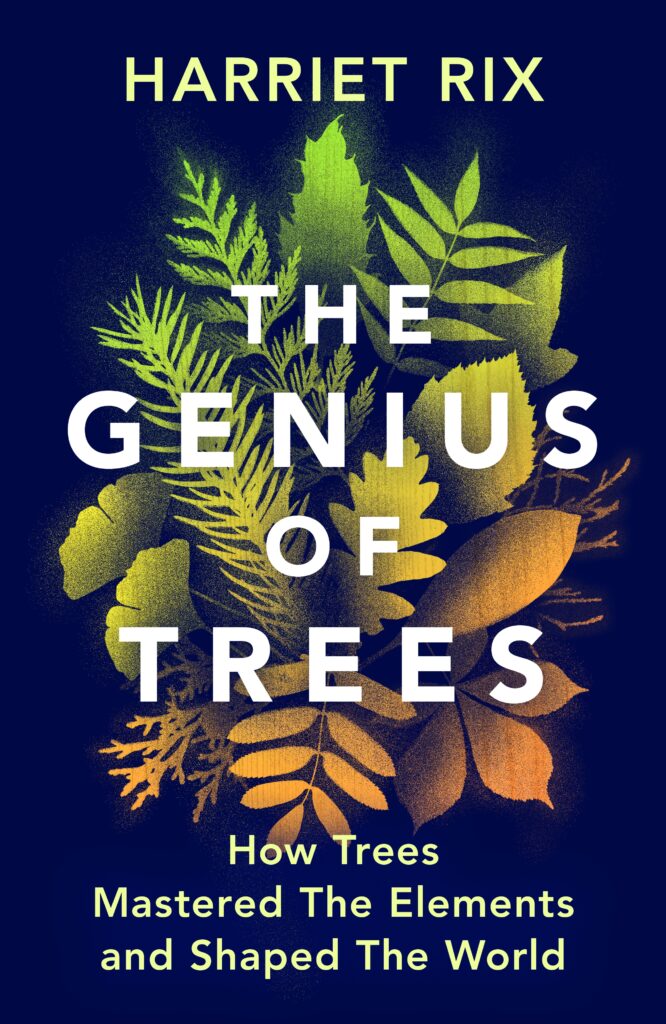
The Genius of Trees: How Trees Mastered the Elements and Shaped the World
by Harriet Rix
Find out more