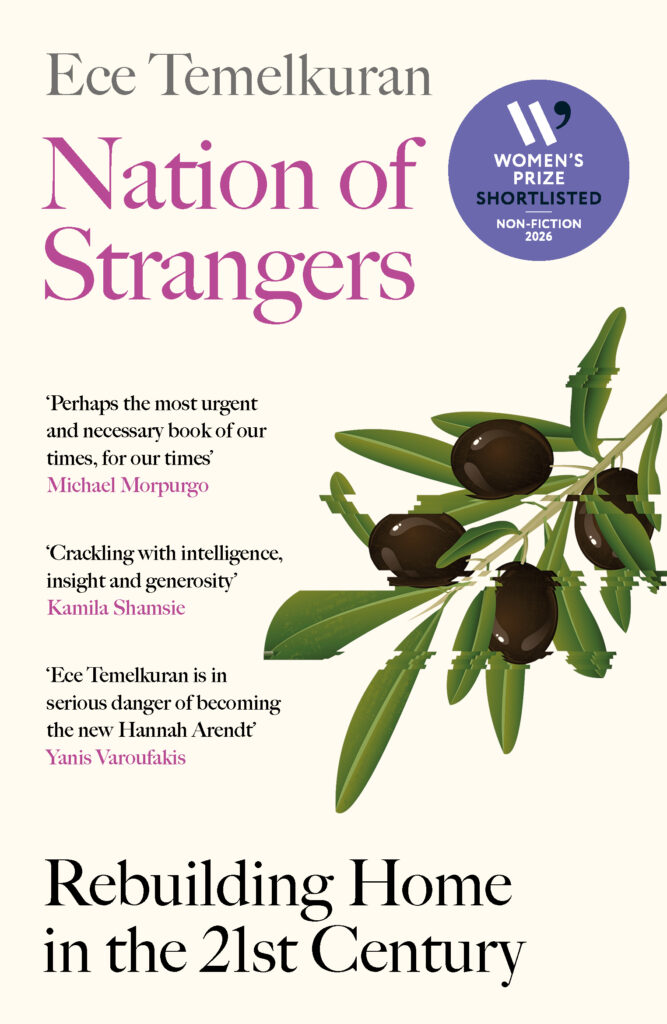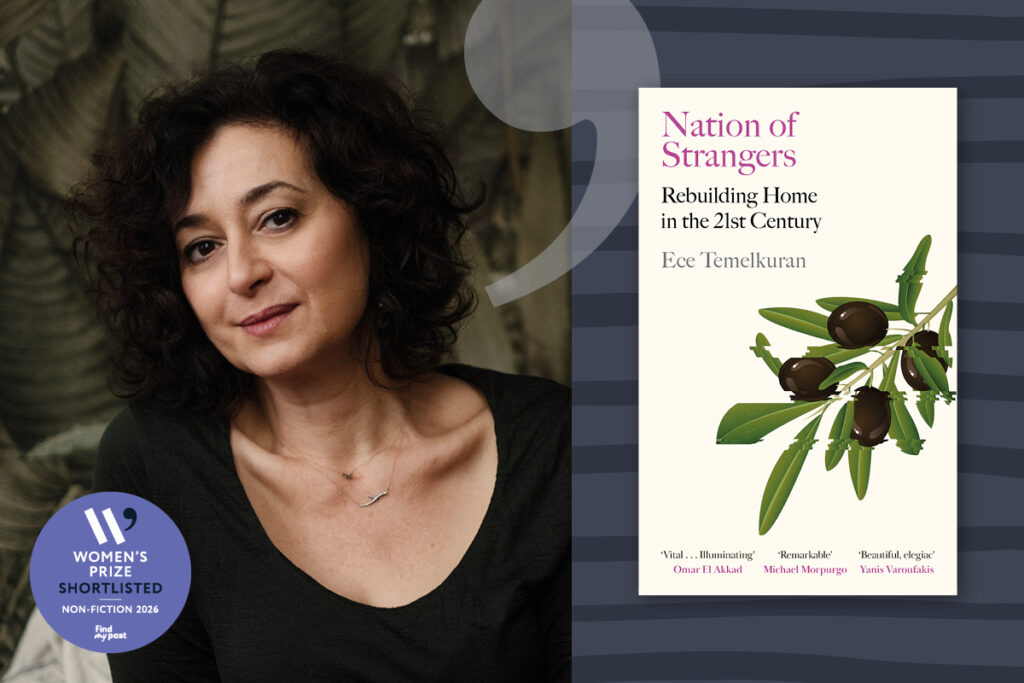
In Nation of Strangers, internationally acclaimed writer and political thinker Ece Temelkuran writes an urgent reappraisal of the concept of exile, migration and home, with a message of hope and compassion for anyone who feels alienated by an ever-more monstrous world.
Shortlisted for the 2026 Women’s Prize for Non-Fiction, Chair of Judges Thangam Debbonaire says: “Nation of Strangers is a story for our times about migration, about dislocation, and about how that makes people feel – but also how it changes how people relate to one another.”
To learn more, we spoke to Ece about her research, writing process, inspirations and more.
Congratulations on being longlisted for the 2026 Women’s Prize for Non-Fiction; how does it feel to be longlisted and what does it mean to you?
I’m honoured to be recognised by the Women’s Prize, especially for Nation of Strangers, a book in which I discuss how women’s lived knowledge of care and support will serve as humanity’s moral compass in this new age of cruelty. After all, for so long we have been the ultimate strangers in the world, always having to live in survival mode while keeping our dignity and humanity intact. To have been longlisted in a language that I only started writing in ten years ago, after having to leave my mother tongue behind in Turkey, also brings me great happiness.
How would you describe your book to a new reader?
Nation of Strangers is a two-layered book. On the one hand, it is perhaps my most personal book yet – it tells the account of my ‘exile’ from Turkey, after I fled the threats of a fascist regime I had become dangerously critical of and consequently targeted by. After years of touring the Western world, warning politicians, academics, anyone who would listen, that fascism would soon be at their door, I found myself exhausted and forced to face my own circumstances, to finally face home, that vanishing dot on the horizon. I was compelled to seek out others who lived in this state, across history, literature and the cities that I drifted through. To connect our disparate experiences, I began to write a series of letters to these other strangers. As I did so, I realised that this loss of home, this ‘unhoming’ (a nineteenth-century word that I resurrect in the book), is occurring at a global scale and on so many levels as we enter a new and terrifying world order.
We are so often confronted by the physical loss of home in the form of refugee crises and migration at scale. In this book, I argue that many more of us are losing our homes – morally, politically and spiritually. We are losing our home to globally institutionalised cruelty, wars and fascism. Familiar political parties are no longer recognisable. Due to the climate crisis, we are losing our ultimate home, the planet. Because of AI, we are losing our spiritual home – language and art. Today, the anxiety and fear we are experiencing as humanity stem from this destabilisation, this loss of home. Amidst the noise of global rupture, we are experiencing a quiet collapse inside each of us. As we enter the age of survival, we should look to those who have already lost their homes and learned to rebuild out of nothing – the exiles, refugees, immigrants and homeless of the world – and who will lead the way.
What inspired you to write your book?
Other “strangers” – refugees, immigrants, asylum seekers, the rough sleepers, and, most importantly, people around the world who are losing their homes and their countries to various shades of fascism. Only through their inspiring stories and generosity could I find the courage to look my own homelessness in the eye and lay bare in my book what happens to the self when unhomed. Looking at my “situation” as an “exile”, as an unhomed person, became possible only when I realised that there is a direct connection between my personal reality and the reality of the world, the current human condition. This was both sobering and a great comfort.
What did the writing process, from gathering ideas to finishing your book, look like?
Nation of Strangers is my third book written in English, but it was the most difficult to write. It was uncomfortable to question how to preserve my dignity and values while talking about the self. That’s why, for about a year and a half, all I did was not write. What I wanted to find during that time was a dignified voice to talk about my personal story, a voice that is neither a glorified victim nor a proud survivor. When I finally found the right tone, it was mostly about going to people, listening to their stories, humbling myself and, meanwhile, looking at the world and noticing the connection between the currently unhomed and the unhomed of the future. Connecting the stories of the unhomed to the human condition required following the world events from a different perspective, an almost poetic distance. Finishing the book was especially important because, in the beginning, I had made a promise to myself that I’d feel at home in the world, with the world, by the end of the book. And, somehow, it happened.
How did you go about researching your book? What resources did you find the most helpful?
There was almost a year-long reading process in Hamburg and in Berlin. Other than that, it was all about tracking down the unhomed; the refugees, the immigrants and the women in homeless shelters. In this quest to find the other strangers, I visited homeless shelters, refugee camps and organisations that helped the refugees and asylum seekers. It was an education through which I left the podium/stage that I’d become accustomed to and the ivory towers that insulate so many experts in their field. On this three year long journey, the real research began at humble cafes or backstages of life – where honest conversation took place. During the research process I was offered a fellowship by Robert Bosch Academy for nine months which I am grateful for.
Which female non-fiction author would you say has impacted your work the most?
Among the living are Arundhati Roy and Naomi Klein. But Hannah Arendt has been my ultimate muse, not only her work but also for the way she lived her life.
What is the one thing you’d like a reader to take away from reading your book? Is there one fact from the book that you think will stick with readers?
I’d love them to acknowledge that we are all strangers and that we are being unhomed. Only through such a profound realisation can people admit the reality that the old world is no more and that we need to build a new home for humanity – a moral, political and spiritual home. I’d like them to take away the book’s compassionate, humorous, and humble language to understand and face today’s enormous crisis. And I’d like them to remember the story of Prague.
During WWII, the city was reduced to rubble, and it was only thanks to the city planners who kept the city’s blueprint throughout the war that the people of Prague were able to rebuild their home from nothing. I want people to remember this: We might be losing our home, but we still have the blueprint and each other to rebuild it again. Most of all, I want people to feel at home with other strangers and begin connecting to them.
Why do you feel it is important to celebrate non-fiction writing?
The pace of change in today’s world is, more than anything, emotionally and intellectually exhausting for those who want to understand it and stand on the right side of history. And non-fiction, through its clarity and accessibility, can provide people with the moral, political and emotional compass they desperately need today. A non-fiction work that speaks to people’s immediate intellectual and emotional needs while remaining truthful to the realities of the world. Non-fiction can also create communities so that people are not alone in their quest to remain humane in these inhumane times. Non-fiction works that tap into the human condition can start the necessary conversations that eventually can change the world.