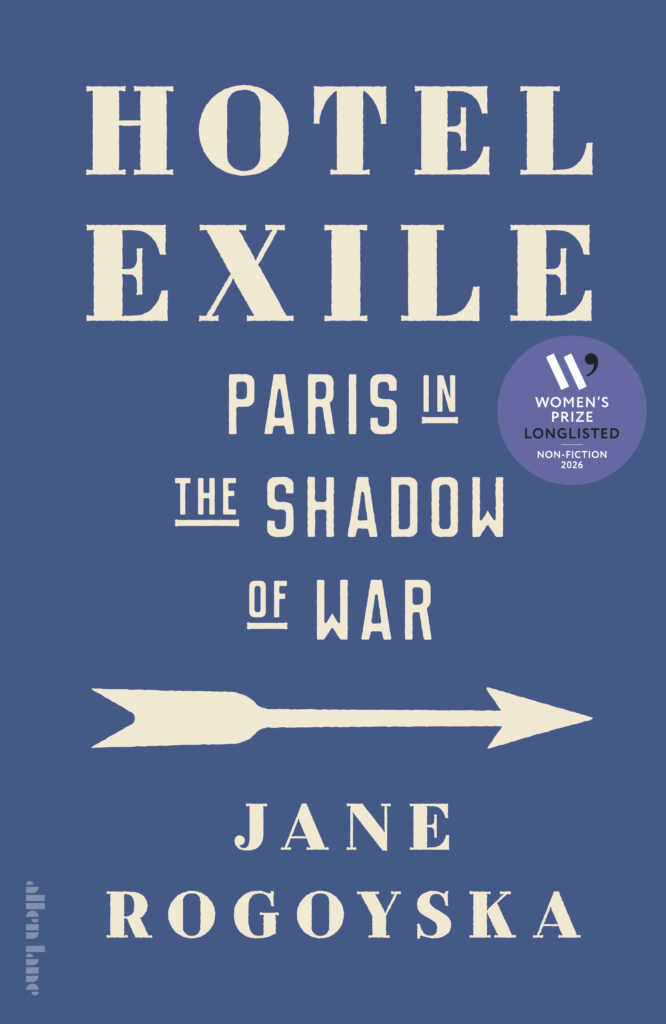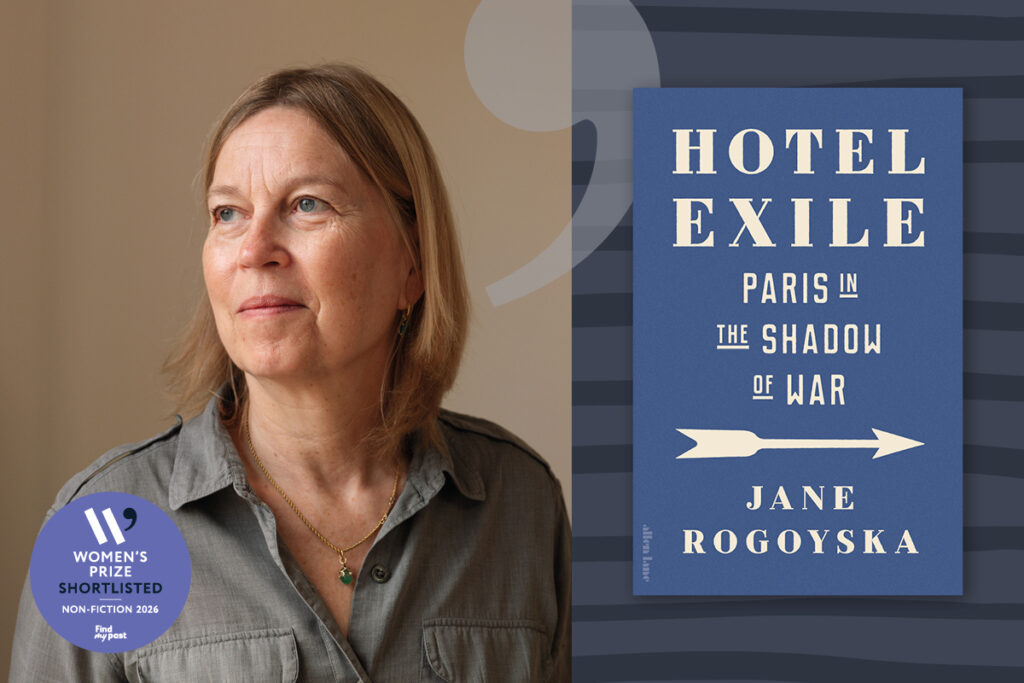
In Hotel Exile, Jane Rogoyska looks beyond the famed bohemian image of the Hotel Lutetia in Paris, to reveal the dark and devastating role this iconic Left Bank institution played in the Second World War.
Shortlisted for the 2026 Women’s Prize for Non-Fiction, 2026 Chair of Judges Thangam Debbonaire says: “Poignant and painful, Hotel Exile takes the vehicle of a hotel as a means of telling the story of exile. Set in the middle of Paris, before, during and after the Second World War, it reveals a part of this period of history that is often left unexplored.”
To learn more, we asked Jane about her research, writing process, inspirations and more.
Congratulations on being longlisted for the 2026 Women’s Prize for Non-Fiction; how does it feel to be longlisted and what does it mean to you?
Putting a book out into the world is always a moment of risk and fear for a writer. Being longlisted for an award gives me a real sense of validation. That is an incredible feeling.
How would you describe your book to a new reader?
Hotel Exile is about three groups of people who are all connected to the Hotel Lutetia in Paris during the 1930s-40s. It is a work of narrative non-fiction which follows the interwoven stories of a group of individuals as they navigate the terrible upheavals brought about by the fanatical beliefs of Adolf Hitler. We meet artists and philosophers, political activists and spies, intelligence officers and members of the resistance. They are all linked – willingly or not – by race, nationality, language, and by their status as outsiders. They all live in exile, in profoundly different ways. Some names are familiar: James Joyce, Samuel Beckett, Walter Benjamin, Anna Seghers, Gisèle Freund – others are unknown. The Hotel Lutetia is the prism through which we view their lives.
What inspired you to write your book?
When I was working on my first book about the German photojournalist Gerda Taro I became fascinated by a group of prominent German writers and political activists who were forced to flee Germany in 1933 when Hitler came to power. They lived in exile in Paris, desperately trying to alert a largely indifferent world to the dangers of fascism while simultaneously facing the practical challenge of how to survive in a foreign city with little money, no papers, few job prospects and a population for whom the memory of the First World War was painfully fresh. As I began my research I came across a brief mention of the presence of these anti-Nazis at the famous Hotel Lutetia in Paris. I then discovered that their connection to the Lutetia was only the first part in a far wider narrative spanning the occupation of France and the immediate aftermath of World War II. A photograph of a group of former deportees seated in the dining room of the Hotel Lutetia wearing their striped camp uniforms moved me so deeply I felt I had to tell this story.
What did the writing process, from gathering ideas to finishing your book, look like?
I write about 20th-century history, so research is always a major part of my work. Usually I like to gather all my research together first, making notes as I go along, trying to remember to keep accurate references so that later down the line I am not tearing my hair out when it comes to doing the footnotes (it happens every time). I put everything into software called Scrivener which allows me to see all the different layers of my work. I pick out the stories that I want to follow, place them in a rough chronological narrative, and choose the quotations I need. It then becomes a process of refinement as I work on pulling the different strands together to tell a story. This is when the really creative part begins. I go through several major drafts, each time editing the text down, refining the language, trying to create a sense of narrative drive. My aim is to be as economical as possible so I am always chipping away at the text to keep the story lean. Immediacy is key: I want to immerse the reader in the time and place where the characters find themselves, to share their dilemmas on a human level rather than imposing a framework of historical analysis upon them. At the final stage of the process I choose photographs (fun) and prepare the footnotes and bibliography (like pulling teeth).
How did you go about researching your book? What resources did you find the most helpful?
There are three sections in the book, each of which required a different kind of research. In the first part there was a lot of literature to get through: many of the prominent German exiles were writers who wrote memoirs about their time in France. I also had to get to grips with major political and historical events of the period in order to be able to provide a few lines of context to the stories we are following. For the second part of the book I spent a couple of months in Paris visiting military and police archives and the Bibliotheque Nationale. The final section of the book uses a lot of oral testimony, most of which is held in Paris at two archives dedicated to members of the Resistance and France’s Jewish community. The staff at these archives were incredibly helpful and generous in sharing their resources. For my research about the Hotel Lutetia itself I began with a single contact, a longstanding staff member whom I met several times. Although I was disappointed to discover that the hotel itself has no archive, he pointed me in the direction of several former staff members, including a 96-year-old concierge who remembered the return of the deportees when he was a 17-year-old kitchen help just starting out at the Lutetia.
In general terms, the internet is an invaluable resource for historians. There is so much information online; libraries and archives do an amazing job of digitizing material; online searches also help me follow up leads which might later take me to a physical archive. The British Library is usually my first stop for all my projects: their collections are astounding.
Which female non-fiction author would you say has impacted your work the most?
Probably Svetlana Alexievich. Her body of work is unique, astonishing, profound.
What is the one thing you’d like a reader to take away from reading your book? Is there one fact from the book that you think will stick with readers?
I would like readers to reflect on the extraordinary complexity of decisions taken by human beings in order to survive. When your country comes under the rule of an authoritarian regime, do you flee or stay? Do you adapt to the new regime or try to fight it? When an occupier takes over your city, do you take a job working for the occupiers? Do you join the resistance even though it risks imprisonment and puts your family in danger? Or do you collaborate with the occupiers because they offer you money and you believe they are going to be in charge for a long time? None of us truly know how we would behave in such circumstances.
I would like readers to remember people’s stories rather than facts.
Why do you feel it is important to celebrate non-fiction writing?
Some people think of non-fiction writing as somehow involving less craft or creativity than fiction, as if non-fiction writers cannot be considered authors of genuine literary merit. This is obviously untrue. Non-fiction literature encompasses an incredible breadth of genres and styles involving personal experience, rigorous research, narrative experimentation. This needs highlighting and celebrating.