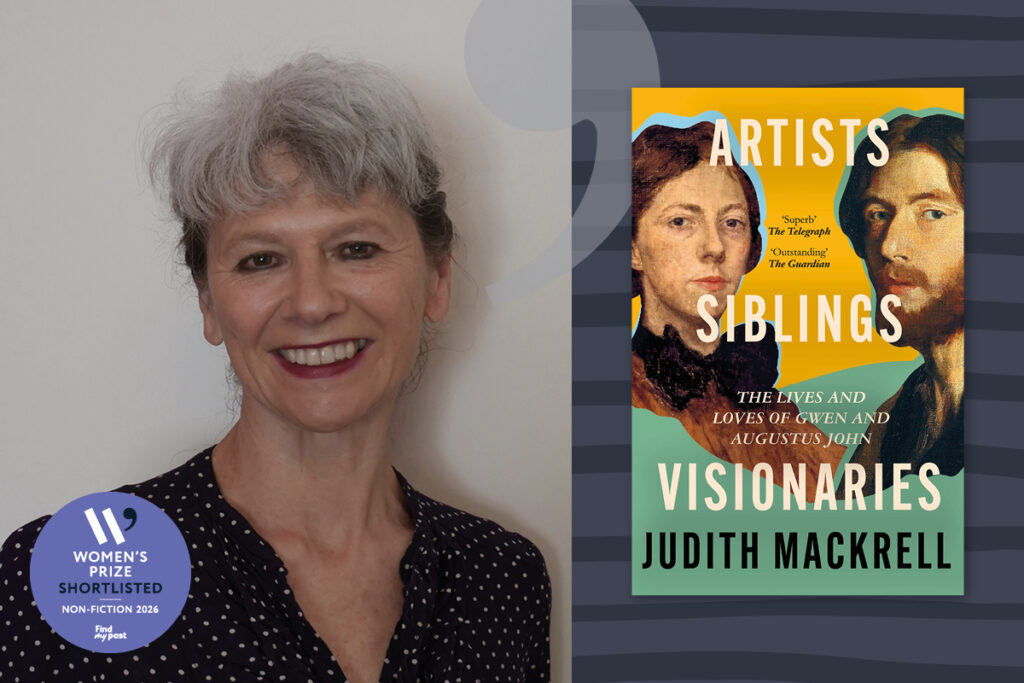
In Artists, Siblings, Visionaries, acclaimed biographer Judith Mackrell brings new depth to British artists – and siblings – Gwen and Augustus John, exploring these two prodigiously talented visionaries, whose experiments with form and colour created some of the most memorable work of the early twentieth century.
Shortlisted for 2026 Women’s Prize for Non-Fiction, judge Thangam Debbonaire says: “Artists, Siblings, Visionaries is about the sibling relationship and artistic development of Gwen and Augustus John. It has so much to follow, rich with the history of these 20th century artists and their lives.”
To learn more about the book we spoke to Judith about her writing process, inspirations and more.
Congratulations on being longlisted for the 2026 Women’s Prize for Non-Fiction; how does it feel to be longlisted and what does it mean to you?
Writing a book can feel like a very private period of discovery, struggle, sometimes exhilaration, and it is always wonderful when a reader sees and feels what you are trying to say. I was so delighted when the Women’s Prize for Non-Fiction was first announced, and to have my first eligible book longlisted for the prize feels like the most wonderful of acknowledgements
How would you describe your book to a new reader?
This double biography of Gwen and Augustus John tells the remarkable story of how two Welsh teenagers escaped their lonely, blighted childhoods to become artists of international renown. It describes the development of their work, as they graduated from the Slade into the larger art worlds of London to Paris; it explores how the early death of their mother created in each of them a craving for love – a craving which led Gwen to form a series of passionate attachments to both women and men (including a turbulent relationships with the sculptor Auguste Rodin) and Augustus into a legendary succession of affairs; it describes how the smallness of their upbringing drove their shared determination for lives of grandeur and freedom, for a revolt against late Victorian society. But it also explores their formative relationship as brother and sister. In superficial ways the two of them were very different: Augustus was profligate and charismatic, a hero to romantics and bohemians; Gwen was a much more private person, reluctant at times even to exhibit her work – although as a woman it was always going to be much harder for her to make a professional career. Yet, there were larger forces of upbringing and circumstance which made the two Johns very alike, not only in their hunger for love, but in their scorn for convention, their commitment to work. And as a consequence of this volatile mix of similarity and difference there was a push-pull dynamic between them – their periods of intimacy punctuated by outbursts of angry exasperation – which makes this book as much a study of family as of art.
What inspired you to write your book?
I had already seen and admired Gwen’s work, and I knew about Augustus’s extraordinarily colourful life because he had featured in two of my earlier biographies. My previous books have tended to be about groups of people, linked by a period place or profession: I’ve found that the links between individuals – the ambitions they have in common, the shared obstacles they have to overcome the circumstances they face – can be as illuminating as studying one person in isolation. To write about a family, a brother and a sister struck me as a fascinating extension of that group dynamic, and because it is rare to have two siblings develop into such gifted and remarkable artists as the Johns, they offered me a tremendously rich subject.
I was also drawn to the idea of having a man as one of my two subjects. In the past it has been women who have been my principal focus as I have looked for stories of those who’ve been overlooked or undervalued. To write about a man who was as tremendously and charismatically male as Augustus (his grand-daughter describes him as the Mick Jagger of the early 20th century art world) was a challenge I relished.
My biographies have also tended to be about people who broke away from the lives into which they were born – and there can hardly be two who escaped more thoroughly than the Johns. From the very beginning I had in my head an image of these two shy, semi-orphaned children, who carried pencils and scraps of paper with them everywhere they went, who spent hours drawing together on the beach of Tenby and who had the combination of talent, grit and vision to become two of the most remarkable British artists of the early 20th century.
What did the writing process, from gathering ideas to finishing your book, look like?
Someone, I don’t know who, once divided writers into two categories, architects and gardeners. The former are those who plan out the structure of their books, get all the material in place before they begin writing; the others are less organised, planting new material as they go on, weeding all the time. I’m the latter, because I need to be writing as soon as I start the research. That allows me to know what I’m looking for when I go into the archives, but also I find that its through the process of writing and re-writing that I get to know the people I’m writing about.
How did you go about researching your book?
I read through all the available reference books, had many conversations with Augustus John’s granddaughter and trawled through the extensive John archive at the National Library of Wales. I also looked at all the art I could find both in galleries and online and spoke to friends who are artists.
Which female non-fiction author would you say has impacted your work the most?
The two biographers I have most admired are Hermione Lee and Victoria Glendinning.
What is the one thing you’d like a reader to take away from reading your book?
I would like readers to understand the world from which Gwen and Augustus John came, and to recognises both its distance from us and its surprising modernity. I would like them also to share the image I have of the Johns – two semi-orphaned children, who somehow had the talent and the obsessional need to make the long journey from a small town in Wales to the centre of the art world.
Why do you feel it is important to celebrate non-fiction writing?
I cherish the power of novelists, playwrights, short storywriters to create imaginary worlds for us to inhabit, and to enlarge our understanding of the real world. But biographers, historians, scientists, philosophers, specialists in any field have equal power to illuminate the world for us, and equal power to grip us with the quality of their prose.
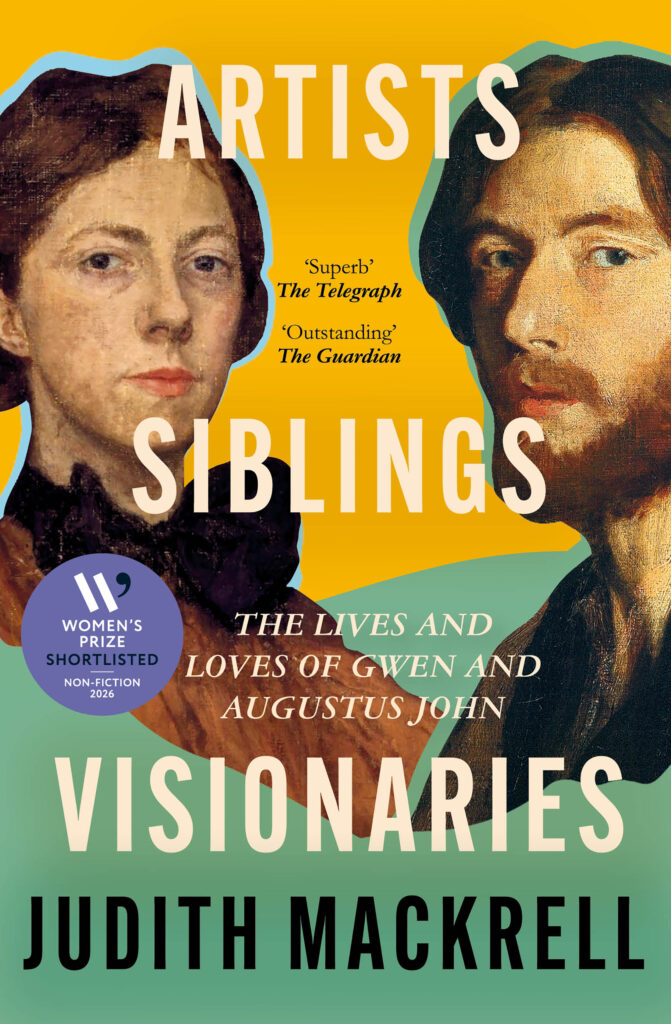
Artists, Siblings, Visionaries: The lives and loves of Gwen and Augustus John
by Judith Mackrell
Find out more