
In her new novel, into the wreck, Susannah Dickey asks the question: ‘How do you mourn someone you never really knew?’. Told from five perspectives, the book worries at the knotty complexities of one’s family bonds, written with Susannah’s trademark empathy and wit. To mark its publication, Susannah has shared with us how she approaches writing about death and grief.
This may come as a surprise to many people, but I have known several people who have died. In some respect, all of my novels are about the same thing: attempting to get to grips with – and render – loss, permitting in all the messy and thwarting facets of personhood that make grief a corrupted and inelegant process. Here’s what I’ve got:
Real people are rarely saintly
The death of a person unavoidably creates the absence of that person and with that absence goes their inability to advocate for themselves, to dispel assumptions or corroborate opinions. This absence becomes a very natural space for conflict among flawed people; grief can turn possessive very quickly, and if a person has to try and make their own sense of loss tesselate with someone else’s, it’s unlikely that their perceptions will be in complete alignment. Don’t feel pressure to make a character good or impossibly noble in the face of loss, it’s much more real that a person might turn selfish or vindictive. Grief is in many ways an unsatisfying process, unfinished and unresolved, so it readily conjures adjacent negative affects, feelings of anger or bitterness that feel less endless and therefore less frightening than feeling exclusively grief. Write the feelings that might arise in the interstices around grief, allow them to complexify your characters.
Grief cannot, by definition, be productive, so what does that mean?
Grief serves no purpose but its own – it does not generate productivity, nor does it kill time. Grief exists for grief’s sake, and it’s interesting to think about that in the context of the contemporary novel, which can feel like a form where every stylistic or narrative choice is made in service of a larger conceptual purpose. In that regard, think about how writing effective grief can disrupt the very intentions of the ‘novel’, and allow that tension to function as a force upon the work. Let your characters fail as ‘characters’: let them stagnate and falter and hiccup in the face of the novel’s demand that they grow and progress. Alternatively, draw attention to the novel’s very inability to properly depict the full obliterating nature of death and grief – think of that brutal central passage in Virginia Woolf’s To The Lighthouse, where Prue Ramsay is stricken ruthlessly within square brackets. Let grief’s innate unproductiveness find its way into the fabric of your novel, let it challenge and alter its DNA.
Don’t be afraid of humour
Grief and laughter are not mutually exclusive, and a novel that deals with death doesn’t have to jettison witty moments in order to feel authentic. In the context of this, I’m really convinced by Henri Bergson, who says in his essay Laughter: An Essay on the Meaning of the Comic that laughter addresses ‘something mechanical encrusted upon the living’. Laughter is many ways an involuntary, animalistic response, and for that reason it sits readily alongside grief. It would never occur to me to try and write about grief without some attempt at humour, because jokes are a way to break through the mannered and procedural, eliciting something that reminds us of our inherent bodiliness, which in turn reminds us that we are finite.
The dead don’t talk, typically
While this doesn’t mean they can only be resigned to memories, there’s a tricky path to walk here: if you are going to have your absent character speak, make it apparent that they are being conjured within the mind of a living character (unless you’re doing a ghost thing – for the purposes of this piece I’m going to assume you’re not doing a ghost thing). In Derrida’s elegiac essay for Paul de Man, he advocates for sustaining a relationship with the dead that fuses a sense of intimacy with a sense of finality: ‘an aborted interiorisation is at the same time a respect for the other as other, a sort of tender rejection, a movement of renunciation which leaves the other alone, outside, over there, in his death, outside of us.’ To have a dead character actually speak, or to have a living character be able to conjure their voice without limitations, is to demean that character’s deadness, the impact of their absence. However, having a living character attempt to summon the dead’s voice, without success, trapped within the limits of their own consciousness, can be a really effective literary technique for emphasising the impact of the deceased character’s absence, the hole they’ve left in the life of the living.
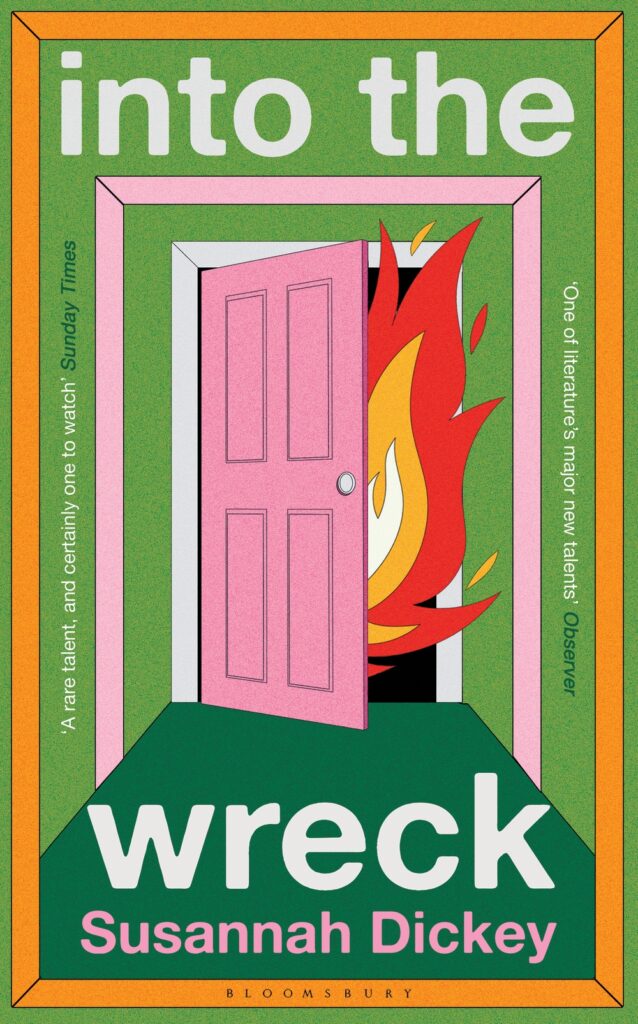
into the wreck by Susannah Dickey is published by Bloomsbury on 9th April 2026.