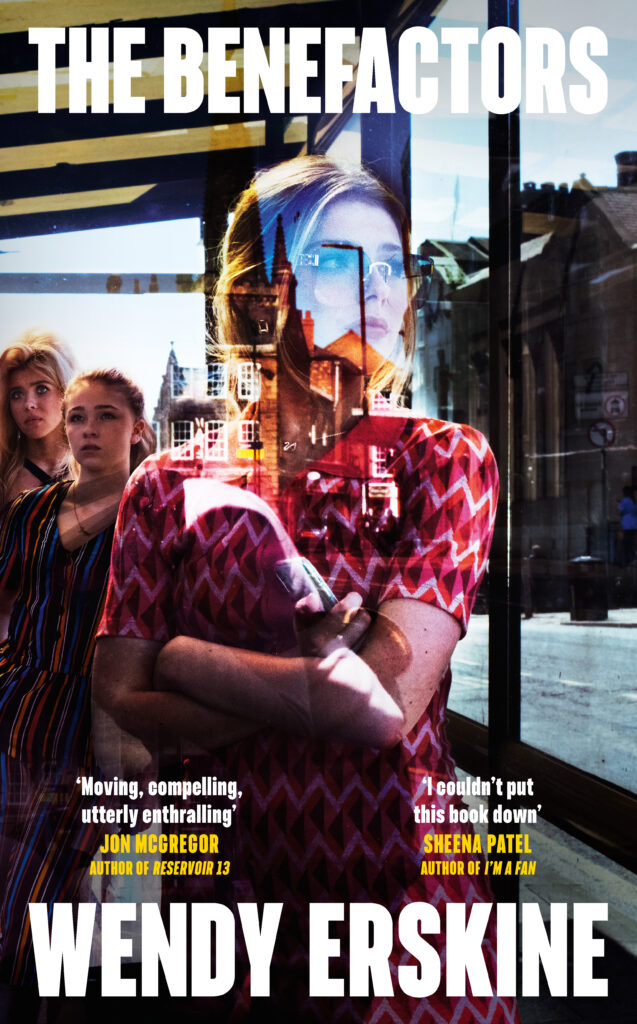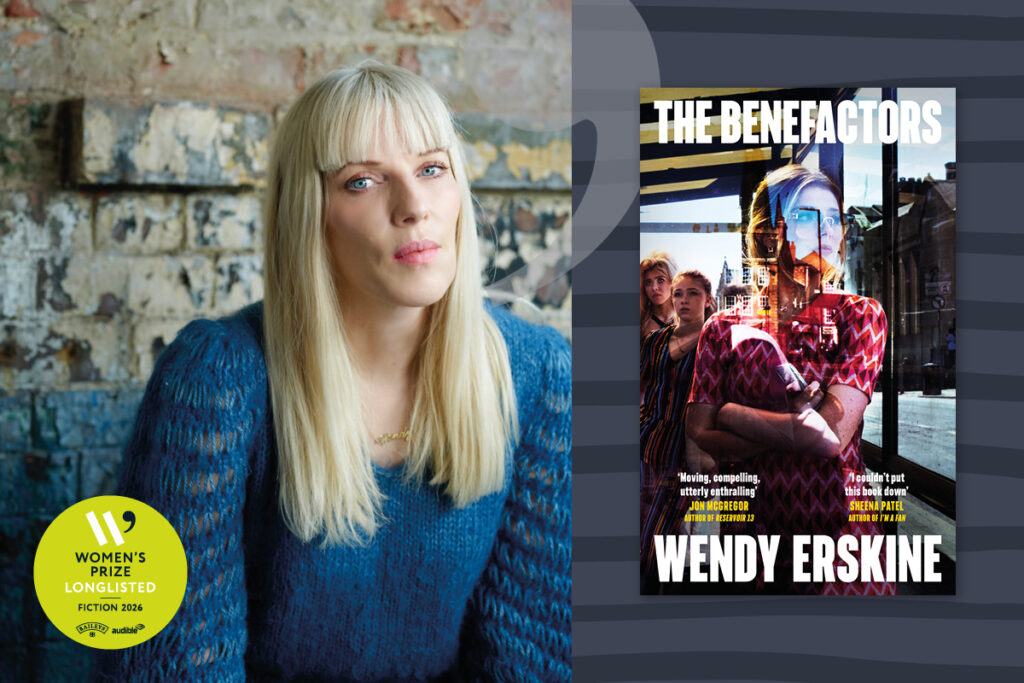
In The Benefactors, Wendy Erskine presents a daring, polyphonic representation of modern-day Northern Ireland through the stories of three Belfast mothers to 18-year-old boys, exploring class, money, and what it ultimately means to be a parent.
Chair of Judges for the 2026 Women’s Prize for Fiction, Julia Gillard, said: “The Benefactors by Wendy Erskine is told by many voices, but has at its core three very different women from Belfast, all of whom are mothers to 18-year-old boys. A real page-turner, this novel has an original style that sets it apart.
To learn more, we spoke to Wendy about her inspirations, creative process, favourite authors and more.
Congratulations on being longlisted for the 2026 Women’s Prize for Fiction; how does it feel to be longlisted and what does it mean to you?
Look, I’m a realist. I know that on a different day a different group of judges might have made a different decision. But, that said, it feels beyond brilliant to be on the longlist for the Women’s Prize for Fiction, a true honour, and, let me assure you, I’ll be telling everyone about it for many, many years to come. So thank you!
How would you describe your book to a new reader?
At the centre of The Benefactors is eighteen year old Misty Johnston. On one side we have Misty’s sister, great-grandmother and step-dad. On the other are the mothers of the three young men who sexually assault Misty at a party. These boys’ actions have ramifications and repercussions for Misty – and everyone else.
What we have is a rich, humane and uncompromising consideration of responsibility and parenthood, money, class, sex and love. It’s a big novel about lots of different things, lots of different people. Woven into the narrative are a further fifty first-person voices; they confide in the reader, tell them all manner of things connected to the novel’s central preoccupations. It’s a brutal book but also a warm and funny one. It’s not a little chamber piece. It’s full contact literature! And although its polyphony might be considered innovative, in a lot of respects it’s nothing new to anyone who has listened in to multiple conversations in a cafe or bar.
What was the idea that sparked your novel?
It’s always easy for me to retrofit the impetus for a piece of work after the event, to make a splashy pronouncement about a single, striking idea. In reality, it doesn’t really work that way for me. It’s more like there is a coalescence of a totally disparate group of ideas or impressions. So for me, with The Benefactors, there were all kinds of elements: the biblical parable of the talents; bad-ass seventy-year old women I have known; Canada Goose coats; Elizabeth Barrett Browning; Boogie Down Productions; a YouTube video of a geyser of foam shooting out of a Coke bottle when Mentos are dropped into it; Gramsci. A key scene that did establish itself early on was one that I imagined as having a heightened, Sergio Leone aesthetic. But instead of a stand-off between gunslingers, it would be three women versus three women, in the shadow of a looming church, under an apocalyptic sky. I did know from the beginning that that was going to happen. Honestly!
What did the writing process, from gathering ideas to finishing your book, look like?
It’s more frequently that I’m writing short stories. That’s an exhilarating form because something can be created in its totality reasonably quickly. However, it can also be quite exhausting, in a manner of speaking, because with each new story you are having to establish from scratch an entirely new universe. With the novel, I thought that it was going to feel like a luxury, being able to reside with the same characters and worlds for a year and a half. I was right. It did. I wrote a first draft where, I suppose, I was essentially trying to get to know the characters. I would write third person partial narration from one person’s perspective until I felt another character wanting, waiting to have their turn. With a draft like that, everything is still very protean, the writing intuitive and unrestricted.
Then I started again from scratch. New document. This time I was starting to feel my way with the structure of the story and developing an awareness of some of the technical challenges.
Then I started again from scratch. New document. This time it was a really forensic, stringent consideration of what I had done. All was under scrutiny. I had to think particularly carefully about the positioning of the first person voices, in terms of how they would inform or reposition the ideas of the previous and following sections.
The best analogy I can use to describe the process in its entirety is a Polaroid photo slowly developing.
Which female author would you say has impacted your work the most?
Lucy Caldwell. She is a superb writer who wears her intelligence and great sophistication of thought with lightness of touch and elegance I was actually Lucy’s A Level teacher and it is a source of delight to me that she is now a friend whose wisdom in relation to all things writing-related is unsurpassed.
What is the one thing you’d like a reader to take away from reading your book?
Well, I wouldn’t be so presumptuous as to be prescriptive in terms of what a reader should take away. I suppose people read for all different sorts of reasons: some to see their own lives reflected back; some to access experiences different to their own; some to see pattern; some to see flux; some to understand a particular locale or time period; some to feel comforted; some to be shocked, challenged, entertained, made to think. Hopefully, my book could potentially provide a reader with any or all of those things. I suppose, at the end of the day, what I want someone to take away is that reading The Benefactors was time well spent. It’s an act of generosity in some respects, giving nine, ten hours to a novel, when you could be doing other things. I would like to think that people considered the time they gave to my book as worth it.
Could you reveal a secret about your creative process? This could be where you like to write, a unique writing ritual you have to unlock creativity, or how you go about writing.
I have a full-time job as a subject leader in a secondary school. But I’m not alone, obviously, in having other commitments beyond writing. What I find useful is adopting an entirely unromantic attitude to writing. Yes, for sure, it is pretty magical creating something from nothing and being swept away on the Wings of Poesy – I do love that – but ultimately it is graft, like anything else. I don’t give it special category status. It has helped me to think of it as having no specific rituals. It doesn’t need retreats, optimum times, views from windows, special desks, being seized by the muse. You can write a novel sitting on a sofa surrounded by kids’ toys. You don’t necessarily need a room of your own, thankfully, because for many people that’s not an option.
Why do you feel it is important to celebrate women’s writing?
I can only remember seeing my lovely, smart as get-out Dad reading one book written by a woman. No, it wasn’t George Eliot. It was Jackie Collins. From what I recall, he thought it was good. That was quite a while ago now – decades, in fact – but the situation remains that there is still a significant disparity between the numbers of women who read books by men and the numbers of men who read books by women. It’s important, therefore, to make unequivocally – and loudly – the quite obvious point that women’s writing is the equal of men’s in every conceivable respect. The Women’s Prize celebrates this. Of course, from my point of view there would be writing by particular women that I would love to celebrate: a novel written by a care home worker, say. A short story collection from a midwife.