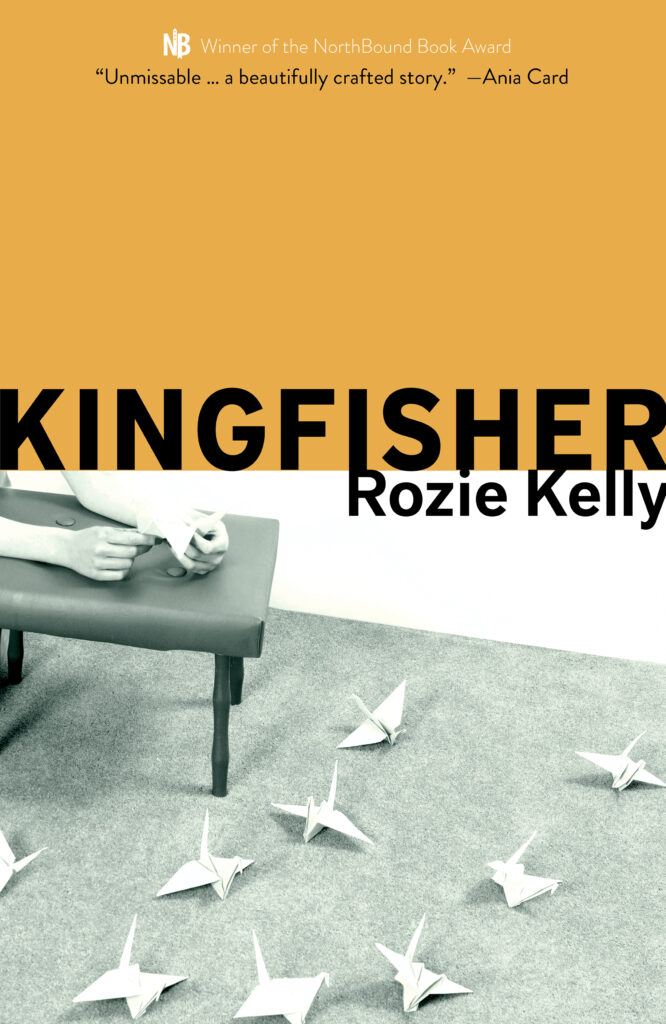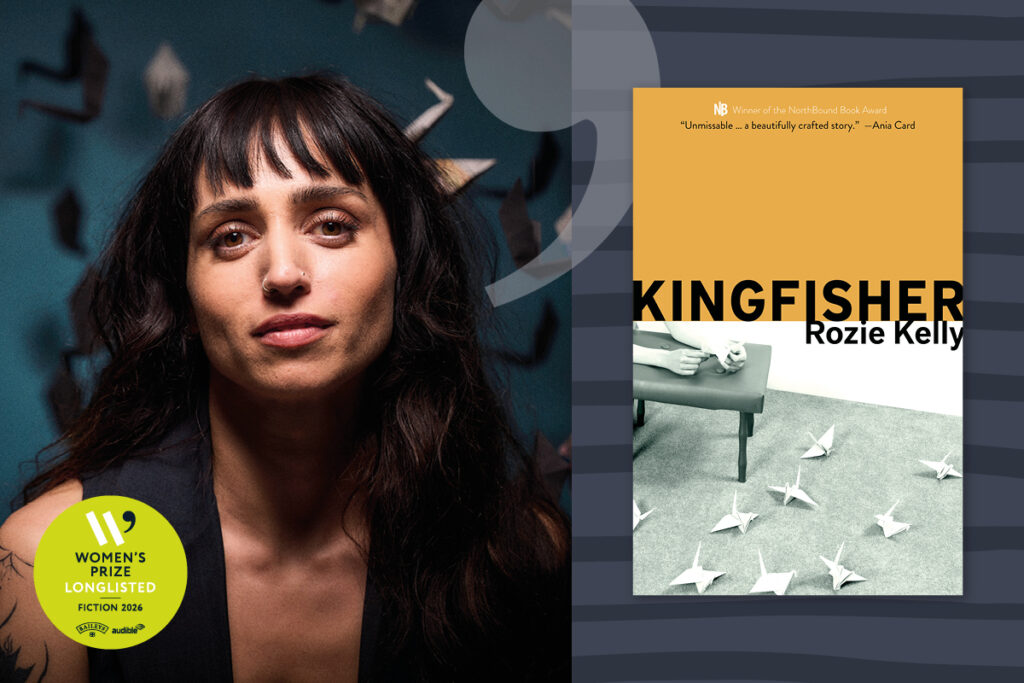
In Kingfisher, debut Rozie Kelly finds beauty in the messiness of being human in her meditation on grief, power, desire, our search for identity, how we love and the consequences when we fall short.
Longlisted for the 2026 Women’s Prize for Fiction, judge Mona Arshi said: “Written in arresting, energetic prose, Kingfisher by Rozie Kelly is a short poetic book about two writers and their complex relationship. It’s a story of how we love and what happens when we fall short.”
To learn more, we spoke to Rozie about her inspirations, creative process, favourite authors and more.
Congratulations on being longlisted for the 2026 Women’s Prize for Fiction; how does it feel to be longlisted and what does it mean to you?
It feels completely surreal, like I’m watching it happen to someone else. Being included in a cohort of such talented women, and selected by women who I so admire is such a lovely, validating feeling. I wish I could go back in time and tell the version of myself who almost gave up on Kingfisher, but I don’t think she’d believe me.
How would you describe your book to a new reader?
Kingfisher tells the story of a man who becomes infatuated with an older woman. They are both writers and she has the life and success he wants for himself. But beyond that, he wants her, desperately. I wanted to play with objectifying a woman who was older than him, to see what happened to the power and control if it was a younger, beautiful man with a successful and respected woman his senior. But I also didn’t want to see this from an entirely heterosexual viewpoint, and I didn’t want it to be lust alone, but something more complex. The man is queer, his sexuality fluid, and his reasons for wanting her extend far beyond his sexual appetite. But their relationship changes when she becomes very sick, and he begins to care for her. He tries to learn what it is to be selfless and yet does what is in some ways the most selfish thing he could do – he writes her story.
I sometimes joke that it’s a sexy sad little book, but at its core it’s about a messy, grieving, confused, conflicted and conflicting man doing his best to figure out what life is and how to cope with it. It’s about love and death and infatuation and what it means to take the narrative of someone’s life for yourself.
What was the idea that sparked your novel?
It really began as the voice of the protagonist. I didn’t know who he was yet but he came to me so clearly – I wrote the first page of the novel out of nowhere and it’s remained largely unchanged. He was so distinct to me that I knew immediately I had to find out who he was and what made him the way he is. As the story progressed and I met the poet I became fascinated by her, too. She’s an amalgamation of all the women I admire, many of whom are writers whose work I love or have taught me in the past.
What did the writing process, from gathering ideas to finishing your book, look like?
When I’m writing a first draft it feels a bit like I’m reading a really terrible book. I have no idea what’s going to happen next, so I just trust it to all bubble to the surface from the back of my brain somewhere. I catch fragments of ideas as they float past me – usually something sensory – the way something feels or smells or tastes, or occasionally scraps of dialogue. These all go into the Notes app in my phone, a stream of total nonsense which I have to decode later, but doing so helps me hold onto the energy of the story I’m trying to tell. I have a notebook by my bed into which I scrawl cryptic messages about how the book should be feeling. It’s very instinctual. Unfortunately this leaves me with a very convoluted pile of words, but once there are enough of them to be book-length, I then spend a very long time turning them into something which has a narrative thread. What that thread is exactly, comes quite a long time afterwards. With Kingfisher, I was redrafting and editing on and off for about two years before it resembled what it is now. I wish I was a writer who planned everything as it would save me a lot of work, but alas this is what comes naturally.
Which female author would you say has impacted your work the most?
There have been so many, but without question I’d say the biggest influence is Deborah Levy. I am in awe of the sentence-level-gut-punch poetic specificity she is somehow capable of in just a few words. There’s a scene in Kingfisher where the poet talks about going to see her favourite author speak. This was actually something that happened to me when I went to see Deborah Levy read and became totally tongue-tied.
What is the one thing you’d like a reader to take away from reading your book?
If anyone comes away from reading it feeling like I’ve created a world that exists entirely out of my hands I will die happy. I hope that the characters, although problematic and difficult and flawed in their own ways, feel human. At heart I think writers are observers and if a single reader thinks I’ve done a good job of that then I’ll feel very smug indeed.
Could you reveal a secret about your creative process? This could be where you like to write, a unique writing ritual you have to unlock creativity, or how you go about writing.
I wish there was a secret! I’m not sure I have a ritual, as such, although I do my best writing in cafes as I can’t bear quiet, it makes it so hard to concentrate. I try to do it as often as possible, and not to be too hard on myself when I don’t manage it. I count sitting down for ten minutes as a big win, to trick myself into doing it more often. I buy myself cake while I do it. I drink too much coffee. I’m not a planner, so whenever I sit down I have absolutely no idea what’s going to come out. I try to treat it as an adventure, if I can. What on earth are these people up to, and how can I find out? It’s afterwards that I make it all make sense.
Why do you feel it is important to celebrate women’s writing?
The simplest answer to this question is that I love women. I want to celebrate all the brilliant art we are making. I want to read stories from the women all around me whose lives and experiences differ so greatly from my own. For most of history women have consumed books made by men, portraying the male experience as universal. I want a rich and varied take on the human experience, in all its messy, raw, hilarious and dark reality. I think fiction especially has the power to tell an emotional truth, and those are the books I want to read. Making those books accessible to all requires a structured effort, particularly as women carry the vast majority of caring responsibilities and therefore are often less likely to be able to access the time and space to write – something that organisations such as the Women’s Prize have done amazing work to address. The literary landscape for women has changed a lot since the Prize was first established, but in a world where the pendulum continues to swing to the right, a rich canon of diverse female voices is needed now more than ever.