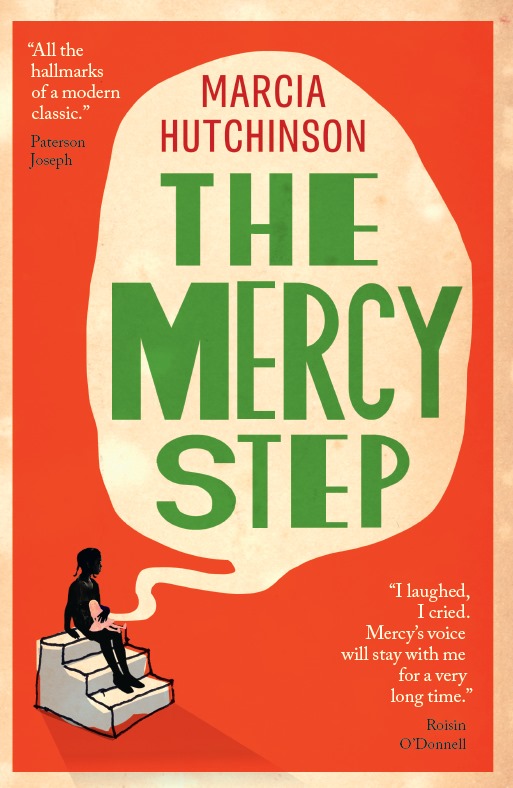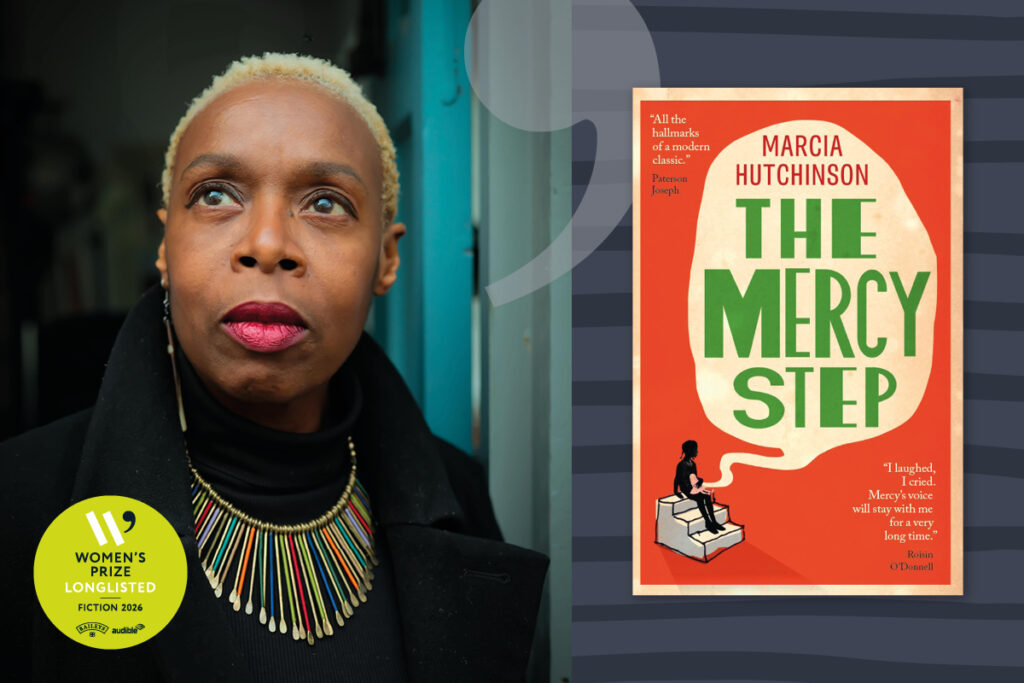
Following the life of a child from the womb to age eleven, in The Mercy Step Marcia Hutchinson crafts a sharply-witted and tender portrait of a young girl’s quiet rebellion in 1960s Bradford.
2026 Women’s Prize for Fiction judge, Salma El-Wardany said: “From the very first page I knew The Mercy Step by Marcia Hutchinson was exceptional. Telling the story of a little girl called Mercy, and her connection with her mother, it draws you in from the get-go.”
To learn more, we spoke to Marcia about her inspirations, creative process, favourite authors and more.
Congratulations on being longlisted for the 2026 Women’s Prize for Fiction; how does it feel to be longlisted and what does it mean to you?
This recognition means that all those years of toiling have been worth it. I started writing and gave up so many times. So often I thought that I just didn’t have what it takes to finish a novel, let alone a good one. The Mercy Step had more than fifty rejections before Cassava Republic Press, a small Black-owned publisher, finally said yes. As an older debut novelist, publishing at 62, I thought my moment had passed. So part of me feels vindicated that I never gave up. It is a reminder to tell the story you need to tell and trust that if you stay with it long enough, it will find its readers. To have Mercy’s story recognised by such an important Prize feels slightly unreal. I’m still in a state of mild disbelief. Don’t get me wrong I’m not indulging in false modesty here. I knew I had written a really good book, the best it could be after a decade of work, but I had no idea how it stacked up against other novels.
How would you describe your book to a new reader?
The Mercy Step is a darkly funny bildungsroman narrated by Mercy, right from her mother’s womb onwards. Born into a dysfunctional family in 1960s Bradford ruled by a mercurial father and a mother whose faith is unshakable, if at times unwise, Mercy grows up negotiating fear, love, and the possibilities of freedom as she asserts her individuality in order to carve her own path in life. Mercy’s story tells of the strength of the human spirit; and the stubborn courage of a child who refuses to give up.
What was the idea that sparked your novel?
The novel is autofiction, loosely based on my childhood in 1960s Bradford. Becoming single at 55 felt like my now-or-never moment: finally I had the means, motive and opportunity to write the story I had carried for so long. I started writing The Mercy Step over a decade ago but found the process so emotionally draining that I often stopped and moved onto other projects. In the years between starting and finishing it, I wrote three other novels. But I was always pulled back to Mercy, compelled to delve deeper into the psyche of this determined little girl.
When I would tell stories about my childhood, people would often say, “You should write a book”. I always knew there was a story there and it took me many years to discover how to tell it.
What did the writing process, from gathering ideas to finishing your book, look like?
My process was largely unconscious. The first chapter of The Mercy Step, ‘inspired’ by memories of my father’s death, was written as a short story about twenty years ago. At the time, I didn’t think I had the stamina to write a whole novel so I contented myself with writing short stories every now and then. An idea would come to me and I would write a chapter / short story (usually in one sitting). Although I didn’t realise it at the time, I think the true genesis of The Mercy Step was the publication of my anonymous letter in The Guardian eleven years ago, dealing with my feelings about my father’s death. I actually forgot all about that letter until January 2025 when The Guardian featured The Mercy Step as one of its best debut novels of 2025. When I dug back into their archives, I was shocked to read what was effectively a short synopsis of the book.
In December 2021, I attended an Arvon writing course led by Russ Litten, who has since become something of a mentor. He introduced me to the term ‘autofiction’, and that was my lightbulb moment. The fact that there was a specific term for fiction based on the author’s life gave me permission to really go for it and plunder my backstory. I was originally signed by my agent for a different manuscript and I mentioned in passing that I had a few chapters of another work. When I sent her three chapters of The Mercy Step in June 2023, she replied within twenty minutes asking for more. After reading the rest, she insisted that we talk and on that call she persuaded me to make The Mercy Step my debut, convinced by the sheer force of Mercy’s voice.
I was reluctant, as I had barely 20,000 words of Mercy. However, and I think this is one of the reasons it is so important to champion women’s writing and especially older women’s writing, her enthusiasm for Mercy’s voice was so infectious that as soon as the zoom call ended, I began writing again. By the end of that day, I’d finished another chapter and by the end of June 2023 I had written another 60,000 words. The first draft of The Mercy Step was done. My agent’s editorial notes followed. After much cursing, I incorporated them and it made for a better manuscript. My earlier training as a lawyer helped: I’m used to criticism, and I know what stings at first often proves necessary.
During the writing of The Mercy Step I was diagnosed with ADHD, which helped me to understand the stop-start nature of my writing, the periods of intense productivity followed by exhaustion and feeling overwhelmed. Instead of a schedule, I learned to accept that this is just how I am wired: when the words come, they come fast; and all I can do is hang on for the ride, trying to get them down before they are lost to the ether. Someone described ADHD as having a Ferrari engine with bicycle brakes and I completely understand that now. At times I can write a mile a minute (the most I’ve ever written in one day is ten thousand words) but then I may need weeks to recover from the mental exertion. Some of the hardest sections to write were the fugue states, where Mercy dissociates in the face of overwhelming abuse. I wanted to capture what it felt like for a child to leave her body in order to survive, while also bearing witness to her experience so she would not feel alone. Finding the balance between holding those emotions and shaping them into narrative was fiendishly hard, and perhaps explains one of the reasons it took me until my late fifties to write the book.
Which female author would you say has impacted your work the most?
Toni Morrison – by a long margin. Sula, The Bluest Eye and Beloved are some of the best books ever written. She is peerless in delving into the psyche of damaged women and girls and finding the resilience within.
What is the one thing you’d like a reader to take away from reading your book?
That the human spirit is more resilient than anyone knows. The term ‘scarred for life’ is entirely wrong; people can recover from the most awful abuse and go on to produce great work. I am not for one moment saying that abuse and suffering are necessary to create great work – I’m saying that they need not be a barrier to it.
Could you reveal a secret about your creative process? This could be where you like to write, a unique writing ritual you have to unlock creativity, or how you go about writing.
My creative process is rather strange in that I have an idea of what I want to explore, and then only discover the details once I start writing. I say ‘writing’ but in fact, I dictate my first drafts while walking, speaking straight into Google docs, perhaps a legacy of my years as a solicitor when speed and dictation were the order of the day. When I’m on a roll I can write upwards of 5,000 words in a day. I don’t consciously gather ideas. Mercy felt fully formed in my subconscious and the walking-and-talking process was me interviewing her and trying to get her ‘answers’ as they came – urgent, overwhelming and at the speed of a firehose turned full on at my face. It was exhilarating, painful and exciting all at the same time. When I got back home from my daily ‘walkie-talkies’ I was usually exhausted, sometimes barely remembering what I had written. I had to open the document on my laptop straight away to make sense of what I had dictated.
Writing The Mercy Step felt like an emotional marathon, everyday. There were times I had to stop, sit on a park bench and cry, while my dog placed a concerned paw on my lap, before I could gather myself and walk again. But in truth I have never felt more alive than when I was writing Mercy’s story.
Why do you feel it is important to celebrate women’s writing?
The majority of novels are written by women and we make up the largest share of readers. Yet, women’s writing is still not given the respect it deserves. Fiction associated with women such as romance is often dismissed in ways that male-dominated genres like crime or thrillers are not, and books by women can face struggle for serious recognition.
As the saying goes, when you are used to privilege, equality can feel like oppression. This was shown in the commentary surrounding 2025 Booker prize winner, David Szalay. The Guardian’s editorial ‘putting masculinity back at the centre of literary fiction’ illustrates how women’s relative success and visibility in recent years can be framed in some quarters as a loss for male writers, despite the fact that ten of the last sixteen Booker Prize winners have been men. Such reactions show the long-standing ambivalence around women’s relative visibility in the literary mainstream and the need for a prize like this.
In the current febrile political climate where misogyny is on the ascendancy in public and online discourse, there has never been a more important time to champion and celebrate women’s writing. The gains we made in the 1960s and 1970s are being rolled back, and the Women’s Prize, as one of those essential institutions foregrounding women’s creative achievements, stands as a beacon of hope in these dark days.