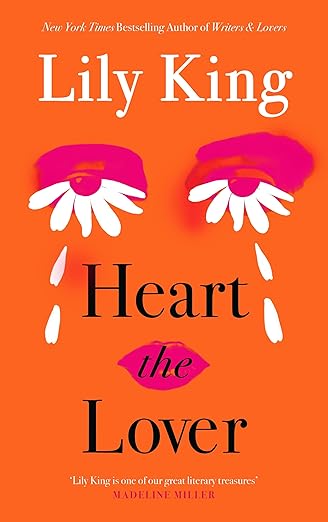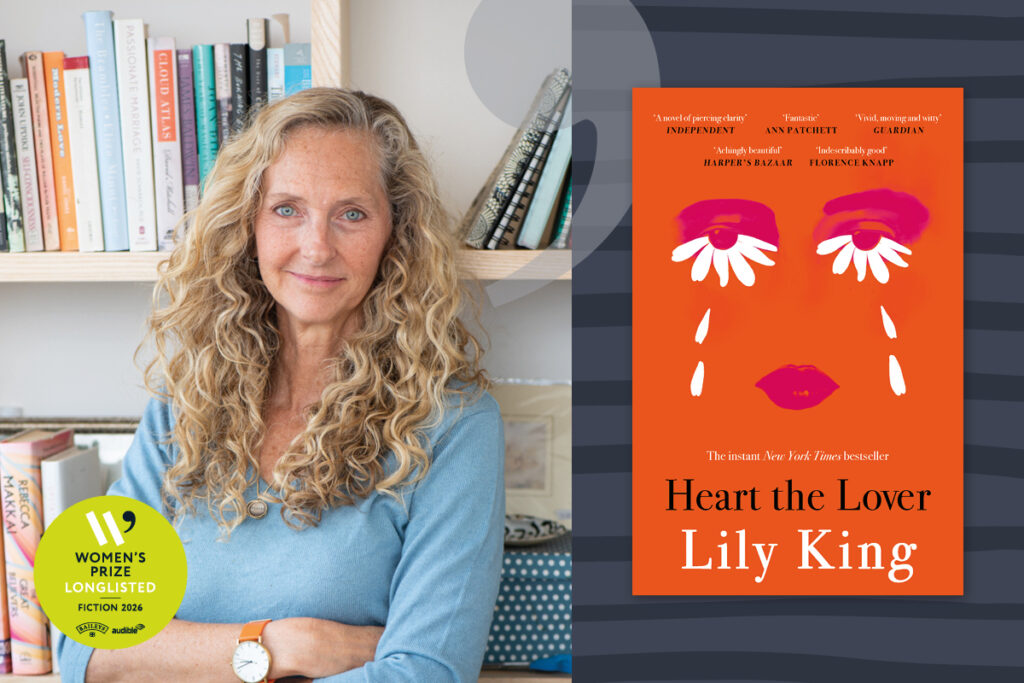
In Heart the Lover, Lily King writes an intimate and truthful celebration of fiction that explores desire, friendship, loss and the life-long echoes of young love with the precision of poetry and the emotional tide of an epic.
Longlisted for the 2026 Women’s Prize for Fiction, 2026 judge Cariad Lloyd said: “Heart the Lover by Lily King is a novel about first love, and the power the past has over us. Spanning the lifetimes of our three protagonists, it’s an intimate novel that explores desire and friendship. Beautiful, tender and utterly truthful, it’s a book that will stay with you for some time.”
To learn more, we spoke to Lily about her inspirations, creative process, favourite authors and more.
Congratulations on being longlisted for the 2026 Women’s Prize for Fiction; how does it feel to be longlisted and what does it mean to you?
I have a vivid memory of sitting at an old laptop when the internet was in its first decade of delivering news, and looking at the shortlist for the Orange Prize and seeing some of my favourite contemporary writers on it, and having this urge to be on that list someday. I wasn’t the type to have outlandish hopes like that, and that is why I remember the moment. It was much less about winning a Prize and more about being in the company of those writers I admired so much. I’d written one book and had two small children and I knew it was a faraway dream. I have always tracked this Prize and its list of writers, and have discovered more of my favourite writers through doing so. I don’t know if I would have discovered Kate Grenville or Jane Gardam without that list. They as well as so many others you have celebrated like Ali Smith, Jhumpa Lahiri, Marilynn Robinson, Shirley Hazzard, Rachel Cusk, and Anne Enright have been my lode stars on this strange journey. Being on this longlist feels like reaching back to that young woman looking at an early website and being able to tell her she should let herself dream.
How would you describe your book to a new reader?
A college senior goes on a bad date with a smart guy that changes the course of her life. It’s a novel about love in many forms, and the way a big first love changes shape during a lifetime but does not die. It’s also about time and the moments when the past presses up so close and so urgently to the present that it is no longer the past. We follow this woman who becomes a writer from her early twenties to her late fifties, through her passions and ambitions, her vulnerabilities and mistakes, and her reckonings with love and death.
What was the idea that sparked your novel?
In 2019, I lost two dear old friends, my two big loves of my youth, to cancer. They died in separate cities a month apart. My mother and father had died three years earlier. The Coronavirus hit, my children came home from university, and I started working on a political murder mystery to explore my rage about the Trump administration. This was perhaps not the best motivation for a novel, and I hit a brick wall at about page 90. Right at that time, Ann Patchett sent me her manuscript of Tom Lake and I wasn’t even six pages in before I thought, she is having fun and I want to have fun. I quit the murder mystery and started writing about Jordan, Yash and Sam in a 17th C lit class. I wasn’t aware of needing to process and express all the emotions I had about big losses in my life until I started writing this novel.
What did the writing process, from gathering ideas to finishing your book, look like?
For this novel, I started writing before I had even made a note about it. But once I started writing that first classroom scene, the ideas came and I put them all in the back of the notebook I was writing in. I knew the novel would make a large leap in time, and that these three characters would find themselves together again in a hospital room years later. Initially, I thought the first section would be fairly short and that the majority of the novel would be in the hospital. But I quickly settled into that last year and a half in college and understood that it was an important and equal counterweight to what was ahead. Soon my notes in the back of my notebook became too unwieldy and I created a file on my computer that helped to organise them, and a timeline on a piece of paper to help me understand the chronology of the novel. After a few chapters of writing by hand in a notebook, I put them into the computer. Then I went back to handwriting, put more into the computer, and so on until finally I had a complete draft. That original draft only had two parts and the hospital section wasn’t working for a long time until I figured out that there was something she hadn’t told him years earlier. I wrote six or seven drafts before I gave it to my husband then my writers’ group then my agent for their feedback. Once I did another draft, I gave it to my editor. I revised the book for her three more times until I finally had to let it go and it went into production.
Which female author would you say has impacted your work the most?
Virginia Woolf. I’m not sure you can find a direct influence on my style of writing, but her impact on my desire to write, my sense of the importance of trying to write, of finding and maintaining a voice, has been enormous.
What is the one thing you’d like a reader to take away from reading your book?
I want to take the reader on an emotional journey. That is always my goal. I want the reader to feel things, remember the range of their own emotional life, feel compassion and joy and fear, feel their humanity in its great fullness.
Could you reveal a secret about your creative process? This could be where you like to write, a unique writing ritual you have to unlock creativity, or how you go about writing.
For me a story is never done until it goes to press. I have gotten some of my best, most crucial ideas and scenes at the 11th hour. I never expect them and they just appear. It’s always a reminder of how much of the creative process happens outside of consciousness, outside of active thought, and how important it is to remain open to what emerges.
Why do you feel it is important to celebrate women’s writing?
More and more I feel I write for the woman who doesn’t feel that she has a voice in the world, whose experiences seem to her unremarkable and insignificant. I come from a time when women’s voices were often considered lesser, second rate, small. I didn’t discover literary women novelists until I was in my mid-twenties. My education up to then had been male, male professors, male books. Then I read Virginia Woolf. The lights came on. It was as simple as that. She put women, their intelligence and creativity, their miseries and epiphanies, at the centre of her novels. We have made great strides since Woolf’s time, and since my youth, but this progress is not guaranteed. It never will be. And there are so many forces right now, gathering forces, terrifying forces across the globe, at work trying to undermine our voices and our rights. To celebrate the value of women’s experiences is vital and essential to any healthy society.