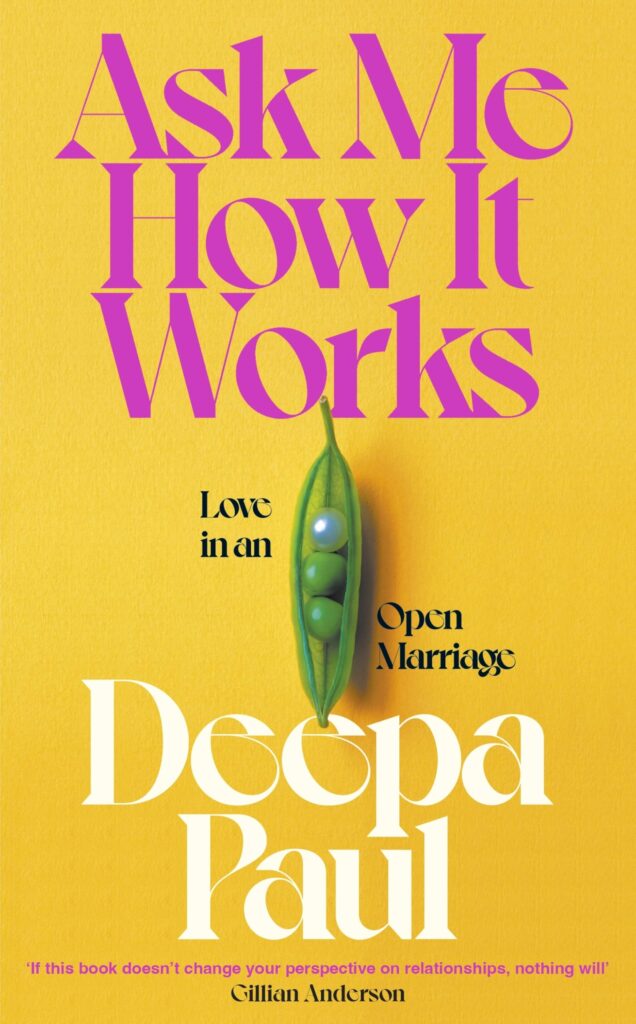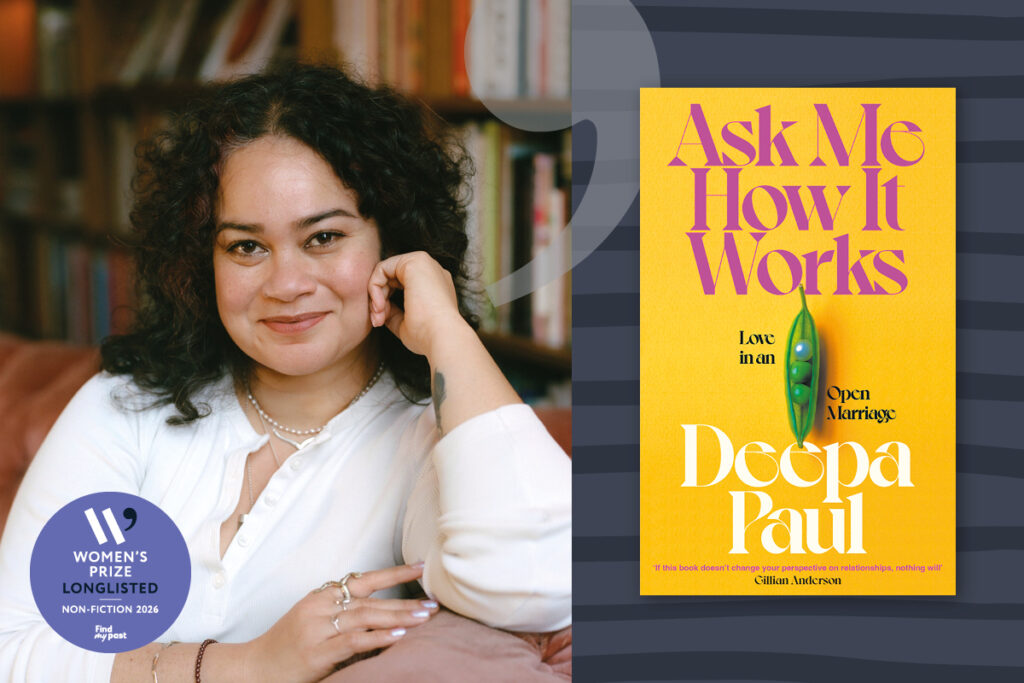
Ask Me How It Works by Deepa Paul is an open and tender exploration of body, sexuality and desire, told through responses to the questions asked about her open marriage.
Longlisted for the 2026 Women’s Prize for Non-Fiction, judge Roma Agrawal says: “In Ask Me How It Works, Paul writes with real joy and reflection about her exploration as a married mother of her body and sexuality, and how she found a way to live that feels authentic. It’s really rare to see this type of story, especially from the perspective of a South-Asian woman.”
To learn more about the book we spoke to Deepa about her writing process, inspirations and more.
Congratulations on being longlisted for the 2026 Women’s Prize for Non-Fiction; how does it feel to be longlisted and what does it mean to you?
Being longlisted for the 2026 Women’s Prize for Non-Fiction was something that I never even dreamed was possible for someone like me.
As a woman who has made unconventional choices, embraced my sexuality and desire, and written and spoken openly about doing so, I faced many choices and crossroads in writing this book. Shame was a spectre in many of them. Women like me don’t write books. Should a woman like me be writing so frankly about sex? Should I remain anonymous, and write using a pseudonym? Didn’t I care about my husband? Didn’t I care about my family?
Taking my first shaky steps as a first-time author, I battled with self-doubt. Would anyone even want to read this book? I almost didn’t query agents in the United Kingdom because I thought what I was writing wasn’t sophisticated enough for this market. Was the book I was writing trash simply because sex was involved? Shouldn’t sex remain a private matter? Am I starved for attention, and is this book simply a salacious way of soliciting it? My earliest doubts have since been externalised in online comment sections as I promote my book in the media.
Being longlisted for the 2026 Women’s Prize for Non-Fiction validates the choices I made in the face of shame and self-doubt: to put my face and my name on my work and my story, and to speak my truth unapologetically for all the women like me who can’t. It tells me that as women, our bodies and relationships, our desires and needs matter. Our mistakes and messes matter — not just the bits of us that are easy, useful, or deemed ‘good’. Our inner lives and our stories matter.
I feel honoured, elated, and validated. It means that my effort was worth it: that my story was worth telling, and my telling of it worth reading.
How would you describe your book to a new reader?
Ask Me How It Works is the story of how I navigated the transition from monogamy to non-monogamy with my husband of 18 years, and how we make our open marriage work. Each chapter is centred around one of the questions I most often receive about my open marriage, from “Do you have rules?” to “Are you ever jealous?” to “What happens if you fall in love?”. Yet, Ask Me How It Works isn’t a self-help guide or how-to manual. It’s the story of real people with real stakes (a long-time marriage, a young child, a new life on a foreign continent) pushing the boundaries of what it takes to make love work.
It’s about marriage, migration and motherhood, but also sex, pleasure, and desire. It’s also the story of my journey to sexual liberation as a woman — how I discovered my needs and desires beyond being a mother and wife whilst honouring those commitments, and integrating all of it into a life I love.
Finally, at its heart it’s also a love story – between me and myself, between myself and my husband, between myself and my daughter, between myself with my boyfriend (with whom I’ve since parted ways), and between myself and Amsterdam, my adopted home. It’s a book about many different kinds of love, for those who are open to being surprised by love.
What inspired you to write your book?
Writing has always been how I’ve made sense of my experiences and my world. I began writing purely for myself, to record and process a time of tremendous parallel changes in my life. Having just started a new life on another continent and given birth to my daughter, I was discovering that marriage, migration and motherhood were revealing me to be quite a different kind of woman from the girl I had been — and a different wife and mother from what I was expected to be. Writing helped me understand the woman I was becoming, and let go of the girl I had been with tenderness and compassion.
A writing class prompted me to distill my writing into an essay called Ask Me How It Works: Frequently Asked Questions About My Open Marriage (which now sounds very Web 1.0). I thought it would be a fun read I could send to people I was dating, so I wouldn’t have to keep answering the same questions about my open marriage over and over again. For several years I tinkered with the essay while trying to get it published. It was rejected more times than I can count, so I shelved it.
When Covid hit and freelance copywriting jobs dried up, I came across my mentor Nina Siegal, a novelist and journalist for the New York Times, offering writing coaching at half-off rates. My dream was to get published in the NYT Modern Love column, and I thought she could help me get there.
Despite a massacre of darlings, I couldn’t get the essay down to Modern Love’s brutal word count of 1,700. It was Nina who said: “Why are you trying to shoehorn everything you have to say into 1,700 words?” Writing unfettered, I produced a 6,000-word monster that now seemed even more unpublishable than ever.
Then she said to me: “This is not an essay. This is a book.” Major a-ha moment! I couldn’t unsee it. I went home and wrote the outline for the book that day. Five years, 14 chapters and nearly 100,000 words later, here we are. It is a book!
What did the writing process, from gathering ideas to finishing your book, look like?
I set out with a clear outline but was open to seeing how it would evolve. My original outline began with 10 of the questions I’m most frequently asked when I tell someone I’m in an open marriage. As I wrote I began to see deeper, unspoken questions that needed to be answered. I ended up with 14 questions, or chapters; those that weren’t part of the original plan felt the most urgent, like they demanded to be written, and I’m very glad I did.
I’m very easily distracted, so I need a lot of structure. I need to focus on one manageable task at a time, or risk becoming overwhelmed. I broke each chapter down into tasks (a section of dialogue, a scene or summary) that I assigned myself each day. At the start of lockdown, I could only write an hour at a time. The day I began writing, my favourite DJ had come out with a new record that was exactly 56 minutes long. I figured if I put on the record and wrote until it stopped, at least I would have written for nearly an hour that day.
I wrote during Writers’ Hour, a virtual write-along session hosted by the London Writers’ Salon in several time zones. Every day, hundreds of writers around the world log onto Zoom and write together in silence for 55 focused minutes. I started with one session a day, then two, then three. It was an amazing community that made me feel like I wasn’t alone, plugging away at writing a book one hour at a time.
As I completed each chapter, I would send it to my writing mentor Nina. She would give me her comments, but told me not to look back, and keep going forward ‘like a shark’ (sharks can’t swim backward, only forward).
After a year and a half, I had a first draft, which I asked my husband, boyfriend, best friend and sister to read. I trusted them to tell me if it was actually any good, or if it was cute that I finished it, but I should just print out a copy for myself and be happy with that. They all came back saying essentially the same thing: “You have something here. Keep going.”
My sister was funny. She said, “Oh my God, I don’t want to read about you having sex! And I don’t want to read about my brother-in-law having sex!” As a big romance reader, she asked me: “There are some books I read for the sex, and some books I read if I want to think. Is this a sex book or a thinking book?” I told her, “Why can’t it be both?”
I took a break for three months, then began implementing all the comments from my mentor and readers on the first draft. After six months, I had a second draft and set out looking for an agent. That draft was what got me my wonderful agent, and what she eventually sent out on submission to publishers.
What resources did you find the most helpful?
I started writing morning pages (three pages by hand, daily) in 2018 after I read The Artist’s Way by Julia Cameron. This practice gave me volumes of source material on my own life that I dug into many times. My most valuable resources were those notebooks and my most intimate relationships.
As I wrote, I asked my husband to read sections of dialogue to check what he was comfortable with, and if he thought what I’d written was accurate. Memory isn’t infallible, of course, but it helped to hear him say, ‘Yeah, that sounds like something I would have said back then.’ It also helped us process events in our earlier, messier stages of opening up, and proved to be very healing for both of us.
Both my husband and ex-boyfriend read each draft as it was finished, which was confronting at times, but necessary. I knew I was asking a lot of them by revealing very intimate moments, so it was important for me to respect their boundaries around privacy. The few requests they did have were very reasonable and didn’t change or detract from the narrative. I also ran sections by lovers who had become close friends.
I stayed away from reading several open marriage memoirs that came out while I was writing, because I didn’t want to be influenced by anyone else’s perspective. However, I did read a lot of books with sex scenes when I realised I actually had to write my own!
I asked readers who followed me on Instagram and subscribed to my newsletter on Substack to recommend books they thought had great writing on sex. It taught me a lot about what the language my reader is comfortable with and how they want to be spoken to when it comes to sex, and influenced my own personal language for writing about sex, the body, intimacy and desire.
Which female non-fiction author would you say has impacted your work the most?
There are several! Patti Smith, Nana Darkoa Sekyiamah, Melissa Febos, adrienne maree brown, Jessica Zafra.
What is the one thing you’d like a reader to take away from reading your book? Is there one fact from the book that you think will stick with readers?
As women, we change and grow throughout different seasons of our lives. What if our most intimate and cherished relationships could make room for all the versions of ourselves we will become in our lifetimes, and instead of adhering to a rigid, one-size-fits-all script, expand and evolve as our identities, needs and desires do?
Every version of us deserves to be seen, heard, and understood; to be met with curiosity and compassion; to be allowed to imagine something different, and to ask for it. Sometimes, the thing we need and want — and what we truly deserve —is on the other side of a tough conversation. I hope this book gives those who read it the courage to start that conversation, and a sense of what they need to see it through.
Fact: Most people are surprised to learn that the Philippines is one of two remaining countries in the world where divorce remains illegal. The other is Vatican City. That fact sticks with everyone.
Why do you feel it is important to celebrate non-fiction writing?
Non-fiction encourages us to approach life with curiosity, bringing clarity, certainty and meaning to the lived experience of being human. By witnessing and describing the facts of our lives with honesty, integrity, and a commitment to the truth, nonfiction writers invite each of us into a conversation about what it means to live, and all the different ways we can and do live. This is rigorous work that must be rewarded and celebrated.
Only by having conversations about our lived experience, at both a personal and collective level, can we begin to grasp what a particular experience — such as non=monogamy, in my case — is really like beyond the limits of our individual knowledge. Non-fiction helps us bridge the illusory gaps of difference between us as human beings and helps us understand each other. I think anything that helps us understand each other better, and be kinder and more compassionate towards one another, deserves to be celebrated.
I believe memoir has a special place within non-fiction. When it comes to desire, sexuality, and the taboo — particularly in my experience of non-monogamy — if fiction eroticises it and experts theorise it, then it falls to memoirists to normalise it. Memoir is the necessary middle ground between dreamers and experts, bridging the gap between the imaginative and the authoritative. Memoir takes the conversation from the realms of the academic and fantastic, then grounds it in lived experience, fleshing it out with the vivid joys, visceral struggles, and honest mess of real life. That deserves to be celebrated, too.