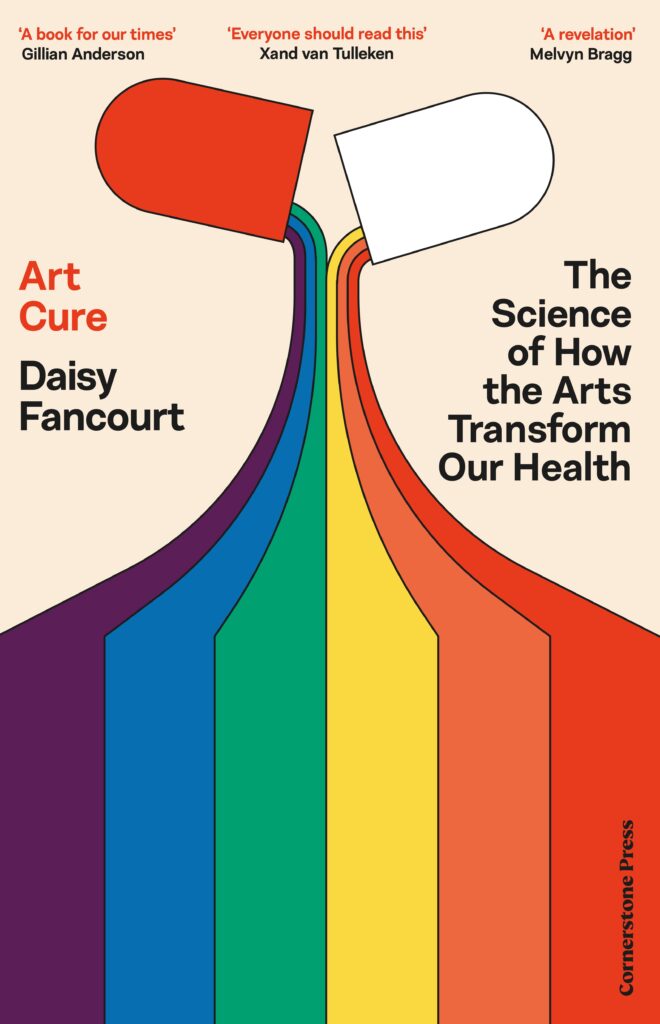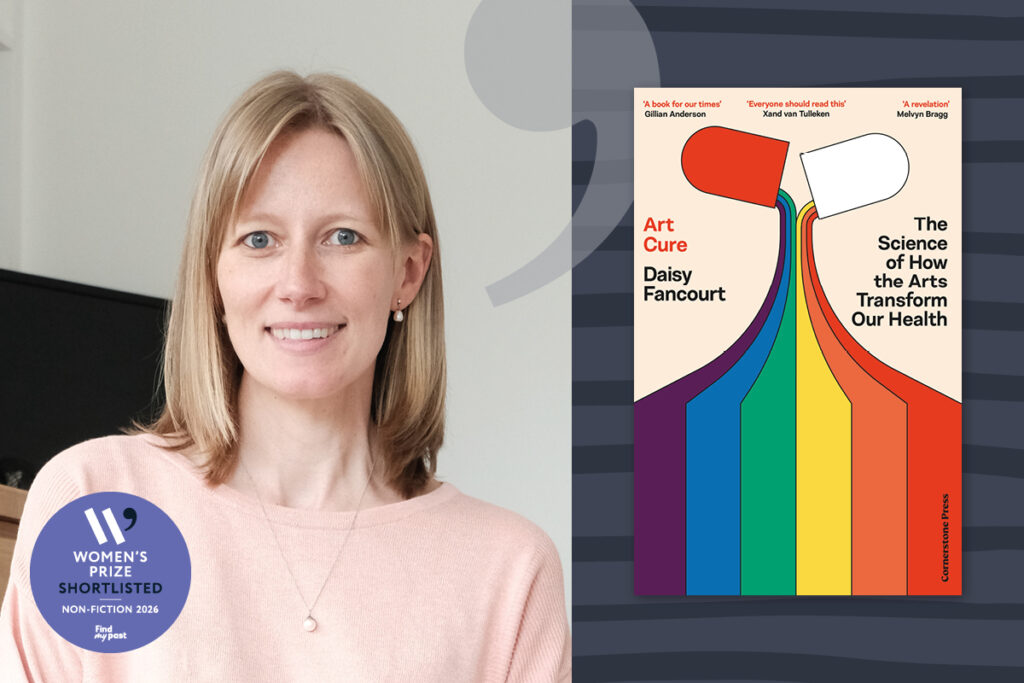
Daisy Fancourt’s Art Cure is an inspiring guide to improving your health, combining ground-breaking research in neuroscience, psychology, immunology, physiology, behaviour science and epidemiology, with inspiring true stories to explore the transformative power of the arts.
Shortlisted for the 2026 Women’s Prize for Non-Fiction, judge Nicola Elliott said: “Art Cure puts forward an amazing case for why the arts can be truly life changing – making us happier and helping us live-longer. Drawing on groundbreaking research, it is an accessible, inspiring and upbeat read.”
To learn more about the book we spoke to Daisy about her writing process, inspirations and more.
Congratulations on being longlisted for the 2026 Women’s Prize for Non-Fiction; how does it feel to be longlisted and what does it mean to you?
I honestly couldn’t be more delighted. I have followed the Women’s Prize for years, so it’s a dream come true to see my own book on the list.
How would you describe your book to a new reader?
From diet to exercise, sleep and supplements, we’re bombarded with information about how to live longer, healthier lives. I believe there is a fundamental piece of health advice we’re missing and it’s probably one of the most enjoyable ones we could be given: do more arts. In Art Cure, I take readers on a journey through the astonishing scientific evidence for how the arts can improve your health, stave off illness and disease and help you live a longer and fuller life. My goal is to fundamentally change the way you value and engage with the arts in your daily life.
What inspired you to write your book?
I’ve worked as a scientist researching how the arts affect our health for 15 years, but when I tell people what I do they’ve rarely heard about the evidence base – people might mention arts therapies or say that the arts helps their wellbeing, but without knowing about the thousands of studies that have been published using neuroimaging, physiological monitoring, blood samples, wearable sensors, big data, even DNA. The evidence base has remained this bizarrely well-kept secret. It doesn’t feel fair or even ethical for the evidence to remain buried, particularly at a time when arts funding is being cut in so many countries globally, inequalities in access to the arts are increasing, and arts engagement patterns are decreasing, with many crafts and folk arts practices even being lost altogether. So I wanted to share this incredible science and open up more public discussions about how we think about, engage with, and value the arts within our own lives and within society.
What did the writing process, from gathering ideas to finishing your book, look like?
The writing process started in 2018 when I was commissioned by the World Health Organization to write a health evidence report on arts and health to help them decide if they should be engaging in the topic. What was intended to be a small report put on the WHO website for posterity ended up being a synthesis of the findings from over 3,500 scientific papers that was downloaded over 250,000 times, becoming one of the most downloaded WHO evidence reports ever. But it was still an academic report – dense and technical and focused on governments, not individuals. So when I started receiving approaches from publishers about writing a public facing book, I knew it was an opportunity I couldn’t pass up. Alas, I completed the book proposal in early February 2020, just as COVID-19 struck, and I was diverted onto pandemic research, heading the UK’s monitoring of the psychological and social impact of lockdowns and planning behavioural science strategies for the vaccine roll-out.
In 2022, it was a personal trauma that made me realise that this project – which had slipped into second priority – actually had to be reprioritised. My younger daughter Daphne was born prematurely and, as I outline in the book, we nearly lost her to meningitis. In the NICU, feeling completely helpless, it was singing that that got me through and, I believe, kept her fighting. Seeing the changes on her monitors when I sang to her, I was reminded of something I’d been forgetting – the arts are not a luxury but a human essential. So, with the breathing space of maternity leave away from normal work, I found myself awake at night writing chapters in my head, considering the puzzle of how to bring the science together with real-life narratives and practical takeaways for readers. It was a rapid write – the proposal took just 2 weeks. The publisher interest was amazing and auction was completed 3 weeks later. A year after that I had a full manuscript. I was kept moving by the realisation that with every month that passed there was more news coming out about cuts to arts funding and closure of arts venues. So it felt like a mission to share this book and the evidence in it publicly to try and open up more discussion about the role the arts play in our societies.
How did you go about researching your book? What resources or support did you find the most helpful?
The evidence presented in this book is already my professional world. I felt lucky I already had such a deep-seated understanding of the research and I get to live and breathe the science everyday, but I hadn’t written a trade book before, so this was what I felt I had to research most. To do so, I read absolutely everything I could. I initially prioritised non-fiction books within science and medicine to get a sense of the spectrum of writing styles, particularly reading other books that promoted lifestyle changes or spoke about personal health. I also tried to read non-fiction books on completely different topics – especially ones that I really didn’t feel that interested by initially (!) because I figured if a book that I didn’t expect to like actually drew me in, I could analyse why – what in the tone, structure or writing style had hooked me. And I continued (aided by my local book club “Kingston Mums”) to read fiction of every genre, analysing how writers manipulate pace and suspense to keep readers turning the pages.
Which female non-fiction author would you say has impacted your work the most?
I love Caroline Criado Perez. Her book Invisible Women did the most incredible job cutting through complex evidence in such a clear way, shining a light on a way of thinking that was so deeply entrenched we hadn’t even realised it, and operating as both an expose and a mission. I’ll be honest, one of my motivations in writing Art Cure was that (outside of menopause literature), there aren’t many female authors writing about health. It still feels like such a male-dominated field that needs more female voices too.
What is the one thing you’d like a reader to take away from reading your book?
We should all pursue as many artistic experiences of as great a diversity as we can in our day-to-day lives. We should allow art to make us feel exhilarated, intoxicated, elated, because it is fundamentally, measurably good for us. Art, alongside diet, sleep, exercise and nature, is the forgotten fifth pillar of health.
Why do you feel it is important to celebrate non-fiction writing?
From my perspective within science, we are so lucky; we live in a world where every day incredible scientific discoveries are made, but these are typically publicised in strange underground channels like scientific papers that can sit behind paywalls and niche academic conferences. Only some of this evidence makes its way to public knowledge, when newspapers pick up a press release, or the complex mechanisms of policy and procurement eventually lead to changes that affect our own day-to-day lives. Non-fiction writing provides an amazing direct route for scientists to share and celebrate these discoveries; to challenge myths or misunderstandings; to let people know about the cutting-edge findings they might want to act on straight away for their own health and wellbeing; and (hopefully) to capture the imaginations of young people considering which route to pursue in their own careers.