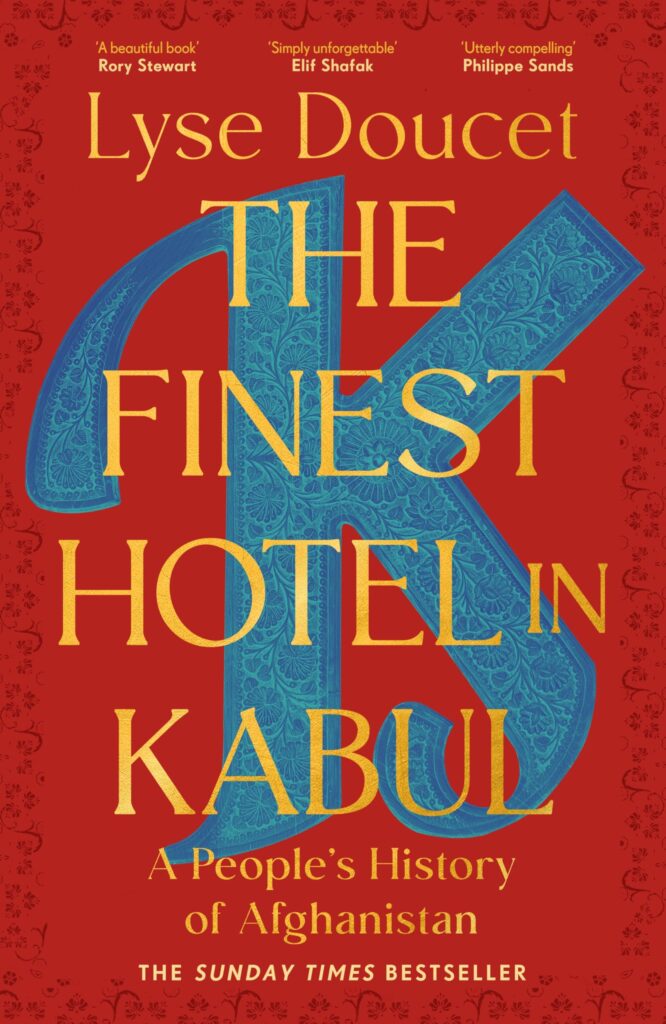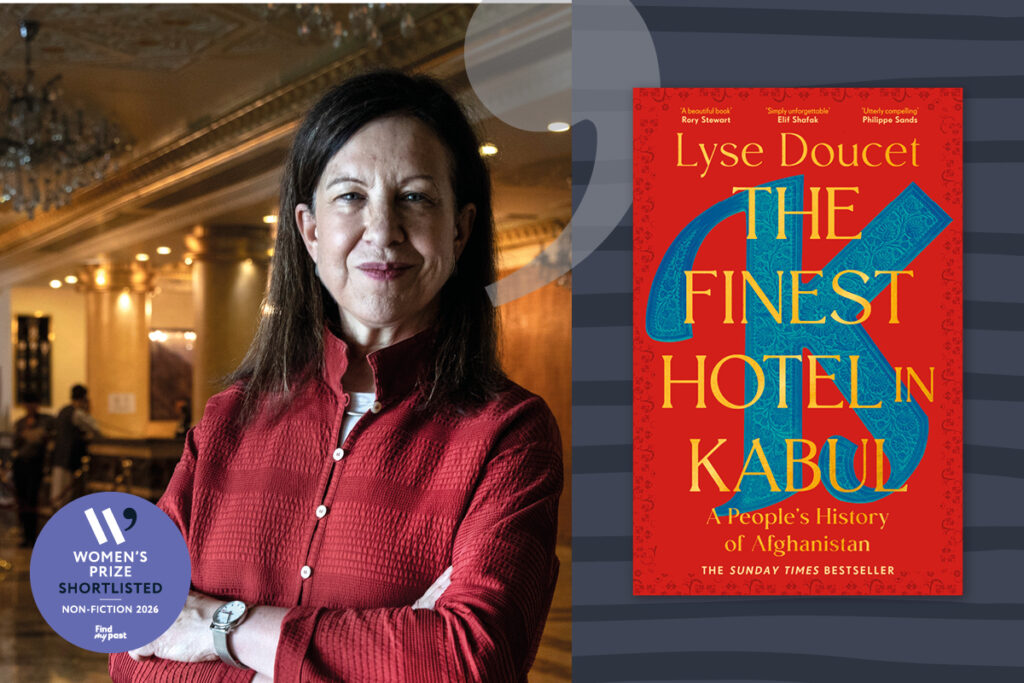
In The Finest Hotel in Kabul the BBC’s Chief International Correspondent, Lyse Doucet, places the Inter-Continental in Kabul at the heart of her richly crafted history of modern Afghanistan, telling the stories of some of the people who worked or stayed there and survived decades of conflict.
Shortlisted for the 2026 Women’s Prize for Non-Fiction, judge Roma Agrawal said: “With great accuracy and care, Doucet has taken an extremely complex geo-political situation and brought it to the real-life experience of very relatable people. The Finest Hotel in Kabul is a nuanced look at the history and politics of Afghanistan, told through the lens of the hotel and the people that occupy it.”
To learn more about the book, read an exclusive extract from the preface below.
‘How long will you be staying?’ asked the man behind the black marble counter. I didn’t know the answer. It was Christmas 1988, the day after my thirtieth birthday, and the gloam of the Inter-Continental Kabul was an unlikely place to be celebrating. The cavernous lobby brightened solely by a shiny blue-and-white banner promoting the Soviet airline Aeroflot. The wooden grid of pigeonholes behind the front counter, packed with chunky metal keys, left little doubt. Almost no one else was staying here.
Would it be six days or six weeks? I had just landed in Kabul for the first time. It was no ordinary arrival. The aircraft had banked sharply in a breathtaking corkscrew manoeuvre, flares bursting outwards with white-hot fire – a way to divert any heat-seeking missiles blasting from mountain bunkers, the foxholes of the Western-funded rebel fighters known as the mujahideen who were locked in battle with the Soviet-backed government in Kabul.
That winter, the harshest in more than a decade, Kabul was in the crosshairs of a Cold War conflict that was decades old. Afghanistan’s unravelling had begun in 1973, four years after the Inter-Continental Kabul’s grand opening, when its mild-mannered King Zahir Shah had been toppled by his cousin. The putsch soon tipped Afghanistan into a blood- soaked spiral: another coup, three leaders assassinated one after the other, then the Soviet invasion over the Christmas of 1979, which sparked what would become the most grievous war in the world.
I had travelled to the Afghan capital to report on the Red Army’s pull-out, following a disastrous decade-long occupation. As I departed from neighbouring Pakistan, one mujahideen commander cheerily told me he would soon see me in Kabul, since their victory was now in sight. Another warned that I would certainly be killed there.
The advice had been that there were really only two places to stay. The older, more conveniently located Kabul Hotel – smack in the centre, but with dubious communications and cuisine, and an even murkier history. And the Inter-Continental – high on a hill on the edge of the city, but with better telephone and telex links and food worth eating, as well as a certain faded splendour. I made a split-second decision. We headed for the hill.
I soon discovered that hospitality is hard-wired in Afghans. At the front desk, Sharif, with his sunbeam smile, and Salem, his dour sidekick, were a delightful double act, offering assistance with a wink, as spooks of the Soviet-backed ruling party lurked. Amanullah, at room service, scribbled caricatures of journalists on food bills to bring some cheer – a very Afghan vision of ‘service with a smile’. Nasir, the telephone operator, offered Dari-language lessons during anxious waits for a telephone line in that once-upon-a-time before the ease of the internet and mobile phones. As so often among Afghans, the gift was laughter.
I ended up staying nearly a year. The hotel became my Afghan home. As the Soviet troop withdrawal approached, the Inter-Continental started bursting with journalists who came and went, until the hotel echoed with emptiness again. Over the decades, when returning to Kabul to report on momentous times, I have often stayed in the place that everyone called simply ‘the Inter-Con’. And, over time, I came to realise it was more than just a hotel. As Afghanistan lurched through decades of trial and terror, laced with bright but brief beginnings, the Inter-Con was an unbreakable constant. Even though its connection to the global Inter-Continental chain was severed soon after Soviet tanks rumbled into the capital in 1979, Afghans stubbornly held on to the name, in the hope of restoring its early glory and membership in that coveted club. It never gave in, never gave up; the Inter-Con is a very Afghan hotel. What was born in 1969 as the finest hotel in Kabul became its most storied building. History – good, bad and bloody – was made within its walls. It became home to fashion shows and beauty pageants, bikinis by the pool, vodka- soaked Soviet receptions, warlord rockets, a guest named Osama bin Laden, American election observers, Afghan female MPs and Taliban suicide bombers. Its doors stayed open through every kind of political system: a peaceable kingdom, Soviet-backed communism, warlordism, Islamism and a would-be democracy bankrolled by the West.
Politics, like hotel guests, checked in and out. Whoever rules Afghanistan sets the rules at the Inter-Con. Today it is run by the Taliban, again. At times guests cursed it as the ‘worst hotel in the world’ – a place without running water, reliable heating or even bread that could pass a taste test. Bedrooms became bunkers. Chandeliers shattered. Floors were ravaged, renovated, ravaged and renovated again. In a land where most Afghans worried whether they would see their next meal or their next day, the Inter-Con was a constant.
Afghanistan’s story tells us that war is more than the blast of bombs, the whistle of bullets. It’s a mother’s anxious eyes, the song of a soldier, a soul-soothing camaraderie, the pause before going out the door. It plays out on the frontlines of everyday life, in dashed dreams, wrecked weddings and the courage of people who hold each other close and do what they can to carry on. My book is a history of Afghanistan told through the story of this landmark hotel, and through the lives of the staff who kept it going, based on recollections of the many Afghans and foreigners who have gone in and out of the Inter-Con. I have listened carefully to their accounts, checked translations, and backed up their stories, as far as possible, by historical records. Every effort has been made to tell their story faithfully, as they told it to me. It is written with enormous gratitude for the many Afghans, over many years, who have made me feel at home. For all that’s been lost, Afghans’ deeply ingrained sense of hospitality remains. Of all the country’s many proverbs, one has always been my favourite: ‘It doesn’t matter how big your home is, what matters is how big your heart is.’