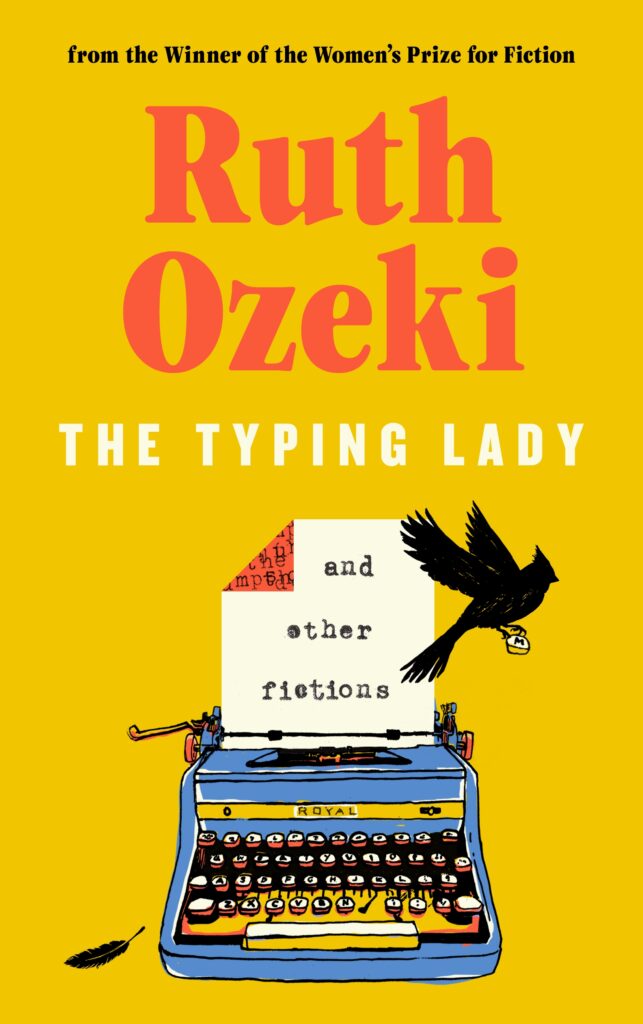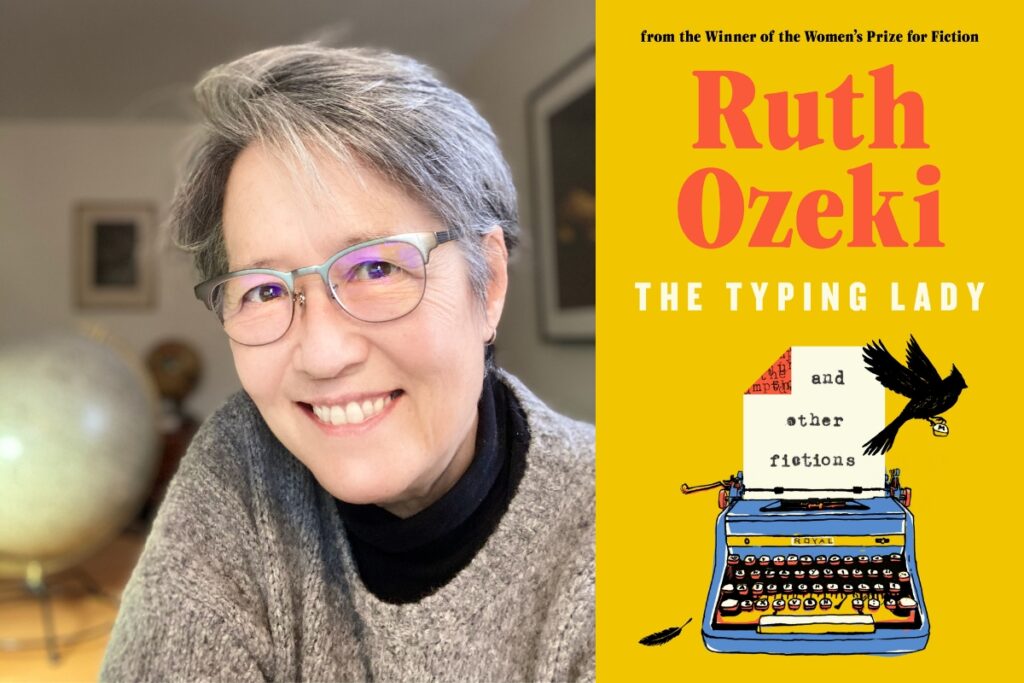
To celebrate the release of The Typing Lady: and other fictions, we talked with 2020 Women’s Prize for Fiction winner, Ruth Ozeki, about her love of typewriters, the decision to write her first collection of short stories and questioning narrative control.
The Typing Lady and Other Fictions is a collection of eleven stories exploring childhood ambition, youthful desire, midlife reinvention and the unsparing clarity of old age. How did you arrive at this structure?
The structure presented itself quite late in the process. I didn’t set out to write it this way, and I wasn’t even aware that the stories represented these different periods of life until a friend read an early draft and pointed it out. This happens to me a lot. I’m often quite blind to the obvious, and it takes a reader to tell me what I’ve written. When that happens, I usually just nod sagely—yes, yes, I planned it that way—but really it’s quite unconscious.
How does the experience differ in telling these lives through individual stories rather than a single narrative?
I loved writing these stories for precisely that reason. After I started to understand the shape of the collection—what the common themes might be and how the collection might be structured—I went back and started to edit. The stories all shared a concern with writing and storytelling as a way of coping with loss. As you noted, they represented different periods in a creative life. Once I understood this, I could reinforce these common themes during the edit, teasing out the subtexts and bringing them to the fore. In other words, I was editing the stories relationally rather than individually, and this was the point at which I began to appreciate what a collection of diverse stories, working in concert, could do.
Your opening story includes a scene with an author at a book launch who is asked why she decided to write her first short story collection. Can I pose the same question to you?
What was it that author said? “She said she’d always admired the form and wanted a new challenge, and from there segued into a brief rant about time poverty and patience, diminishing attention spans, and the impact of digital technology on reading skill.” Right, that was part of it. But actually I’d been writing short stories for years, although I’d never really concentrated on the form. It was just something I did when asked to contribute to an anthology or a journal. But when I started teaching undergraduate creative writing, the focus was on short fiction, and I realized that if I was going to teach this form, I ought to try to learn more about it. I started writing more short stories, and after a while, I had enough for a collection, and the timing seemed right, for all the reasons that that other author said.
You selected Elizabeth Bishop’s poem of loss “One Art” to frame your collection. Why did you start from a point of loss?
That poem is one of my favourites, and it’s one I come back to every time I encounter loss. I first read it in college, at a time when my heart had recently been broken. My sadness made the poem even more beautiful, and this is the paradoxical tension I tried to evoke in the eponymous story, “One Art.” Years later, when I was taking care of my dying parents, the poem took on a different significance, but again I was keenly aware of how sadness intensifies beauty. The poem becomes increasingly meaningful the older I get and the more I lose.
In my story, the narrator receives a letterpress edition of the poem, which winds up in a box in her basement and where it is eaten by silverfish. The poem disintegrates into a lacelike filigree of holes and words. This was something that happened to a beautiful letterpress edition of the poem I owned. Foolishly I tacked it to my cabin wall, unframed, and the silverfish got to it and made it even more beautiful. The image was so apt and so poignant, I had to use it in a story. Loss happens in so many ways. Loss changes us. It can make us wiser and more beautiful.
In ‘The Anthropologist’s Kid’, the children grow up being observed by people whose profession is to interpret and categorise other cultures, while also navigating their own mixed-race identities. How were you thinking about the tension between being seen and being understood when writing, and what did anthropology as a setting allow you to explore about power, belonging and who gets to define someone else’s story?
The setting and circumstances for that story are drawn from my life. Like Joji, I grew up as the mixed race kid of a white anthropologist father and a Japanese mother, and at the time, many of my father’s colleagues in the department had Asian wives. When I was a child, it seemed perfectly normal to be half-Asian and half-anthropologist. Only much later, after I developed some consciousness about race and power, did I realize how odd it was. In the story, Joji, who is also called Georgie, has unconsciously aligned himself with his father’s white, male privilege, and when he exercises the power of that privilege, things go terribly wrong. Like me, it takes him years to unpack the dynamics of the situation.
The motif of typing (especially on old typewriters) feels almost mystical – what drew you to analog writing tools as a creative and symbolic device?
I just like typewriters. I also like fountain pens. They are machines that are full of promise. I usually write on a computer, but I like to have analog writing tools at hand, and I use them when I get stuck or hit a block. These old technologies require a more physical involvement in the writing process. They demand a letter-by-letter relationship with the sentence and the page. They force me to slow down. My writing blocks usually stem from my impatience, the old “I don’t want to write, I want to have written” problem. Computers exacerbate impatience because they’re so fast and efficient; I should be done with this story, but I’m not! I’ve come to think of impatience as a form of laziness, and the cure for impatience is slowing way down. And you’re right about the almost mystical power of those machines. A writer named Frederic S Durbin, who has a passion for typewriters, once said, “We humans go through many computers in our lives, but in their lives, typewriters go through many of us.” Maybe this is the source of their mystical power. They outlast us.
Many of the works mentioned in this collection such as Borges or Benjamin hint at metafictional traditions – how have these influences shaped your approach to narrative structure?
Benjamin is less a metafictional influence than a theoretical one. The metafictional influences have come largely from Borges, who frequently draws attention to the artifice of writing. As a lapsed documentary filmmaker, I am skeptical of the notion of authenticity in any form of representation. So I like to mess with this: interrupting the seamlessness of a narrative, breaking the fourth wall, confabulating autofiction. There’s a wonderful essay he wrote called “Borges and I”, in which Borges describes, in hilariously self-disparaging terms, his relationship with Borges. I read it many years ago, and it stuck with me because I could relate. I’ve never felt like an integrated self—possibly because I’m mixed race or simply maladjusted. In everyday life, this has often felt like a handicap, but it’s been an asset in my life as a fiction writer. My characters—the heroes and the villains, the major players and the supporting cast—are all facets or aspects of this unstable and ever-changing entity I experience as myself. Maybe this is a solipsistic way of approaching the creative process, but when you think about it, where else could fictional characters come from?
Precarity, alienation and artistry all contend against one another through the character of Mel in your story “Leafblower”. Is connection and artistry more imperiled than ever when we’re forced to tread water and drown in the noise of late stage capitalism?
There, you see? Once again, you’re pointing out something in my own story that I hadn’t realised. Yes. I do feel connection and artistry and care and craft and precision and patience and art-for-art’s sake and a nonteleological, non-utilitarian approach to creativity are all more imperiled than ever. Which is precisely why we must strive to preserve these virtues and values—they are our superpowers.
This collection gravitates towards life’s thresholds – from youthful innocence to midlife reinvention. Do certain moments and thresholds in life feel more weighted or poignant perhaps? Can we transcend the anxieties of, as you say in the collection: ‘securing our place in the space-time continuum’?
Probably not. I think any attempt to transcend our anxieties just leads to delusion and repression. It’s probably better to focus on learning to be patient with ourselves and our anxieties and cultivating our tolerance for the discomfort. We’re human. We like stability. We like certainty. Transitions are scary and hard, because they foreshadow the final transition, the ultimate loss, that we know is coming for us. There is tremendous poignancy in this, and beauty, too. Again, that powerful conflation of beauty and sadness.
Did you use a typewriter to write this collection?
This collection came about when I started buying old typewriters. This was in 2023, after the pandemic, right around the time that ChatGPT was launched, and I felt exhausted by “progress. I remember telling my friends, “It’s okay. You all can go on ahead, but I’ve had enough. I’m going back to the 20th century.” I was kidding, but also not. Right around that time, I happened to pass a typewriter store when I was driving one day, and on a whim, I pulled over and went in. Hours later, I came out with a 1956 Smith Corona. A week after that, I bought a second, a Royal Quiet Deluxe, on eBay. Then a third, then a fourth. Once I had the typewriters, I had to use them. Typewriters are working machines, after all. They want to type. By then, I’d already written many of the stories in the collection, but typing on the typewriters gave me the idea for the title story and the throughline for the collection as a whole.
Your thread loss and forgetting throughout these eleven stories creates a kind of Escheresque reading experience. Is there something to be gained from questioning the degree of control we have over the stories we tell and how we record ourselves in language?
What an interesting question! The easy answer is yes, there is much to be gained. As someone who records myself in language, it’s my job to question the stories I tell and how I tell them, and to improve the degree of control I’m able to exert over that telling. The more complicated answer—the one I grapple with—moves us into more philosophical domains: what are the ethical considerations I engage with when choosing what and how I write? How do I deal with the slipperiness of language? How do I write with authenticity and is it even possible? How can I presume to exert control when any text or literary artifact is by definition a collaboration between writer and reader? As a Buddhist, my vow is to do no harm, but writing can be cruel; sometimes intentionally, as when writing humour and satire; or unintentionally, through simple carelessness or misrepresentation. You can see the Escheresque conundrum here, going round and round. It’s surprising I’ve ever completed anything.
But you started this question with the mention of loss and forgetting. Writing often positions itself as a bulwark against loss and forgetting; we write for posterity, after all, to preserve memory and record history. But I’m pretty sure this isn’t as simple as it sounds. I’ve always been fascinated by the impact of the imagination on what we think of as real or true. I’ve also been fascinated by agnotology, a field of study that examines the gaps and holes in our historical and epistemological record: what goes missing and why? Control over the narrative is highly desirable and generally falls into the hands of the powers that be, whether corporate, national, political, identitarian. There is much to be gained by questioning the control these powers exert over us and the stories they feed us and want us to believe.