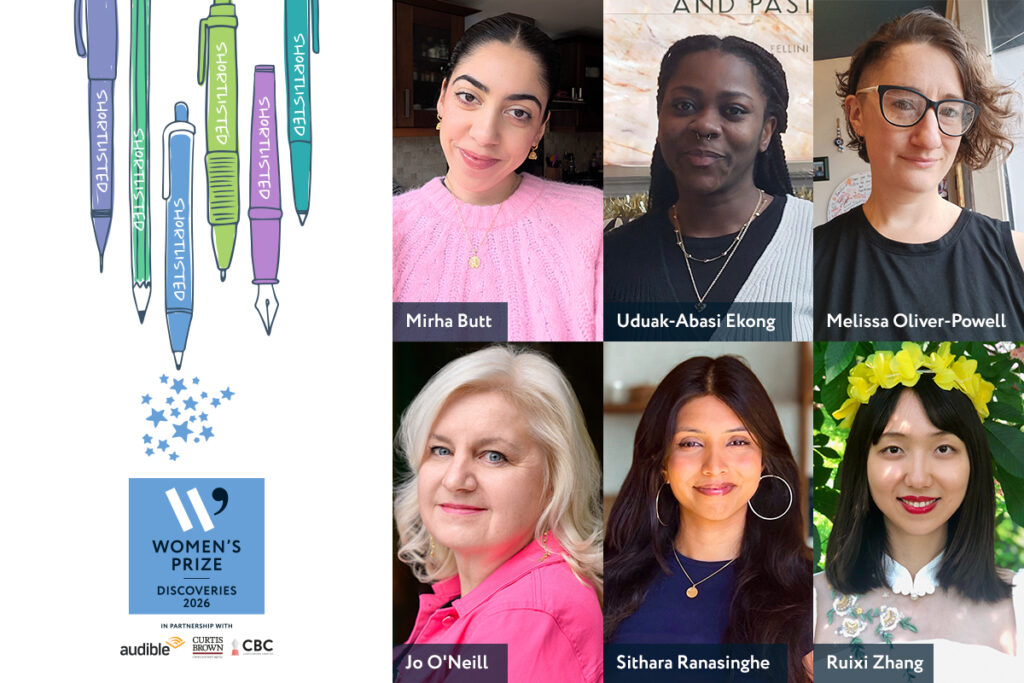
We’ve just announced the six talented writers shortlisted for Discoveries 2026 – our writer development programme and prize run in partnership with Audible, Curtis Brown and Curtis Brown Creative.
The writers selected for this year’s shortlist present a captivating variety of subjects and writing styles, influenced by the breadth and richness of their backgrounds and experiences from all around the UK. Each writer skilfully draws from their intimate personal histories and interests, infused with imagination, telling stories that reach across time, space and topics: immersing us in literary thriller, mythological reimagining, subverted fantasy, and body horror; transporting us to 1990s Kashmir, sixteenth-century Scotland and the folklore of West Africa; questioning power structures and the status quo, interrogating human-inflicted environmental decay, and examining alienation and othering.
The six shortlistees are:
- Mirha Butt, Notes From The Valley Of Unclaimed Daughters
- Uduak-Abasi Ekong, Welcome Back, Darling
- Melissa Oliver-Powell, Sea-Mouth
- Jo O’Neill, The Peat Cutter’s Wife
- Sithara Ranasinghe, The Spare
- Ruixi Zhang, Confessions of an Alien
Read on to learn a bit more about each of them, and their writing.
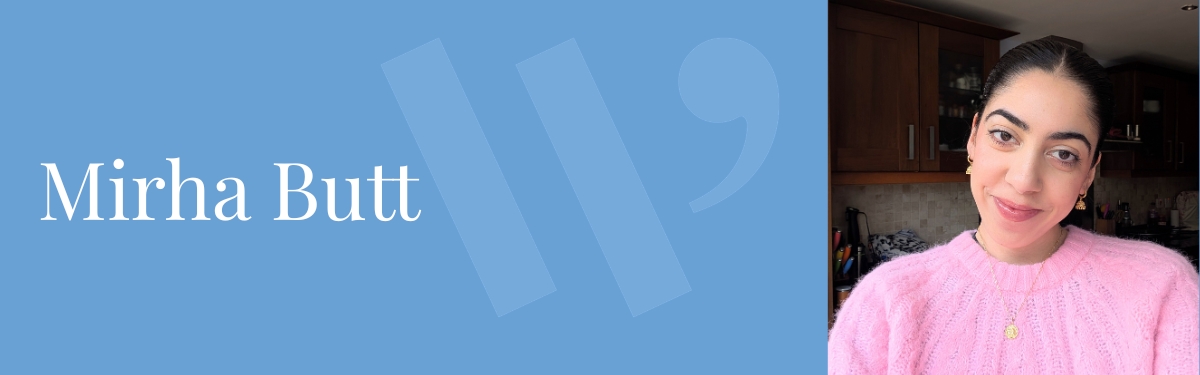
Mirha Butt, Notes From The Valley Of Unclaimed Daughters
Mirha Butt is a London-based public policy and research professional and a recent graduate of LSE, raised in Watford. She is also an identical twin and the proud owner of a cat called Bibble. Her work centres the complexities of female relationships, whether in friendship, motherhood, sisterhood, or elsewhere.
When did you begin writing?
I started writing when I was twelve, inspired in part by my mum, an English teacher who raised me on the belief that reading is good for the mind and soul. My first few attempts were, frankly, dreadful, but I adore them for the same reason I adore the work I write now: every word helped make me the writer I am.
What made you enter Discoveries in 2026?
I wanted exposure, community, and a reason to stop quietly doubting myself in a corner. As a young woman of colour, I’ve had a lot of imposter syndrome, so Discoveries felt like a real chance to meet like-minded writers and industry experts.
How does it feel to be shortlisted for Discoveries 2026?
It feels genuinely surreal. I’ve always written just for myself, never really believing it was good enough for anyone else to read. Knowing that people see value in my work is deeply validating. In the space of two weeks, I’ve gone from “this is just a fun escape from reality” to “maybe I could actually become a published author”.
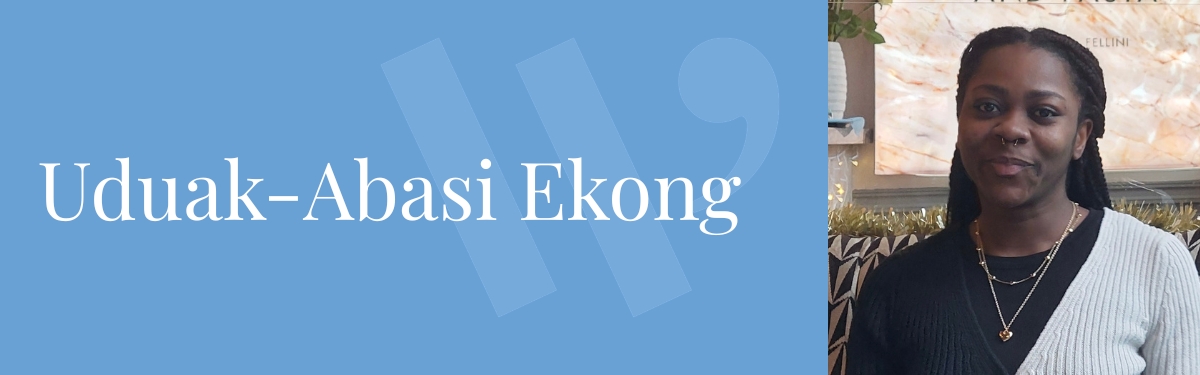
Uduak-Abasi Ekong, Welcome Back, Darling
Uduak-Abasi Ekong is a Manchester-based Nigerian writer. Her fiction has appeared or is forthcoming in Afreada, The Bournemouth Journal, Ojuju Magazine, Wensum Literary, Everscribe Magazine, Brittle Paper, and Ekondo Review. She was runner-up for the inaugural Hilary Mantel Prize for Fiction and a winner of the 2025 Book Edit New Writers’ Prize. Her work has also been shortlisted or longlisted for the Bath Novel Awards, Exeter Novel Prize, Merky New Writers’ Prize, and Creative Future Writers’ Award. She is a 2026 SmokeLong Emerging Writer Fellow and a Faber Academy alumna.
How does it feel to be shortlisted for Discoveries 2026?
I thought the longlist was as good as it gets so I’m still in shock to find out I’ve made it to the shortlist. I’m honoured to be surrounded by such incredible talent and deeply grateful to the Discoveries team for believing in my words.
What key themes do you explore in your writing, including in your novel-in-progress?
My writing explores grief, love, envy, ambition, jealousy, despair, and all the ways intense emotions (especially the ones often considered negative) can become consuming. I’m interested in how these emotions shape identity and how people carry what they feel, sometimes beyond what is healthy or possible. In my novel-in-progress, these themes extend into psychological horror where grief distorts reality and love becomes a form of possession.
Which female authors inspire you to write, or have shaped you most as a writer?
Several female authors have shaped my writing, particularly in how they handle voice and emotional complexity. I’m especially influenced by writers like Pemi Aguda and Oyinkan Braithwaite who have shown me how fiction can explore darker emotional landscapes.
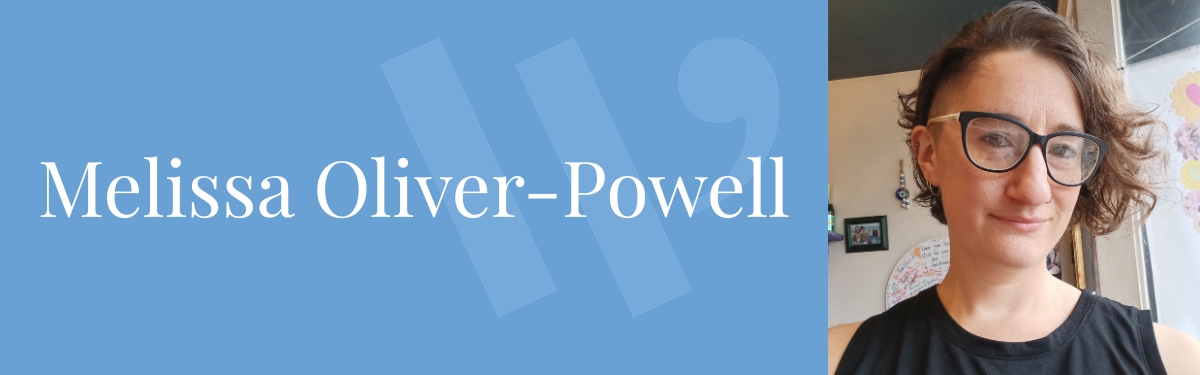
Melissa Oliver-Powell, Sea-Mouth
Melissa Oliver-Powell is a lecturer in film studies and literature at the University of York, where it’s her job to introduce unsuspecting English lit students to weird and wonderful bits of world cinema. As a researcher, she has published an academic book, Pepsi and the Pill, and several articles and chapters on gender and sexuality in film. After years of thinking about feminist and queer studies in her day job (and beyond it), she is now exploring these ideas and passions in more untamed forms through fiction.
How does it feel to be shortlisted for Discoveries 2026?
Literally incredible. I’ve reread the email a frankly embarrassing number of times to check it’s real (I’m now *nearly* sure it is…). My self-belief in my writing has wavered a lot over the past few years, and I never thought I’d make it onto a list like this, in the company of such amazing writers – past, present and future.
What made you enter Discoveries 2026?
This is the first literary prize I’ve entered, so I wasn’t totally sure what to expect. I wanted to enter this competition in particular because Discoveries and the Women’s Prize Trust do such important work in supporting and celebrating women writers, in all their diversity.
What initially inspired your novel-in-progress?
I drew on my own fears and experiences with illness. In 2014, I received an unexpected diagnosis of hydrocephalus (or ‘water on the brain’), which gave me a fascinated fear of the sea and all the strange things that can emerge from its unseen depths, as my own watery health condition had. Basing my character’s transformation around grotesque things from the ocean, I wanted to look these fears in the face and see if I could turn them into something beautiful. I’m really interested in écriture feminine, especially Hélène Cixous. Contemporary queer author Laura Kay has also been a brilliant mentor and inspiration.
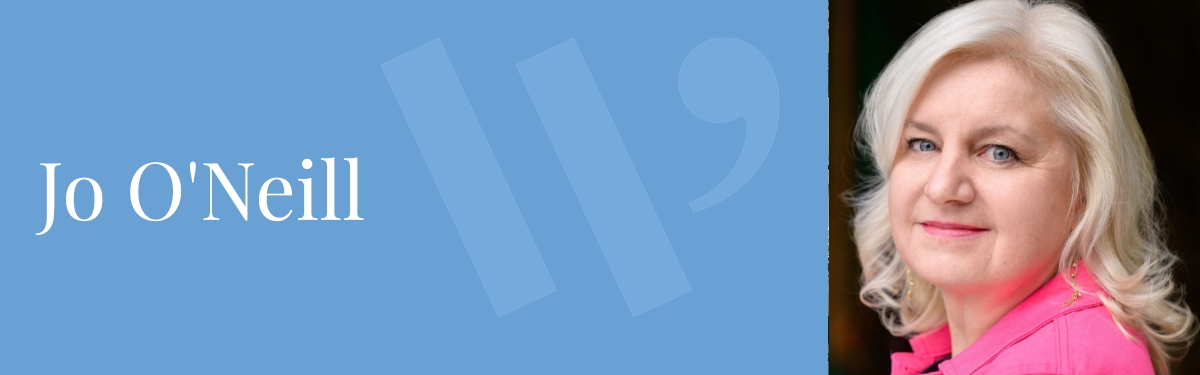
Jo O’Neill, The Peat Cutter’s Wife
After a hectic career living and working in South Africa, Norway, the Netherlands and Scotland, Jo O’Neill hung up her construction helmet in 2023 and returned to England to fulfil a lifelong dream and write full time. Now Jo lives in the South of England and is an active member of her local writers’ group – Reading Writers – who she describes as the most supportive, talented group she could ever hope to meet. She lives with her husband, John, a professional artist.
Which female authors inspire you to write, or have shaped you most as a writer?
Hannah Kent is a writer I keep coming back to for atmosphere and psychological depth. Sarah Waters and Margaret Atwood – their prose and character work are exquisite.
How does it feel to be shortlisted for Discoveries 2026?
So thrilled, lucky and grateful. I know how fine the margins are between writers’ work and it’s an honour to even be considered among such a group. Writing means so much to me, and this particular novel means everything because of the story it tells. Thank you Discoveries.
What is the thing you are most excited for as you continue through the Discoveries process?
The opportunity to interact with other writers, and to learn from them. Growing my writer community network and supporting more writers the way my writer friends have always supported me.
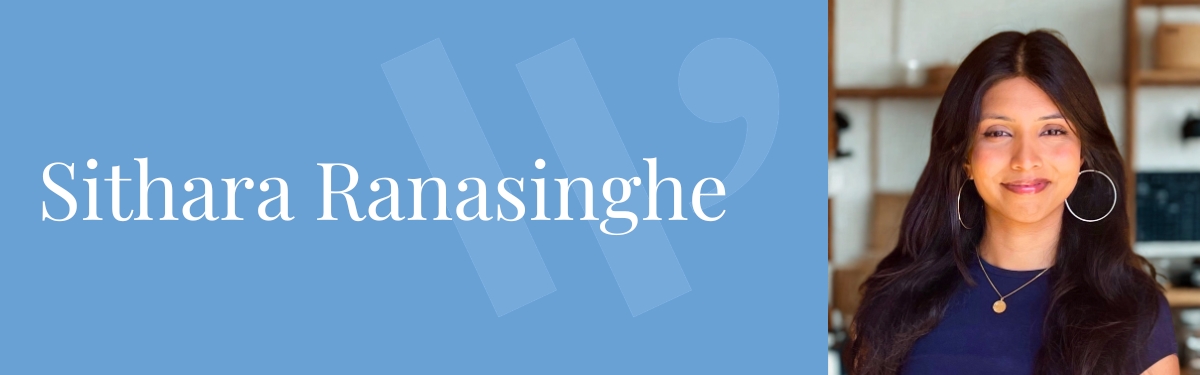
Sithara Ranasinghe, The Spare
Sithara Ranasinghe was born in Sri Lanka and raised in Loughborough. Her writing has been featured in Cake Zine, Design Observer and Eaten. She posts niche historical deep dives on her Substack, Sithara’s Newslettara, and co-hosts the podcast Further Reading.
When did you begin writing?
When I was a kid, I would fold sheets of printer paper together and write “books” about fairies and ghosts. I then moved onto writing very bad emo-flavoured second world fantasy in spiral-bound notebooks. With that, I think it’s fair to say I’ve been writing fantasy my whole life, but I only started taking it (somewhat) seriously very recently.
What initially inspired your novel-in-progress?
I’ve always loved fantasy novels, but a lot of them either explored European-inspired settings with race-blind or White casts of characters, or they were set in fantasy versions of other countries. I’m an immigrant, so I didn’t see myself in either of these boxes, so I wanted to write a fantasy story that had space for immigrant characters.
How does it feel to be shortlisted for Discoveries 2026?
I’m mostly just shocked! I still can’t actually believe that any of this is happening. It feels so amazing (and surprising!) to have made it to the shortlist. If I could pirouette, I would hit 500 of them really fast.
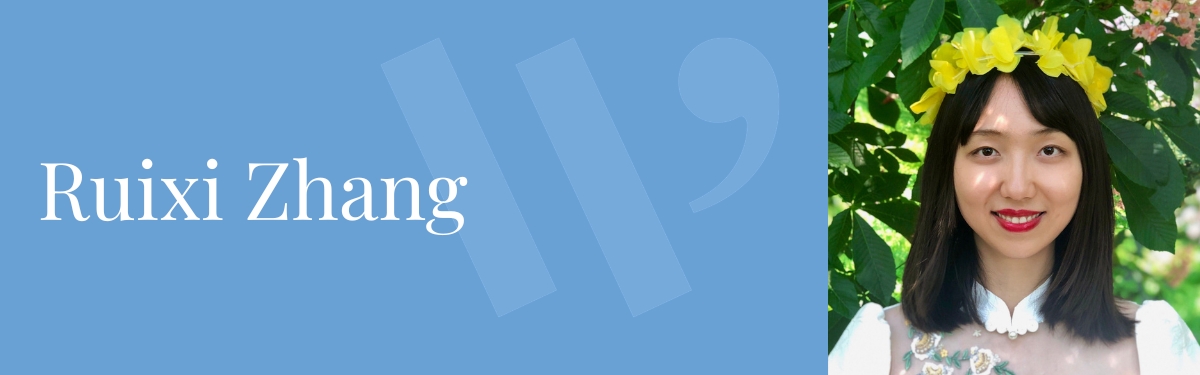
Ruixi Zhang, Confessions of an Alien
Ruixi Zhang is an exophonic writer based in London. Born and raised in China, she studied English and psychology at Wellesley College, a women’s university in the US, before coming to the UK for an MA in comparative literature at the University of Oxford. Her debut short story appeared in Colorado Review. Her novel-in-progress was longlisted for the Bridport Prize in 2025. An alumna of the HarperCollins Author Academy, she has been awarded the Curtis Brown Creative Breakthrough Scholarship and the Faber Academy Scholarship.
When did you begin writing?
When I was a kid, I wrote stories and sentimental essays in Chinese. I began writing fiction in English in my early 20s, when I learned about authors like Yiyun Li, whose works showed me that it was possible to write beautifully in a foreign language. Around the same time, I also took a psychology course at university, in which we were asked to create a therapist and a patient character, and write fictitious transcripts of their conversations. That was the first time I wrote anything fictional in English, and the reason why I still enjoy writing dialogue the most!
Are there any locations that have a special connection to your novel-in-progress?
I grew up mostly in Beijing, went to university in the greater Boston area, and currently live in London. So far, I have lived in eight different cities. Voluntarily or not, I’m always moving from place to place. This sense of rootlessness and restlessness is at the heart of my novel-in-progress.
How does it feel to be shortlisted for Discoveries 2026?
I feel like I have found a home as a writer. Since being longlisted, I have learned that Discoveries is much more than a writing prize: It is also a community of women writers who support and celebrate one another. I hope, or rather believe that together we can create “the poems of our climate” (to quote Wallace Stevens). I look forward to the exciting journey ahead, filled with new friends and more stories to tell!