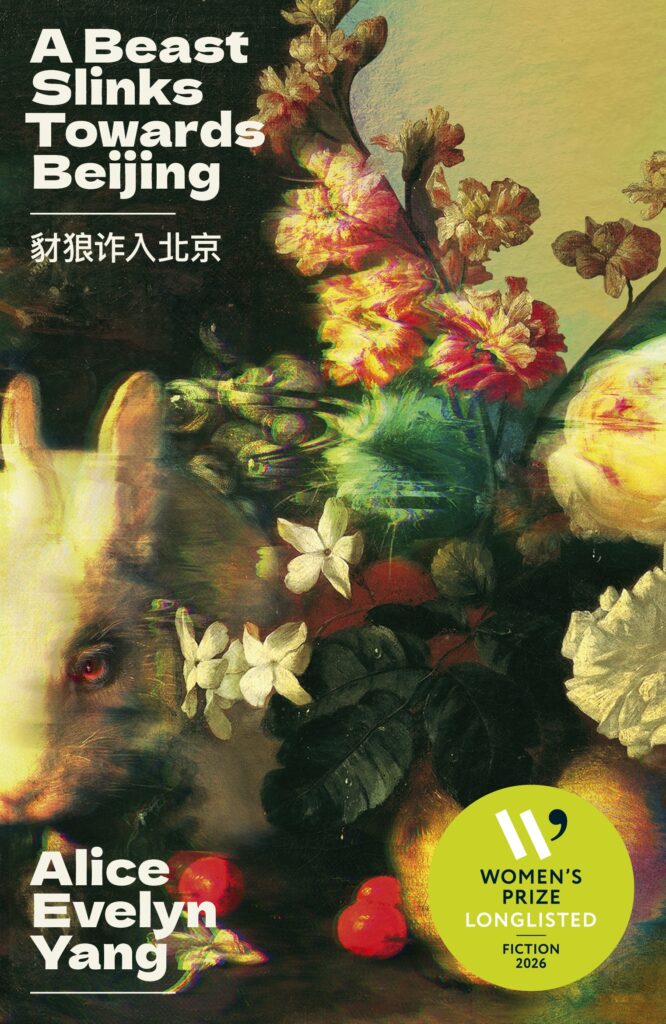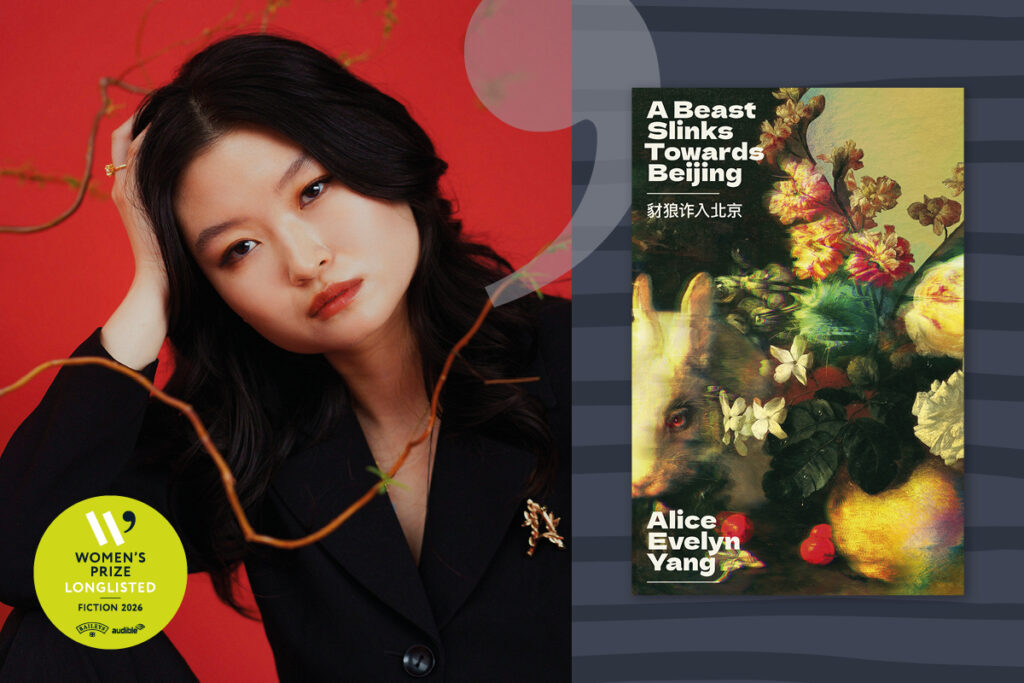
In A Beast Slinks Towards Beijing debut Alice Evelyn Yang uses folklore and magical realism to dive headfirst into the violent legacy of colonialism, intergenerational trauma, and the past’s refusal to stay silent.
Longlisted for the 2026 Women’s Prize for Fiction, judge Mona Arshi said: “A Beast Slinks Towards Beijing by Alice Evelyn Yang is a book that’s deftly crafted, a rich tapestry braiding together three generations of a Chinese family. It’s a gorgeous story that unrolls like an ancient tapestry and holds you under its spell into the very end.”
To learn more, we spoke to Alice about her inspirations, creative process, favourite authors and more.
Congratulations on being longlisted for the 2026 Women’s Prize for Fiction; how does it feel to be longlisted and what does it mean to you?
When I learned I was longlisted, I spent my day floating in a state of disbelief. This honour means the world to me as a working writer, but it means more to the writer I once was. Like many writers at the early stage of their careers, my inbox was a sea of rejections. I used to believe that these rejections reflected my writing. Receiving this news would have been a life-affirming validation for that early career writer. That said, I am most proud of how much I have changed since then: I have grown into a writer with faith and belief in my work, and I think my confidence — the knowledge that not everyone will like my work and staying true to my voice regardless — shines in my writing. Learning that I’m on the longlist has only strengthened my resolve to continue writing what I want to write: work that is unafraid to interrogate authoritarianism, colonialism, and institutional power.
How would you describe your book to a new reader?
A Beast Slinks Towards Beijing is a magical realist family saga that follows one northern Chinese family. It begins in the present day with the reunion of an estranged father-daughter pair and traverses the history of twentieth-century China, documenting the family’s past from the Second Sino-Japanese War and the Japanese occupation of Manchuria through the Cultural Revolution. All the while, they are haunted by creatures from folklore and omens as they’re forced to make difficult and morally questionable decisions to survive.
At its core, I see A Beast Slinks Towards Beijing as a story about the relationships between parents and children. Stripped down of the magical realist elements and the history, it is a novel about what is passed down between generations, and how this inheritance influences our familial relationships.
What was the idea that sparked your novel?
I was interested in creating a family history that could’ve been mine. I grew up in a household with two parents that were very quiet about their past — and still are — and I never felt that I knew my roots. In my eighteen years living in my parents’ house, I collected only a handful of facts about their lives in China: keepsakes I devoured that would rattle in my mind for months after. In college, away from the conservative swath of the South where I’d grown up, I began to read Asian writers, notably Min Jin Lee’s Pachinko, and learn Asian history and slowly stopped seeing my Chineseness as something to excise. I learned about Japanese imperialism and the Rape of Nanjing, about the Cultural Revolution, and, after confronting my parents, discovered that they had lived through and participated in the latter.
What echoes of this violent century still existed in them? In me? The premise of A Beast Slinks Towards Beijing began with this question: how much of my being has been shaped by an inheritance that I was not told about?
Researchers in epigenetics have discovered that intergenerational trauma can manifest in the body of descendants, changing how genes function. I imagined myself as a Russian nesting doll, the generations before me housed within my ribs, bringing with them all their unknown joy and history and trauma. I carried this notion into the magical realism space. What if the trauma buried in my genetic code was monstrous?
What did the writing process, from gathering ideas to finishing your book, look like?
Much of my early process was messy and nonlinear. I began with research, concepts, and ideas that I put on my bedroom wall like I was a detective solving a murder mystery. Historical timelines of major events in the Second Sino-Japanese War. Chinese numerology perspectives on the number seven. Scene breakdowns from media I enjoyed that dealt with multiple perspectives and timelines.
After I had done my preliminary research, I wrote the three narrative timelines of the novel in chronological order, beginning in 1924 and ending in 2017. I did this because I wanted to understand how the earliest timeline’s events would influence subsequent generations. After each character’s sections were written, I saw which scenes were in conversation with one another and how the timelines echoed. I highlighted the connective tissue and tried to hide the stitches, weaving together a patchwork story that would build to the story’s final reveals.
I completed a first draft in two years and then spent the next three in revisions and edits with my agent and then my editor. I’ll admit now that I’ve lost track of the individual hours of this process. My memory of writing the book has been flattened, and all I see is myself at my roll-top writing desk — only about 30 inches wide, just enough for my laptop, a mouse, and a cup of coffee — languishing over my next word, my next sentence.
Which female author would you say has impacted your work the most?
Min Jin Lee.
What is the one thing you’d like a reader to take away from reading your book?
I set out to write this novel for my fellow second-generation Chinese Americans, whose parents never spoke to them about their past. But in the process of writing this book, I interviewed my parents, and for once, we engaged in an open communication about their past. Writing it has been an act of empathy, bravery, and care, creating a bridge across the cultural and generational chasms between us.
The novel concludes on a hopeful note, one in which there is a possibility of breaking these destructive generational cycles. I hope that it finds the readers who are also willing to do the hard and often uncomfortable work of disrupting those long-standing patterns.
Could you reveal a secret about your creative process? This could be where you like to write, a unique writing ritual you have to unlock creativity, or how you go about writing.
At two in the morning, on the cusp of falling asleep, I conceive of sentences and paragraphs in which the words are so perfectly arranged, I feel like they were placed in my head by some otherworldly force. I usually forget them by morning, but I consider these lines a product of True Inspiration. Writing, however, is very rarely True Inspiration. Writing is a hard discipline, one that requires endurance. I have no secret to my creative process, only the grit to sit at my manuscript each day.
To stave away burnout, I like to take up crafts while I’m drafting. The particular craft has changed over the years, cycling through to crochet, jewellery-making, embroidery, and, most recently, notebook-making. I like creating something with my hands, something I can grasp, especially when writing demands years of patience before you can physically hold what you have made. It is a nice respite from being in my head so often.
Why do you feel it is important to celebrate women’s writing?
I often return to Saidiya Hartman’s concept of “critical fabulation,” which she introduced in her work Venus in Two Acts, a piece where she reconstructs the lives of African slaves in the Middle Passage. Critical fabulation combines both a critical reading of the archives and the act of fabulation. It is a speculative act of writing within the gaps and erasures of the archive — particularly the stories of Black lives.
In my own writing, I try to dredge up lesser-known histories. I see these as gaps in the Western education and canon. Much of the Western canon has been populated by the writing of white men, and only very recently have we begun to remedy that, acknowledging and celebrating the writing of women, especially Black, Brown and Indigenous women. These are necessary additions to the literary canon, which only benefits from the multiplicity of perspectives.