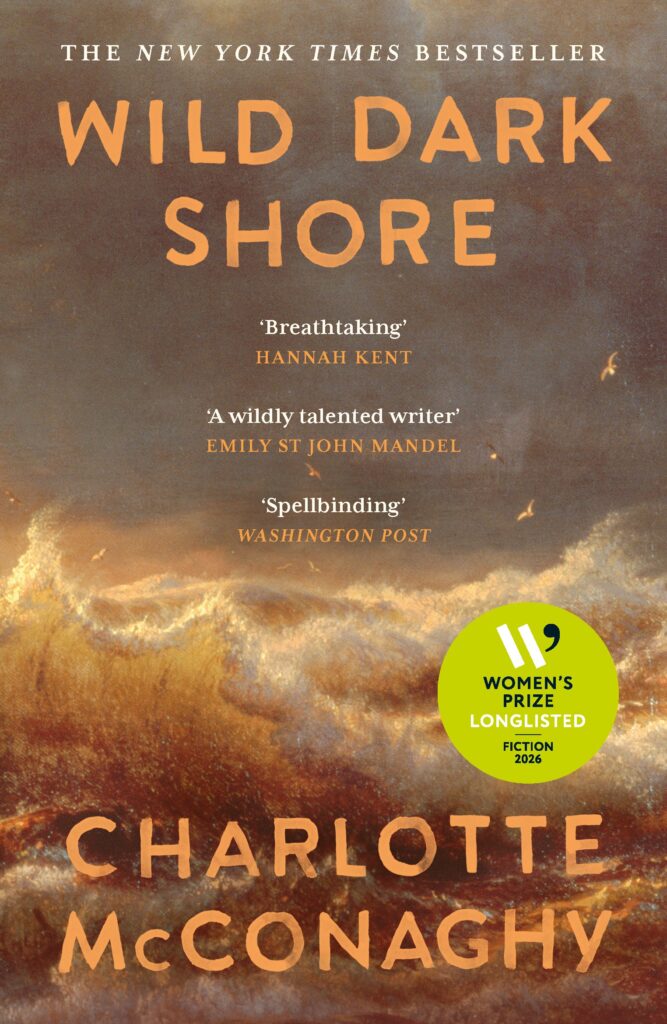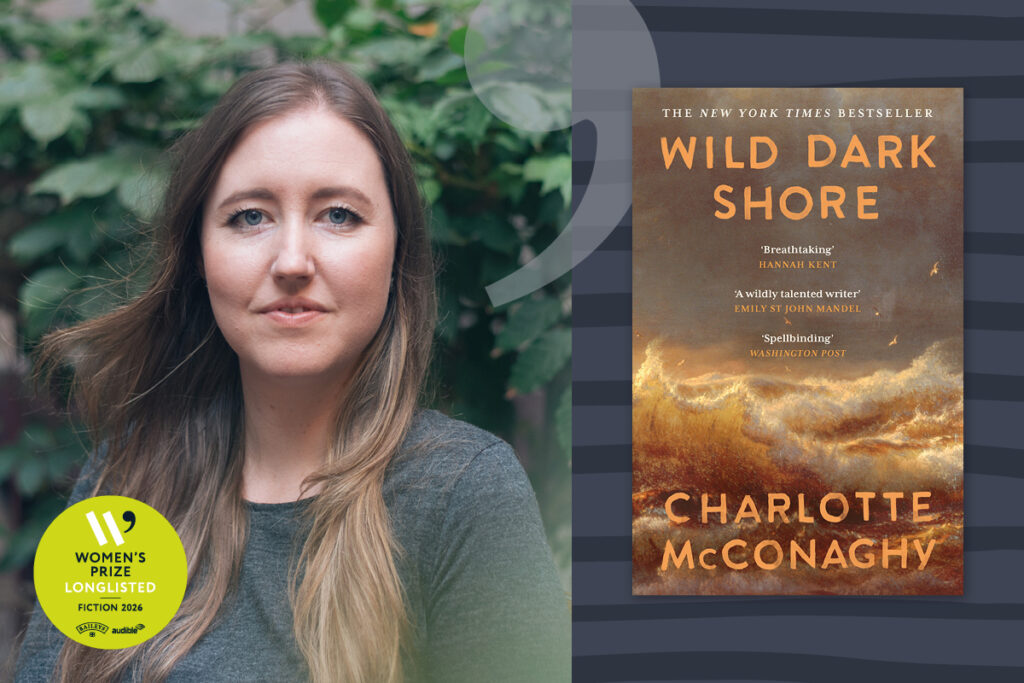
Wild Dark Shore by Charlotte McConaghy is a novel of breathtaking twists, dizzying beauty, and the impossible choices we make to protect the people we love.
Chair of Judges for the 2026 Women’s Prize for Fiction, Julia Gillard said: “Wild Dark Shore by Charlotte McConaghy is a haunting piece of climate fiction. Set on a sub-Antarctic island, the plot will have you on the edge of your seat to the last page.”
To learn more, we spoke to Charlotte about her inspirations, creative process, favourite authors and more.
Congratulations on being longlisted for the 2026 Women’s Prize for Fiction; how does it feel to be longlisted and what does it mean to you?
This is an extraordinary honour, one I never imagined receiving. The Women’s Prize is incredibly meaningful, influential and prestigious, so I count myself as deeply fortunate to have been recognised in this way by it. Thank you.
How would you describe your book to a new reader?
Wild Dark Shore is the story of a father and his three children who are living as caretakers of a remote and isolated island not far from Antarctica, a place that protects a vault full of the world’s strange and unusual seeds. This small family are the last inhabitants of this wild, dangerous place, until the night a storm washes a woman ashore. As they nurse her back to health they realise she isn’t being truthful about what has brought her here, and she quickly discovers that they too are keeping secrets that threaten to unravel them all. It is a gothic, romantic mystery about the interconnectedness of all living things, the difficulties of raising children in a time of ecological collapse, and the profound lengths we go for the people we love.
What was the idea that sparked your novel?
This novel came to me at the same time my children did, and so I knew it was going to explore the questions that were troubling me: how do we raise our children in a time of ecological collapse? In what ways do our responsibilities change? How do we teach them about the world and our part in it, how do we teach them what love means in the face of loss and impermanence? All my work explores in some way the wilderness both beyond us and within us, and so Wild Dark Shore needed to grapple with this idea in the context of also being a parent, or the decision not to be. The book also organically became linked to seeds when I learned about the Global Seed Vault in Svalbard, which was designed to protect the world’s most precious stock of seeds, to withstand anything and last long into the future, but when the only thing they didn’t foresee was that the temperatures would rise enough to melt the permafrost, the vault flooded. Learning about this sculpted the novel around the question of what we might choose to save, were we forced to make the hardest of decisions.
What did the writing process, from gathering ideas to finishing your book, look like?
I spent a long time researching and planning this book, but once I started writing I found I couldn’t connect to it; I wrote and rewrote the first quarter of the novel multiple times, exploring different perspectives, different points of view. I think because I didn’t have a sense of the strange place I had chosen to write about, I was struggling to make decisions about form and craft that would normally have come naturally to me. It became undeniable that I needed to go to Macquarie Island, which was the place upon which I had based my own fictional island, but this wouldn’t be easy, not only because it is a remote and difficult place to reach, with one boat that travels there at one time of the year, but also because I had just had my first baby. Despite all my misgivings we took him with us, and it was an extraordinary experience, exploring this truly wild island, its rich wildlife and its violent history. The trip revealed to me that this was in fact a gothic mystery about a family haunted by ghosts, in a place haunted by ghosts. This textural and tonal revelation allowed me to finally understand my characters deeply enough that when we got home from the research trip, I knew how to structure the story using multiple points of view, and so I was able to write the first draft quickly in a little over a month.
Which female author would you say has impacted your work the most?
Maggie O’Farrell’s work in Hamnet was a beautiful lesson for me in how it is possible to write about the most profound kind of loss in a way that is life-affirming. Her characters are always rich and complex and just so engaging, they challenge me to think more deeply about my own character work.
What is the one thing you’d like a reader to take away from reading your book?
Aside from feeling deeply moved by the human capacity for love, courage and sacrifice, I hope readers feel inspired towards purpose. I hope they feel energised and galvanised towards that purpose, and encouraged to think about their own impact on this world, and the decisions they can be making to ensure that impact is a positive one.
Could you reveal a secret about your creative process? This could be where you like to write, a unique writing ritual you have to unlock creativity, or how you go about writing.
I always write to music. It helps me to sink into the right flow state, where the words feel like they’re flowing through me instead of coming from me. All of my favourite scenes are written because of my favourite songs.
Why do you feel it is important to celebrate women’s writing?
Literature is a historically male-dominated space. We see this in major literary prize winner statistics, we see it across lists of most popular books of all time, we see it in the books that are studied in schools. The Women’s Prize became a vital means of correcting this imbalance, but during a time where women’s bodily autonomy is being stripped away, where women’s books are being banned in schools around the world, where women are having their rights dismantled, it has never been more important to celebrate the ways in which we invite each other inside the interiority of women’s experiences, the ways in which we amplify these rich and diverse stories. Reading is fundamental to our humanity because it allows us to connect with new perspectives, to understand and empathise with each other; it teaches us how to be. To fail to celebrate women’s writing would be not only a disservice to women, but to everyone.