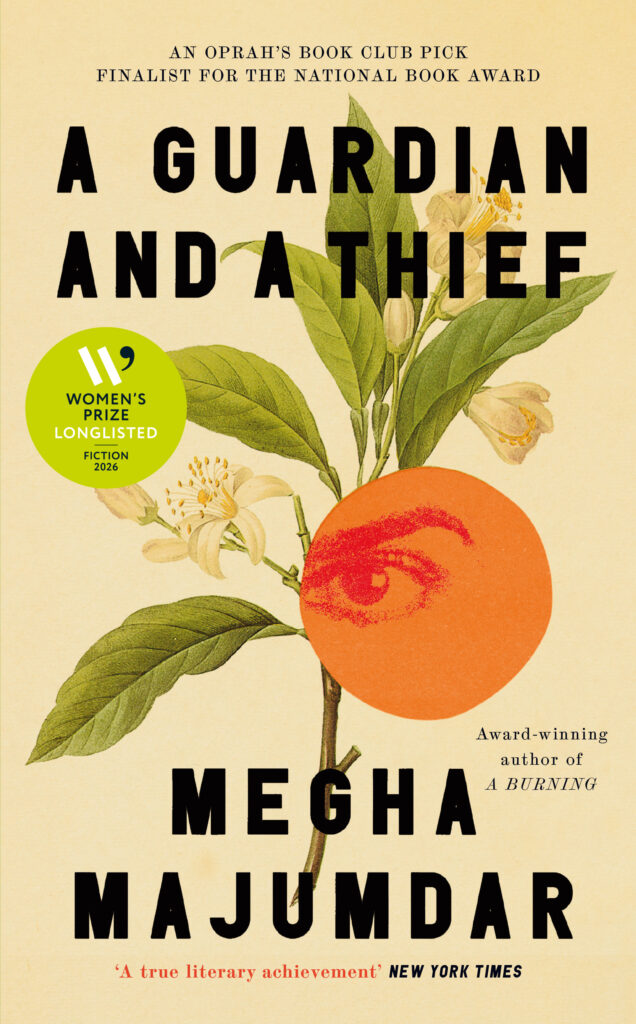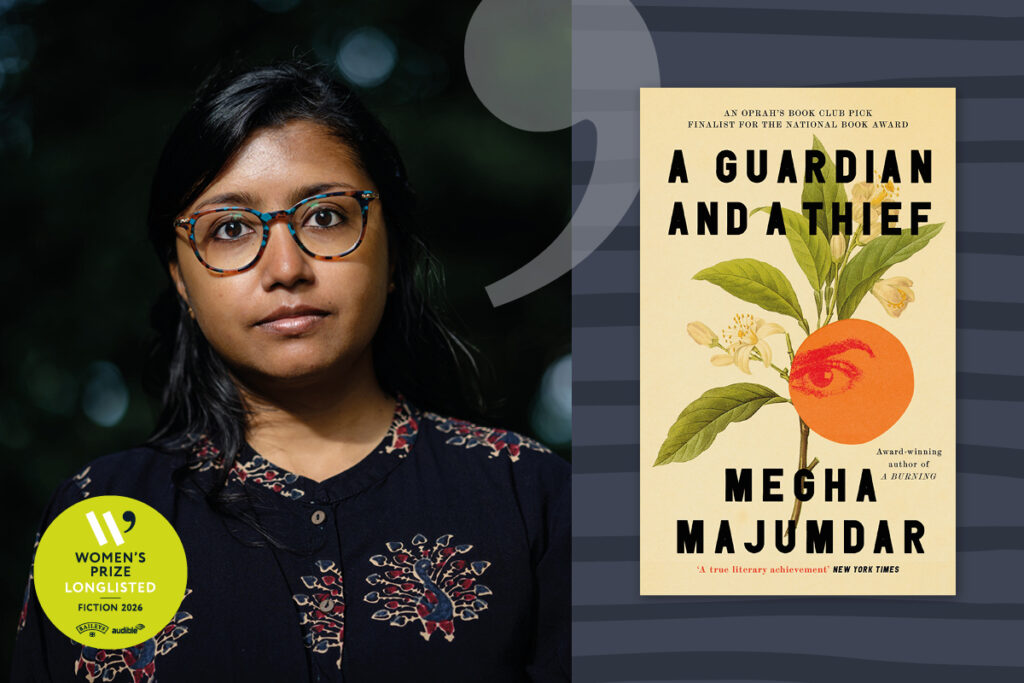
Megha Majumdar’s kaleidoscopic portrait of families, A Guardian and a Thief, takes us to near-future Kolkata devastated by flooding and famine, raising pertinent questions about the moral ambiguity of humanity and the extent to which parents will go for love.
Longlisted for the 2026 Women’s Prize for Fiction, judge Annie Macmanus said: “A Guardian and a Thief by Megha Majumdar follows a family in a near future Kolkata in the midst of the climate crisis. Incredibly well-written, it is a book about the moral ambiguity of humanity that constantly challenges the reader.”
To learn more, we spoke to Megha about her inspirations, creative process, favourite authors and more.
Congratulations on being longlisted for the 2026 Women’s Prize for Fiction; how does it feel to be longlisted and what does it mean to you?
I feel astonished, and delighted! It feels quite surreal. I’ve followed the honoured books and authors since the days when the Women’s Prize was called the Orange Prize, and to see my book on this list is astonishing.
How would you describe your book to a new reader?
A Guardian and a Thief is a novel set in a near future Kolkata, India, a time when climate change has wrecked the city and there’s a severe food shortage. In this crisis, two families who are seeking to protect their own children come into conflict. The book is interested in climate change, migrations, the future of food, and the question of how to live a moral life when our morals and our love for our children are opposed to each other.
What was the idea that sparked your novel?
My hometown of Kolkata, India, is one of the cities in the world that’s most profoundly affected by climate change. (A UN IPCC report published a few years ago stated that, since 1950, Kolkata has seen the highest increase in mean temperature of any major city surveyed. By the year 2100, Kolkata is predicted to flood more frequently and endure more storms.) Reading about climate change in Kolkata made me curious about what the lived experience of it might be. I had memories of very hot days growing up, walking outside in a heat wave and my shoes sticking to the melting tar of the road. From there, I imagined crops destroyed by pests and drought, resulting in markets without our familiar fruit and vegetables, with seaweed on offer instead. I imagined human bodies struggling to cool themselves, and needing, say, cooling garments. That’s how I entered this world.
In all my reading, I encountered repeated declarations of hope, and I grew interested in the complexity of hope in a time of crisis, not on the scale of nations or systems, but in the life of a person. What if, in the context of an unstable world, hope becomes morally impure, sly, vicious? When an adult steals an orange from a child to feed their own child, is that an erosion of their humanity or the most uninhibited expression of who they are? I grew interested in the gap between who we want to be, and who we truly are. So the book began circling those questions of moral life.
And finally, I had my son in 2021. Becoming a parent helped me find the emotional core of the book. How might a parent hold on to their moral center while knowing that they would do anything to protect their child? Who might a mother become in a time of crisis?
What did the writing process, from gathering ideas to finishing your book, look like?
It was a lot of failed drafts, failed directions, failed characters, and a lot of rewriting and revising over the course of 6 years. Now I feel that every moment of failure lit the path here.
Which female author would you say has impacted your work the most?
Amy Hempel.
What is the one thing you’d like a reader to take away from reading your book?
I’d love for them to think about how they make moral choices in their own life. How do they make decisions about right and wrong? What of their morals do they surrender, and what do they hold on to?
Could you reveal a secret about your creative process? This could be where you like to write, a unique writing ritual you have to unlock creativity, or how you go about writing.
The secret is to encounter many failures, feel deep disappointment each time, but never question the worth of the project.
Why do you feel it is important to celebrate women’s writing?
The vastness of this category is beautiful. Women’s writing is Tania James’s lush and maximalist Loot and Amy Hempel’s spare stories. Women’s writing is Celina Baljeet Basra’s unconventional and funny migration novel, Happy, and Sindya Bhanoo’s powerful stories of displaced women. The specificity and richness of each voice is worth lifting up and celebrating.