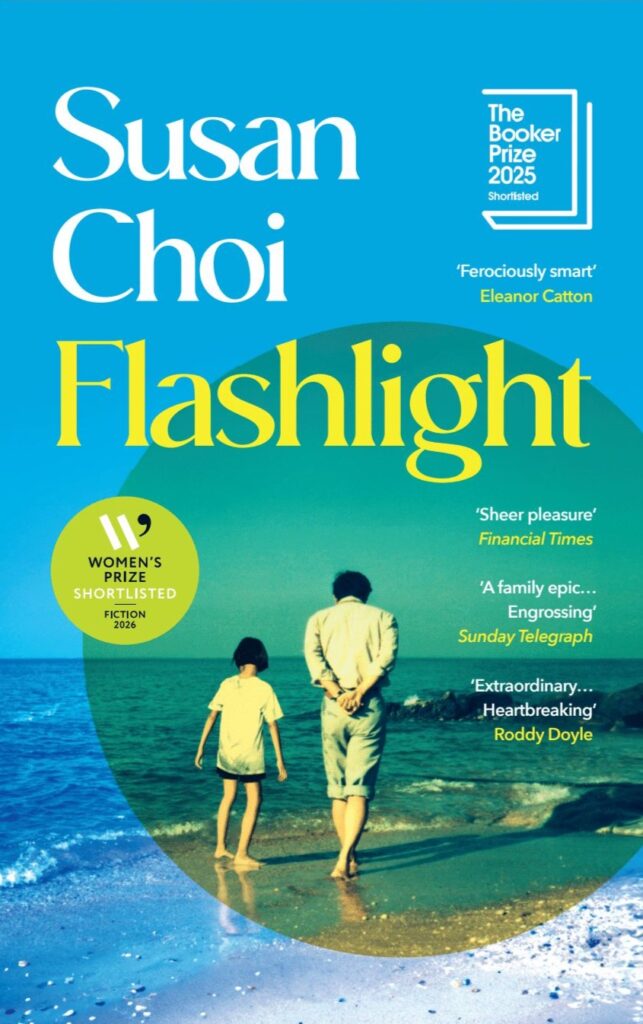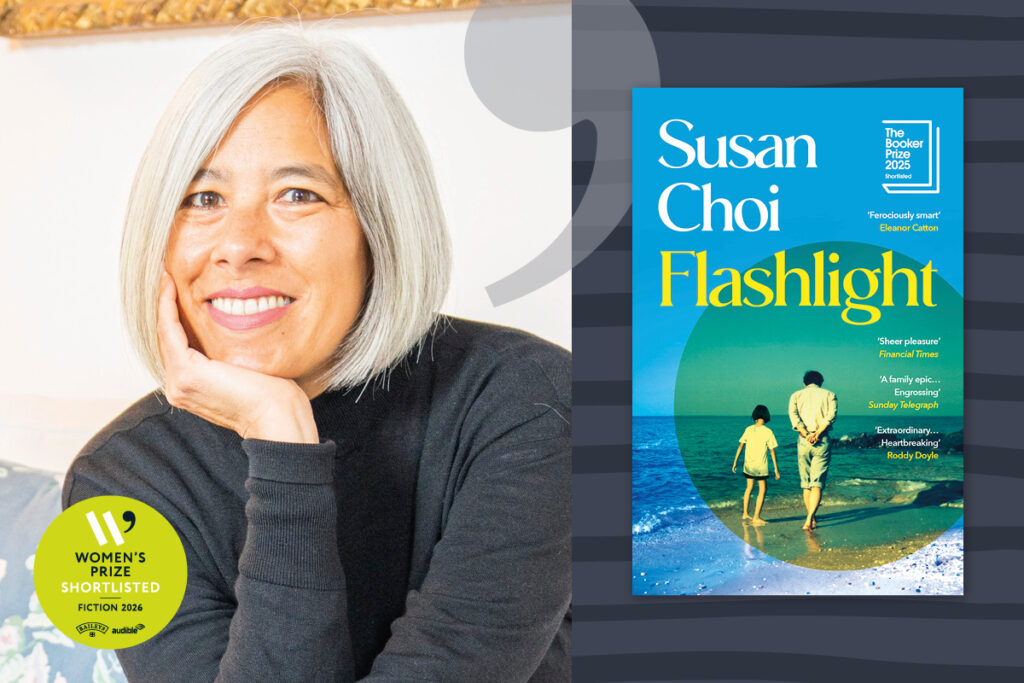
In Flashlight, Susan Choi presents an illuminating historical family saga propelled by a father’s disappearance, and explores the traumatic consequences over generations and geographies.
Shortlisted for the 2026 Women’s Prize for Fiction, Chair of Judges Julia Gillard, said: “Flashlight by Susan Choi is a family and historical drama that constantly surprises and intrigues with luminous writing. Set against the backdrop of one tragic event, the mystery plays out over heart-rending decades.”
To learn more, we spoke to Susan about her inspirations, creative process, favourite authors and more:
Congratulations on being longlisted for the 2026 Women’s Prize for Fiction; how does it feel to be longlisted and what does it mean to you?
I’m thrilled and completely surprised. I didn’t have it on my mind at all and that’s the best sort of condition to be in when an honour like this falls into your lap.
How would you describe your book to a new reader?
It’s the story of a family who don’t know each other as well as they should, and who suffer an enormous shock they aren’t able to truly understand. Mainly the book follows them as they come to understand what really happened to them, and find their ways back to each other as best they can.
What was the idea that sparked your novel?
I’d become fascinated by a series of missing-persons cases in Japan in the late 1970s that all turned out to have the most astonishing explanation. I’d spent a short time in Japan in the last 70s myself, and so I wanted to see if I could draw on my childhood memories while crafting a novel around these other events I learned about much later.
What did the writing process, from gathering ideas to finishing your book, look like?
It looked very long and full of a lot of discouragement, but all of my novels have been like that. It takes me a long time to figure out how the story will work, and once I’ve begun writing I almost always find that whatever I had figured out in advance of the writing wasn’t enough, and a lot of problems have to be solved along the way or in revision. Plus, with this book I had to do a lot of research – a long preliminary period of research that was broad, and then many later more focussed bouts of research on specific subjects.
Which female author would you say has impacted your work the most?
Both Virginia Woolf and Alice Munro have taught me so much about how to write that it’s hard to imagine I ever could have written anything without having read them.
What is the one thing you’d like a reader to take away from reading your book?
That our lives are subject to so much contingency, so much that is beyond our control, that the best thing we can do is strive to care for other people as best we can.
Could you reveal a secret about your creative process? This could be where you like to write, a unique writing ritual you have to unlock creativity, or how you go about writing.
If I reveal it, it won’t be a secret any longer though, will it? But my process really doesn’t have secrets. I’m very messy and spend much more time not knowing what I’m doing than the opposite, and it has never gotten any easier but I’ve become more relaxed about how hard it is; I know that’s just how it always goes.
Why do you feel it is important to celebrate women’s writing?
It’s important to celebrate all writing, and at the same time women writers have been so to speak walking upwind since time immemorial to receive their fair share of recognition. Any way of lessening that resistance is a good thing – writing is hard enough all on its own.