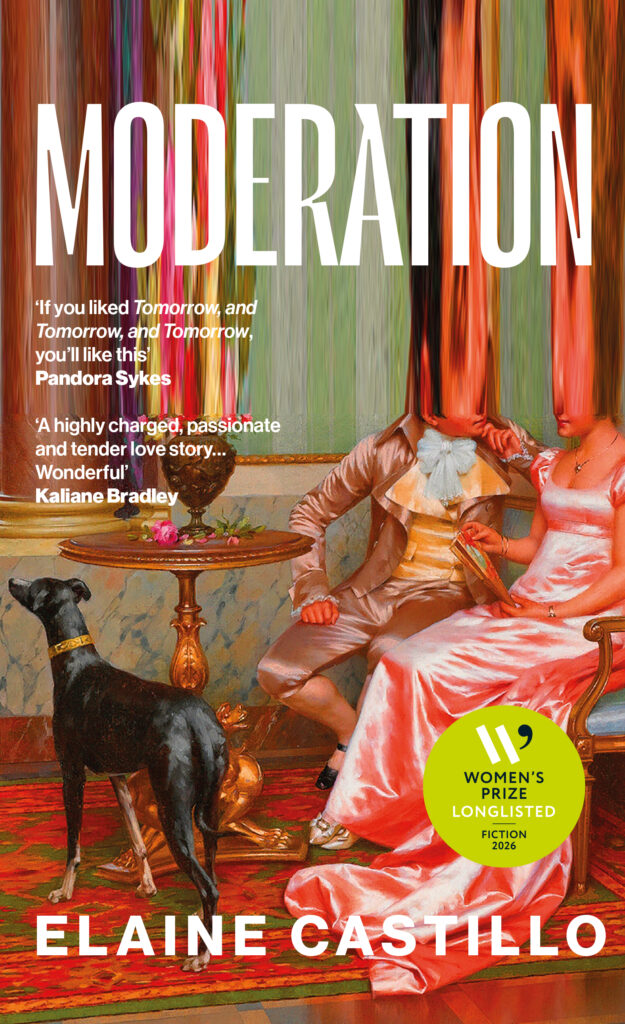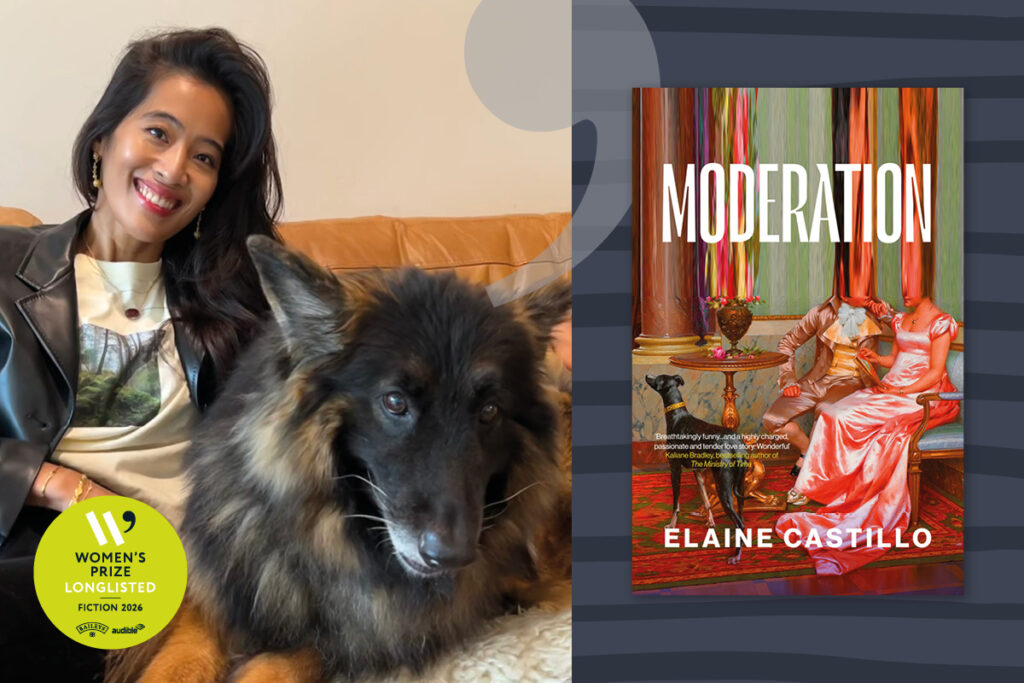
Tackling questions around censorship and the age of AI, Moderation by Elaine Castillo uses the lens of a real romance in the virtual workplace to explore the possible future of love in an increasingly online world with sharp cultural criticism and wit.
2026 Women’s Prize for Fiction judge, Annie Macmanus said: “Moderation by Elaine Castillo, told from the perspective of a young Filipino who works in tech, asks big questions about technology and AI, but is a love-story at its heart – I couldn’t put it down.”
To learn more, we spoke to Elaine about her inspirations, creative process, favourite authors and more:
Congratulations on being longlisted for the 2026 Women’s Prize for Fiction; how does it feel to be longlisted and what does it mean to you?
An absolutely surreal honour, made even more meaningful not only by the significance of the Prize itself, but the fact of it being based in the country I called home for so many years. Moderation is in many ways a valentine to the years I lived in London, so this feels like getting a little valentine back.
How would you describe your book to a new reader?
As an unlikely love story. Ultimately, Moderation is a novel about the people who do the invisible dirty work that makes all of our Internet activity possible — focusing on one woman in particular, and imagining her past, present, and hopeful future. It’s a novel about gendered labor and the dystopian nature of contemporary tech, but one that nevertheless refuses to tell yet another story about tech dystopia; a novel about debt, diaspora, and family in the atomic half-life of the post-2008 economic crash; a novel about the ominous world-building ambitions of our most boring tech oligarchs; and at heart, a novel about love, connection and repair as forms of world-building in their own right.
What was the idea that sparked your novel?
The first article I read about content moderators was back in 2014, and it was Adrien Chen’s seminal article in Wired, which described the harrowing and largely invisible work of their work — and in that article, the moderators described were mostly either from the Philippines or Fil-Am labourers in the States. It reminded me that a cousin of mine may have been a moderator (she’d had to sign an NDA, and so never spoke about the work, and didn’t stay in the job long, which is also typical). It wasn’t difficult to draw the links between contemporary content moderation and other forms of racialised, colonial labor that so many in my community performed: all the nurses, security guards, and cleaners who raised me.
That combined with the fact that in my second book, a collection of essays published in 2022 called How to Read Now, I wrote briefly about Jane Austen; particularly a museum that had attracted not a small amount of fervour around the fact that they dared to mention Austen and her family‘s ties to the transatlantic slave trade (including the fact that her father was a trustee of a sugar plantation in Antigua), contextualising the wider colonial reality that is the invisible foundation for all of Austen’s works and worlds.
Writing about that controversy must have planted a seed in my head: if I were to write a Regency novel, or imagine an Austen-like heroine, how would I do that? And could I write one that would explicitly historicise its version of Elizabeth Bennett in the labor and colonial conditions that made her world possible—one that would even imagine her as one of contemporary society’s most exploited workers?
Because Girlie, the protagonist of Moderation, is a content moderator; one who specialises in flagging online content depicting child sexual abuse. She’s essentially one of the frontline workers of the Internet. Much of the research I did around content moderation was deeply harrowing and punitive — but not nearly as harrowing and punitive as the reality of the labor that makes the Internet as we know it possible. Yet the task of fiction can also be not reducing a character to the most harrowing part of their lives, which was why it was so important for me to shift genres in the novel and ultimately write a love story: to imagine the fullness of Girlie’s life, beyond just being yet another tragic, exploited figure in yet another tale of tech dystopia. Why shouldn’t a modern content moderator be a grand, complicated romantic heroine?
What did the writing process, from gathering ideas to finishing your book, look like?
I started writing the early bones of what would eventually become this novel sometime in 2018, around the same time my first novel America Is Not the Heart came out. I’d just published this sprawling immigrant family epic, and I knew I wanted to shift and write a leaner, more sci-fi-inflected novel. Then I got distracted writing the essays that became How to Read Now, and it was only around 2022, 2023, that I slowly started drawing together the threads of ideas that had been floating around in my head for years, and which found their way into Moderation: the racialised labor of content moderation and its links to other forms of labour in my Filipino family history; the St. Louis Fair of 1904, and its virtual reality vision of the colonial world (where indigenous Filipinos were once displayed like carnival attractions); even a real-life historical theme park in France that was gaining media attention for its controversial (some would say far-right friendly) take on Western history.
That said, with my first novel, I used to joke that I didn’t believe in side characters; if someone was showing up for one scene, you’d find out the history of their entire family line, their grandma, their third cousin. But I knew I had to move into a different space with this novel. In my first novel, I was writing about a close-knit community, but in Moderation, that community has been decimated, and most of the novel focuses on encounters between strangers in a workplace, with all the hierarchies and divisions that such an environment (especially one in tech) presents. It became clear that the storytelling device of omniscience would be unhelpful to that project.
Instead, what I found most emotionally and structurally urgent was staying with the characters in their ignorances, their lacunae, their closed off rooms, so as better to be by their side during their epiphanies; all the moments when the world, all of a sudden, surprises. What it meant practically is that — as someone who tends to over-research her way into a book — for the first time, I just had to let myself leave things unsaid, stones unturned. I also knew I wanted to write a shorter book than my first, which was its own challenge; as someone with a long-form brain, I always say if I ever write a short story, it’ll be a career highlight (see also: the length of these answers).
As for finishing the book, I did also struggle with an alternate last chapter for the novel. I’d written multiple endings, none of which felt quite right, all of which felt much safer and tidier than the ending I did finally write. One was a much less romantic, more explicitly labour-resistance-focused ending; another was a kind of sequel to my first novel. They were endings that felt like affirming my own political bonafides, rather than serving my characters’ true needs.
But how could I write a finale of collective repair if I wasn’t prepared to write the daily minutia of personal, intimate repair? The opening chapter of Moderation, graphic and harrowing as it is, is fundamental to the journey Girlie goes through in the book to get to the last chapter: that underlying violence is a fundamental part of experiencing who she is, where she comes from, what she’s had to do to survive, and therefore why her love story matters — what its stakes are. This is particularly true when some of her own past experiences around sexual violence and formative harm become apparent. As someone who’s experienced some of the same formative harm Girlie has, I also want to imagine post-traumatic joy, not just despair: to imagine post-traumatic sexual and romantic desire, pleasure, humour, connection, and repair.
That was also why — even as I struggled with which exact ending to write — I did know one thing: that I wasn’t going to write an unhappy ending. Fredric Jameson notoriously said it was easier to imagine the end of the world than to imagine the end of capitalism — and since nowadays we seem to be playing an apocalypse speedrun, it often feels like it’s easier to bring about the end of the world than to imagine a different one. But for me, the urgency of imagining a happy ending — or, to put it another way: the urgency of imagining a future based on something other than unending harm and despair — was at the heart of why I was writing this novel in the first place.
Which female author would you say has impacted your work the most?
Toni Morrison: her art, her conviction, the shape of her mind, the depth and breadth of her inimitable feeling-thinking, the sharpness of her joy and vigour, most of all her commitment to making art commensurate to the world as it was, as it is, as it can be. She’s a literary canon all in herself.
What is the one thing you’d like a reader to take away from reading your book?
A galvanising vision of love and repair — and a novel that doesn’t limit Girlie’s story to one of exploitation and opposition, or presume that her entire narrative arc should focus on the punitive nature of her job, or even about fighting the known evils of tech — all of which would be easier and familiar narrative choices (and ones that would ultimately still centre the oligarchs that reign over her world). What I’m interested in, and what I hope readers will take away, is something that lies outside that narrow scope: a novel about labour, exploitation, and our chillingly possible sci-fi future that also conceives of unexpected love, humour and the erotic not as forms of escapism, but as vital forms of expansion, transformation, and resistance. As ways of making a future we might actually want to fight for, and live in.
Could you reveal a secret about your creative process? This could be where you like to write, a unique writing ritual you have to unlock creativity, or how you go about writing.
The true secret of my creative process for this book: much of it was written while also simultaneously playing tug with my rescue German shepherd, Vincent. I highly recommend the method to all, but it may make you miss some deadlines.
Why do you feel it is important to celebrate women’s writing?
Well, we can’t say we love world literature, and not be interested in the literature of half of the world. But in this I’m reminded of Toni Morrison’s great riposte to Charlie Rose—lest we forget, fired from his PBS show after multiple in-house accusations of sexual misconduct—when the latter asked her if she “could ever imagine writing a novel that’s not centred about race.” Morrison rightly pointed out that, well, “Tolstoy writes about race, so does Zola, so does James Joyce”—that these and similar questions evince certain assumptions, not just about who is and isn’t raced (or indeed gendered), but about whose lives are worthy of being imagined in art, and how, and by whom. To celebrate writing without celebrating women’s writing is to celebrate something else altogether.