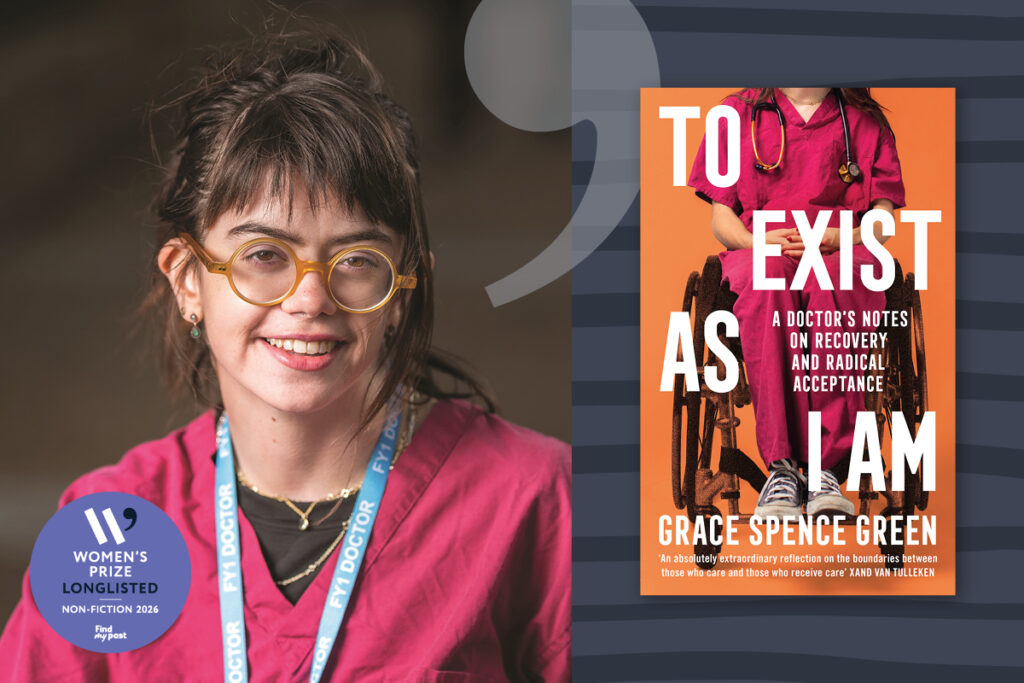
Chronicling author Grace Spence Green’s journey from idealistic medical student to spinal-injury patient, and then qualified doctor and vocal disability activist, the grippling honest To Exist As I Am is a vital account of care, what it means to heal, and the many shapes recovery and self-acceptance can take.
Longlisted for the 2026 Women’s Prize for Non-Fiction, judge Nicola Williams says: “To Exist As I Am demonstrates how it is possible to turn the most horrific misfortune into a force for advocacy and change – it is a poignant account of resilience, and an accessible and powerful memoir. I absolutely loved it.”
To learn more, we spoke to Grace about her research, writing process, inspirations and more.
Congratulations on being longlisted for the 2026 Women’s Prize for Non-Fiction; how does it feel to be longlisted and what does it mean to you?
I am truly thrilled, as a first-time writer it’s hugely validating. To be given the opportunity through this to meet a community of female writers that I admire so much is the real gift, and it’s made me really excited for the year ahead. I have been feeling in a bit of a rut with writing and reading so this has been the perfect thing to liven me up.
How would you describe your book to a new reader?
A raw, honest and hopefully thoughtful exploration of disability, of care, of independence and community.
What inspired you to write your book?
3 days after my injury, once I was moved out of HDU and had my laptop again, I began to write. For me, I don’t think I was ever inspired to write. It felt like something that was absolutely necessary, that had to be put on paper, whether or not anyone would read it. What is the most wonderful thing was people do seem to want to read it! I guess I could say I was inspired to take back control of my dialogue that I felt I had lost.
What did the writing process, from gathering ideas to finishing your book, look like?
Long, scattered, chaotic at times! I had to grab small moments constantly, particularly when working as a foundation doctor. Sentences in phone notes, emails to myself, scraps of paper, waking up in the middle of the night to write something down before it was lost into the sleep ether. Writing this book felt like a constant humming in the back of my brain that wouldn’t stop until it was finished.
When I lacked ideas, I tried anything, I bought and repaired an old typewriter which I used for a brief period (until my husband vetoed the constant click clack of keys!), I started recording voice notes on my way to work (which ended quickly after finding it too painful to listen to the sound of my own voice). If I couldn’t write I’d read and vice versa. I just wanted to do something every day that would be meaningful for the book. Even new experiences that I wasn’t sure would go well, or might be difficult – if anything, I would tell myself, it will be good for the book! Time was such a gift for me, I needed time to have passed since my injury. As if some things needed a long time to float to the surface.
How did you go about researching your book? What resources did you find the most helpful?
It helped I had sort of researched before starting this book in a bid to learn more about the disabled community I now wanted to feel a part of. I was desperate for connection with other disabled people, ones that were still alive and ones throughout history.
I used reading as a trail; I would read one disability theory book which would mention another so I would find that one and so on.
Which female non-fiction author would you say has impacted your work the most?
In terms of disability, Alison Kafer’s Queer Crip Feminist was an introduction to disability theory and spoke with unflinching clarity I had not come across before. Rebekah Taussig’s personal story Sitting Pretty is joyous and beautifully written and really helped me realise I was a part of a community, a bigger story. Other non-fiction I love is anything Susan Sontag has written; her curiosity is wonderful. Patricia Lockwood’s memoir Priestdaddy is incredibly funny and beautiful.
What is the one thing you’d like a reader to take away from reading your book? Is there one fact from the book that you think will stick with readers?
I want people to question things, to turn things on their head. That if we can be honest with ourselves and each other, honest with our own lack knowledge, with our own bias, we leave ourselves open to connection, to understanding.
Why do you feel it is important to celebrate non-fiction writing?
I find reading non-fiction is the fastest way to gain some human connection, to not feel alone in the world. Often fiction receives more of the glamour, but I think writing non-fiction, writing truth with no guise of fiction, can be incredibly brave.
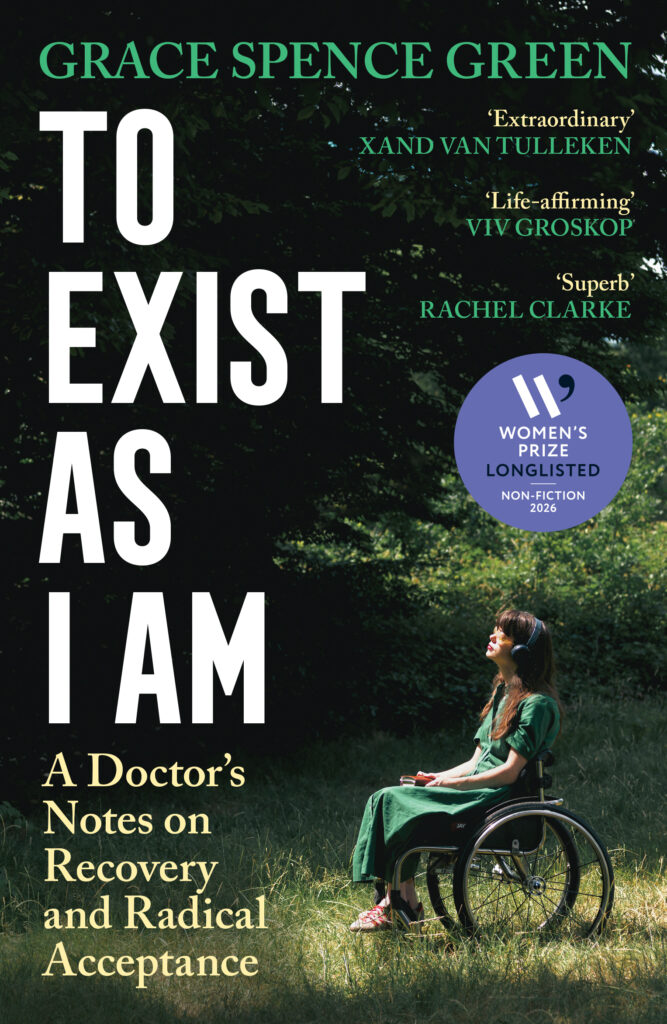
To Exist As I Am: A Doctor’s Notes on Recovery and Radical Acceptance
by Grace Spence Green
Find out more