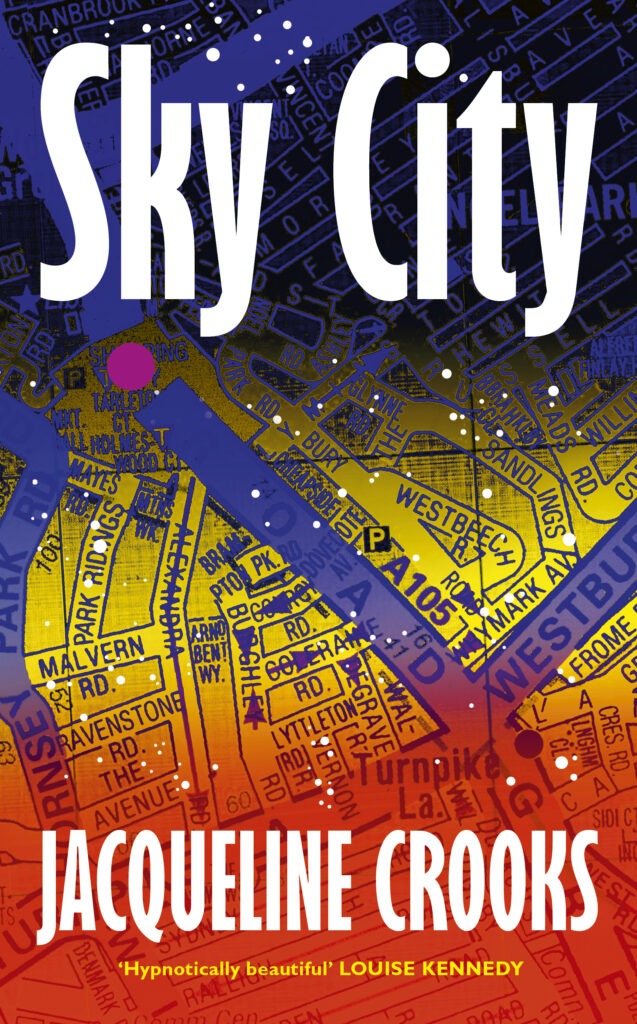
Following the publication of her acclaimed and award-winning debut, Fire Rush – shortlisted for the Women’s Prize for Fiction in 2023 – Jacqueline Crooks returns this year with her new novel, Sky City, and reflects on the unique challenges of writing the sophomore novel from embracing uncharted territory to seeking inspiration from visual art and architecture.
Writing a second novel requires, I believe, a certain rewiring of the mind. My new book demanded that of me. I didn’t want to draw on what I had learned from writing Fire Rush. And, anyway, I don’t think that experience was transferable. Also, it might have complicated the process of writing book number two, shut down new ideas and ways of working.
What I carried forward was not technique but an attitude. Specifically, a commitment to experimentation, exploration and risk; a determination to keep searching for overlooked voices and worlds.
It’s important to ask different questions and use different literary tools. Writing a second book, I decided to abandon certainties. Here are some of the approaches I used while writing my second novel, Sky City.
Unfamiliar Territory
For me, writing is a search for answers to urgent questions that have followed me for many years. Those questions are powerful enough to override thoughts of expectation, particularly the desire for success. I think it is important to write a novel – especially a second novel – from a place of freedom. If your first book has been successful, whether critically or commercially, there can be a temptation to repeat what worked before. But the questions that drive the work are often asking you to go into unfamiliar territory, both on the page and within yourself.
In writing Sky City, curiosity became more important than certainty. Sky City grew from a desire to write about a lost world: the London of the 1980s where I once lived. London is a place with its own hidden language. Known and unknown routes, voids, and places of sanctuary such as Sky City, the hidden housing estate above Wood Green Shopping City.
The novel has been described as ‘a lyrical hymn to London’s overlooked places of sanctuary’, which comes close to what I was trying to achieve.
The second novel asks for a kind of forgetting. Fire Rush was loud, a book of revolution and rebellion. To write it, I tuned into a bombastic energy. To write my second novel, I had to tune out that story. Sky City is quieter and more internal. During the writing process, I retreated further into myself than I had with Fire Rush and searched for a different language.
I was not chasing the success of Fire Rush where my ambition was to find a dub reggae language. With Sky City, I wanted to write through the experience of someone who is dissociated and outside reality. Like the protagonist, I was drawing on lived experience and a different version of myself.
With every new work, I believe that you should only return to the certainty of what you are searching for as a writer. You have to be prepared to write from and into new territory.
Writing the City
Begin with the theme you feel most strongly about. For me, it was loneliness in cities and the performance of city life: people acting as though they are anything but lonely. I was interested in the many ways city dwellers conceal their isolation. We perform connection, busyness and purpose while often feeling disconnected, cut off from one another, and living at the margins. The idea of loneliness as a form of performance became the starting point for the novel.
I was fascinated by those who had passed through Sky City before me, those who lived there when I did, and those who would come after. The place connected them all despite their isolation. In that sense, it became a witness to their lives. I like to animate places and sites of sanctuary, allowing them to become characters in their own right. Buildings absorb the traces of the people who move through them. They carry stories long after their inhabitants have gone.
Loneliness in cities is inevitable. Loneliness as a writer is inevitable too. In writing this book, I gave myself over to it. Rather than resist it, I tried to find its beauty: the way it illuminates the self, builds resilience, and reveals how much exists beyond the material world for us to engage with, imagine, vivify and write about. It allowed me to push through with the second book, to immerse myself more deeply than I had with my first book. I learned that loneliness is not always an absence. Sometimes it is a space of attention, reflection and discovery. I think of this as the art of loneliness.
Dissociation, Fragmentation
I think writing requires immersion and, to some extent, a kind of dissociation. You enter the world of the book fully, listening closely to its tones, rhythms and textures, while also hovering slightly outside it, allowing something deeper and less conscious to emerge. During the writing of Sky City, there were many days when the work seemed to take the lead, carrying emotional and psychological truths that I could not yet explain. Voice carries knowledge that logic cannot always reach in a first draft. By following it, I often discover what the book is trying to become.
I try not to resolve everything too early. Psychological fragmentation is central to this second book, functioning both as a theme and as a survival mechanism. I learned to sit with fragmented drafts, to observe them patiently, and to allow coherence to emerge organically. Writing is an act of working with fragments—ideas, characters, images, memories and materials—and paying attention long enough for meaning to reveal itself.
Structure, Architecture
With my second novel, I felt more confident in structuring the book while still allowing myself to experiment. With my first novel, structure caused me a great deal of anxiety and many writing lows. Writing a second book taught me to seek structural ideas from the themes of the story itself, or from visual art, architecture, music, and soundscapes—anything that might offer a way in.
For Sky City, I worked closely with the architectural plans of the building itself. They provided a strong foundation from which I could move into more immaterial language and gave me ideas for the structure of the novel. I drew on these images not only to shape the structure of the story but also its world-building, language, mood, and the building’s presence as a character in its own right.
Writing a second novel gave me the confidence to be bolder because I knew that if something did not work, it could be excised, deconstructed, or adapted. Nothing is ever entirely lost. The ghosts of discarded structures and characters continue to hover beneath the surface of the final story.
Sky City is a novel about impossible geometry and the ways cities can exist beyond straight lines and singular minds. Although it is told through both third- and first-person narration, the structure somehow allows the voices of other characters to enter the space and resonate within it.