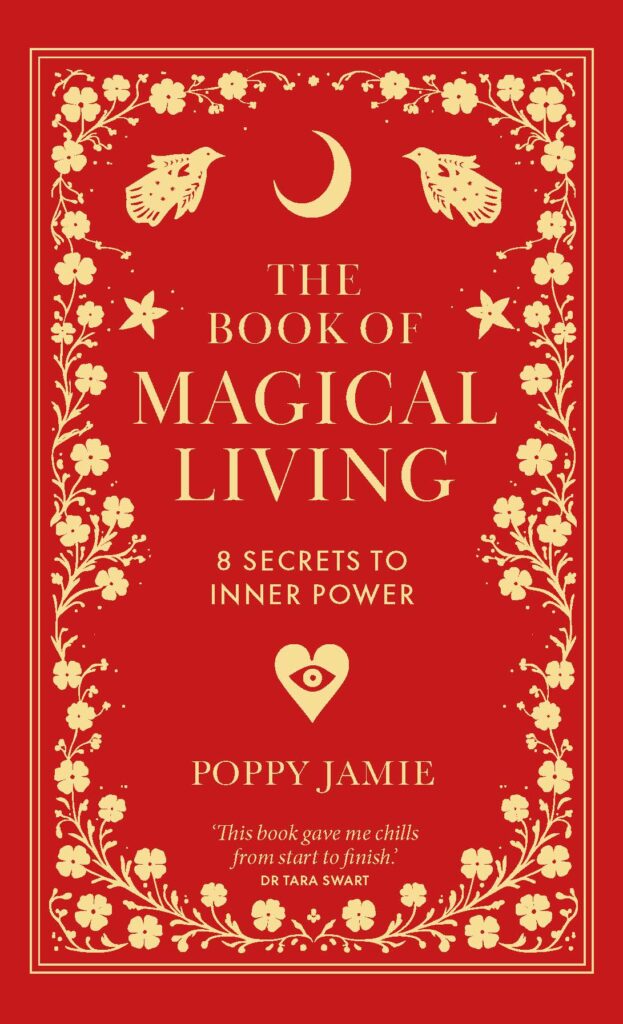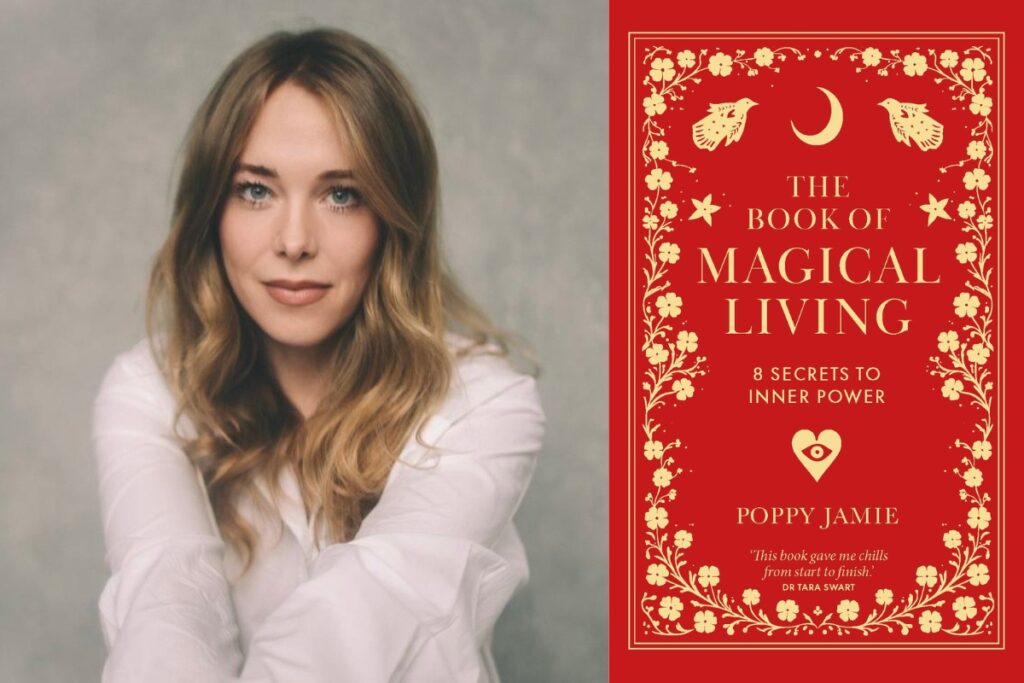
How can we trace and rediscover the ancient wisdom of women forgotten by history? In this fascinating conversation, the author of The Book of Magical Living explores why forgotten female knowledge still matters, how feelings of synchronicity and intuition should not be so easily dismissed, and why magic may be far more real than we think. From café writing sessions to research rabbit holes, Poppy shares the inspirations, rituals and discoveries behind her extraordinary new book.
What inspired you to write The Book of Magical Living?
I am most motivated to write when I feel part angry and part inspired. The Book of Magical Living encapsulates both emotions. I have always been inspired by the psychology and history of ancient magical wisdom, but troubled by how much of it we have lost. Ask people to name the great wisdom keepers of the past and a stream of names comes tumbling out: Descartes, Plato, Marcus Aurelius. Yet almost never a woman. Historical women’s wisdom has been largely extinguished, a process that accelerated when wise women were branded ‘dangerous witches’. The very knowledge that had soothed and saved lives for thousands of years became a death warrant. The same women who birthed our ancestors and comforted the dying were the ones punished and excluded. This book was a way to right some of these wrongs in my own small way, by redefining what a witch truly was and is. Far from a cauldron-stirring, malicious creature, a witch is a woman deeply connected to her intuition and the world around her; she is a keeper of wisdom who uses her power to help others. The Book of Magical Living celebrates this close-to-forgotten witch wisdom, once driven to the very brink of persecution, and highlights how its most surprising and unexpected ally is science.
New science is now validating ancient magical wisdom. What early civilisations understood to be true about life, from spiritual beliefs to old wives’ tales, is increasingly being confirmed by measurable tools. Thousands of near-death experience accounts share uncanny similarities. Emergency-room staff notice a busier, stranger flow of patients when the moon is full. Around 75% of people admit to telephone telepathy, that peculiar sense of knowing who is calling before you answer. Mystical happenings aren’t so ‘woo woo’ after all. And perhaps the most magical discovery of all is also the most rigorously proven: the placebo effect, where your belief and expectation can change your biology and shift what is real. Invisible forces, it turns out, can have visible impacts.
The sceptical mind is quick to dismiss anything that lives on the fringe of ordinary existence. The idea that life communicates with you through signs sounds laughable, until it happens to you. Until you meet the love of your life on the very night you almost stayed at home, or that life changing idea suddenly pops into your head for no apparent reason at all. Just as bumblebees navigate along unseen magnetic lines, what force threads through each of our lives, guiding, directing, leading? These are the questions that fill me with excitement to share. They are what motivate me to write and seek out some of the most energetically powerful people I could find. Nothing has changed my life more than what now resides inside this book. I lie awake most nights wondering what else early civilisations knew to be true that we have silenced in our desperation for rational logic. What might emerge if we opened our minds a little more to the unknown?
What does your writing process look like?
The Book of Magical Living has been a sixteen-year journey in the making. Although I didn’t officially begin writing until three years ago, I have been on a very long research quest. The book is about reconnecting to the magic in your life: those synchronicities, signs and serendipitous patterns that weave in and out of your days, offering clues to your deepest unanswered questions.
I therefore describe my writing process as more of a research process. I read as deeply and widely as I can, inevitably falling down many rabbit holes long before I put a single word on the page. The thrill of uncovering something new is a little addictive, and I like to fill my books with fresh discoveries for the reader. Although this book is largely about remembering what you might already know deep within, it is the new science now validating these very old ideas that gets my heart whirling. For example, in 2022, the physicists who observed quantum entanglement, particles that remain connected across time and space, were awarded the Nobel Prize. Who would have thought that real science could confirm that time and space might be mere illusions? Moments like these have the potential to change entirely how we understand the universe.
Is there a particular place you like to write?
I like to write in very busy cafés, and I rotate the ones I visit. I have a few favourites, but I am always open to exploring more. Nothing relaxes me more than ordering an extra-hot latte, sitting down with my laptop and beginning to write. The hustle and bustle of life is my ideal background noise for going within and exploring my thoughts. I think I am happiest when I am writing a book. The long-form nature of it is pure medicine for my soul. To return again and again to the same body of work, to iterate, change, rethink and adapt my thinking in light of new research, awakenings and experiences, is a genuine joy. I am quite a slow writer, and my dyslexia means I revisit a sentence many times before it truly feels as though it has conveyed the essence of the point. I see writing as an energetic exchange. It is not the words themselves I fret over so much as how they have made me feel, and how, hopefully, they might make the reader feel too.
What would be your one tip for aspiring writers?
For anyone considering writing a book, I would encourage you to just begin. As mentioned, I started looking into this topic over sixteen years ago, and it is only now that I have a piece of writing on it. The Book of Magical Living went through so many iterations. I rewrote chapters countless times, which is why I don’t believe a new writer can ever start too soon: the work will inevitably change and evolve as you go deeper into your subject.
Which woman writer has had the most influence on your work?
The woman who has influenced my writing most is Deike Begg. Her book Synchronicity is one I return to often. For the last eight or nine years I have had the privilege of meeting her every few months to talk about Jungian psychology and tarot. She has endless extraordinary stories, and it is because of her that I studied for my postgraduate degree in psychosynthesis, learnt to read the tarot and finalised this book. Deike is now in her eighties and still writing. Her curiosity, and her discipline to keep learning and researching, is a shining light. Over the years she has validated my inklings and soft intuitions, and that is exactly what I hope my book might do for you: strengthen your own nudges and suspicions about life.
What are you currently reading?
Most recently, the book I have loved is Pixie by Jill Dawson, a novel based on the real life of Pamela Colman Smith, the artist behind the most famous tarot deck in the world, the Rider-Waite-Smith. I am also completely lost in, and in love with, the Throne of Glass series by Sarah J. Maas at the moment. I have surprised even myself with how addicted I have become. It is almost becoming painful to do any work at all, because all I want to do is lock myself in a room and finish the entire series. I am obsessed, and that is the best feeling!