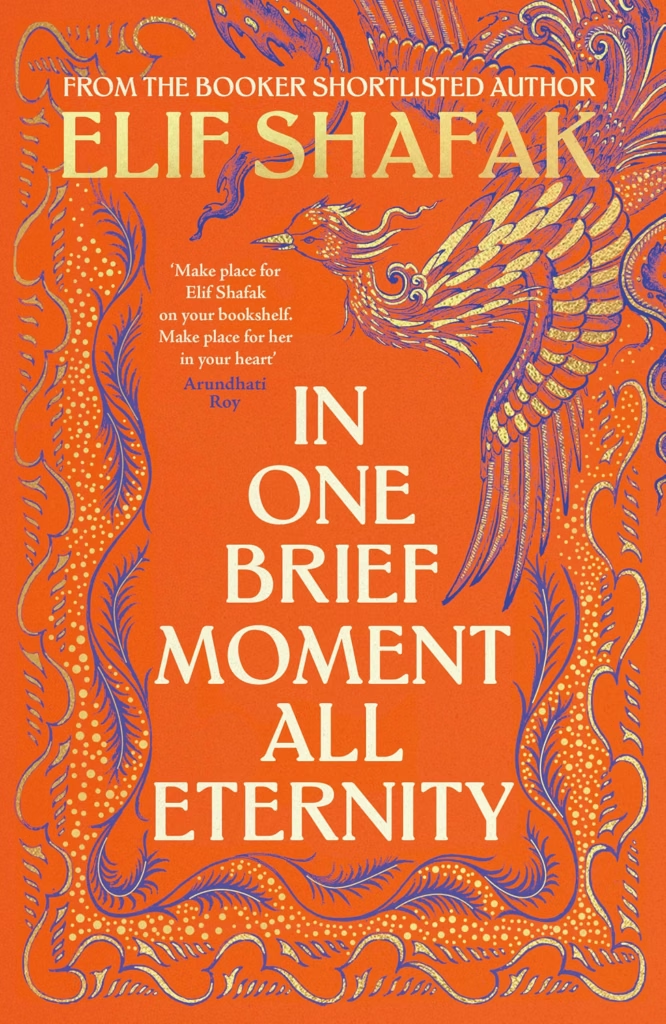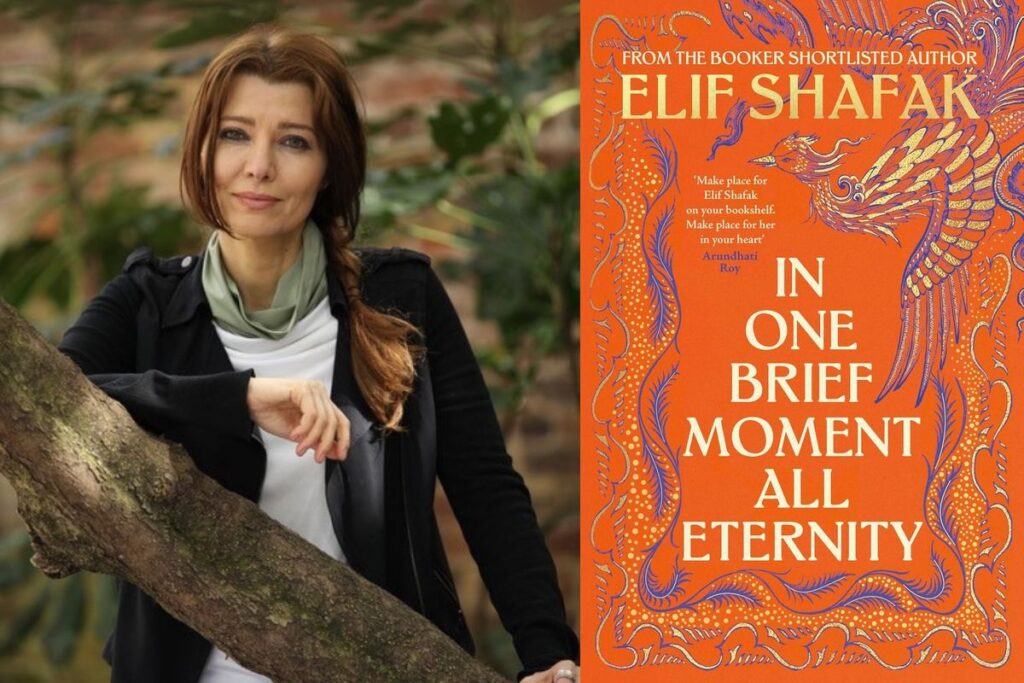
To celebrate the publication of In One Brief Moment All Eternity, we talked to Women’s Prize for Fiction shortlisted Elif Shafak about why she decided to reach back into the 19th century and ‘pluck the quill’ from Flaubert’s hands, the dance of traditions in her writing and the power and freedom of journeying to other worlds through fiction.
The conversation forms part of a special Picturehouse Book Club event, hosted by Executive Director of the Women’s Prize Trust, Claire Shanahan, presented in partnership with Dark Matter. Taking place at The Gate, London, audiences able to join the conversation live from seven regional Picturehouse cinemas across the UK – including Brighton, Cambridge, Chester, Edinburgh, Norwich, Oxford and York. Learn more and book your tickets here.
Throughout literary history, certain male writers and artists have been placed at the centre of the cultural canon, and Gustave Flaubert is one of those figures. What made you decide to flip the script and tell Emma Bovary’s story?
This novel started from a very personal and emotional place. A few years back, I found myself struggling with anxiety and depression, feeling overwhelmed by the world we are living in — as I believe many people are feeling today. I asked myself, ‘what is the meaning of literature, of writing a poem or looking for the perfect synonym, when there is so much suffering and uncertainty all around?’
That question and quest about ‘creativity in a time of crisis’ took me straight to the 19th century — a time of revolution, counterrevolution, brother killing brother. It was an era of seismic political and social change, characterised by a shift from an agrarian to an industrial lifestyle; empires were coming to an end, nation-states were being born with rival ideologies and rising nationalisms clashing…
I believe that the 19th century is not over yet. We are still dealing with the central themes of that momentous era. In the middle of that century of chaos and confusion there lived a beloved novelist who passionately dedicated his whole life to literature. I wanted to take a close look at him.
Flaubert was regarded as the connoisseur of the female mind. I wanted to take that premise and turn it upside down — pluck the quill from his hands and let women tell his story. Not just Emma, but 30 different female voices. Women we never hear about in official narratives, women whose stories have been written out of history. I wanted to bring their voices and their silences into the narrative.
Emma Bovary is one of the most iconic and scrutinised women in literature. What was it like to approach a character who has been interpreted and judged for more than 150 years? Did you feel a particular responsibility towards her — or did you have to find a way to forget everything that had already been said about her?
Flaubert changed the way we write novels. Nabokov says had there been no Flaubert, there would have been no James Joyce in Ireland, no Marcel Proust in France and Chekhov would not have been Chekhov. He says this because Flaubert played a very crucial and foundational role as a novelist.
He did not judge his Emma from above. He understood how universal and how existential her situation was. Emma is no saint, obviously, but she is not a villain either. She is a combination of good and bad. There is a chasm between who she is and who she wants to be — everyone can relate to that. We are all secretly dissatisfied with our lives, longing for something better, something more. Flaubert understood that so well. But this is one side of the story.
The other side of the story is: he gave his beloved Emma arsenic, he poisoned her and in some editions of Madame Bovary it takes her more than 10 pages to die. Isn’t that a bit too much? So I thought, if Emma could speak, I bet she would like to ask a few questions to Flaubert.
Equally it was important to capture the voices of 30 different female presences in his life. That number is not coincidental. It could not have been 29 or 31. There is a reason why it is 30, which will be revealed along the story.
In One Brief Moment All of Eternity is such an arresting title. But this title surprisingly comes from a Persian poem. Can you tell us more about that?
We tend to use the words “East” and “West” as if they were mutually exclusive, static and monolithic blocs. That was never the case. The borders were always more porous, fluid. Ideas traveled, stories traveled. The literary and cultural heritages of different lands influenced each other.
For instance, Goethe was very much influenced by a Persian poet called Hafez, and he wrote East-West diwan, under that influence. Equally Flaubert traveled extensively across the Middle East and the Levant — from Cairo to Damascus to Constantinople. His travels left a deep impact on him.
The title of the book is from a Persian poet and mystic called Attar, he wrote an important book titled The Conference of the Birds. For me, personally this is very important. I feel very attached to the Western canon, the European novel in particular. But that is not the only tradition that I am connected with. I equally cherish and treasure the literary heritage of the Balkans, Asia Minor, the Middle East, and hence in my writing these worlds tend to blend and dance together.
For aspiring writers, the research, structure and ambition of a novel like this can feel daunting. What did your writing process actually look like day to day? Were you a meticulous plotter for this book, or did you discover parts of it as you wrote?
Every novel starts with a feeling, an intuition, a sense of curiosity, often a small and humble thought. I do not set off with grand ideas or meticulous plots. There Are Rivers in the Sky started with a tiny single raindrop that landed on my hand, for instance. In One Brief Moment All Eternity started from a feeling of loneliness and angst. As I write the story grows.
I like it when my characters lead me, guide me, surprise me. For me, literature is less autobiographical than transcendental. I like to leave my little corner of the universe and journey into other worlds, other possibilities. The author and philosopher Iris Murdoch used to call this un-selfing. It is a brilliant description. Writing fiction is un-selfing.
For storytellers, nothing is insignificant and nobody is ordinary and time is not linear. We have to pay loving attention to the seemingly small things, search and find the extraordinary in the ordinary, the beauty in the broken.
Also, I come from a country of collective amnesia, and as a writer from a wounded democracy, it is important to me not only to focus on stories, but also to silences — and the silenced.
What did you hope readers will take from this book?
Every reader’s reading is personal, individual, unique. I respect that diversity deeply.
Writing this novel made me realise that there will always be stories — even in times of chaos and destruction. Perhaps especially then. Literature cannot stop wars, or make hatred disappear, but without it, without stories, we each would be so much lonelier.
I believe a reader does not need to know much about Flaubert or the 19th century or Madame Bovary to come on this journey with me. That is because, for me, this novel is primarily about a little boy who was regarded as a failure, a loser, a disappointment by almost everyone around him. He was raised in a house attached to a hospital attached to a morgue. He watched corpses being carted in and out. He was very imaginative, inventive, and very lonely. He was born into a family of esteemed doctors. He was told and instructed to become a doctor — just like his father and brother. He had no aptitude for medicine. The parents, grudgingly, then wanted him to become a lawyer. But he failed in that too. All he wanted was art, all he wanted was literature.
My point is: how ironic that of that esteemed family of his, 200 years later, Gustave is the only one we remember today. We remember the boy who was called a loser, a failure. So this novel is dedicated to anyone and everyone who, for whatever reason, might have felt unloved, or treated as ‘the other”. I wanted to say “you are my brother, my sister” and maybe you will find an inspiring and empowering story here for those like us.