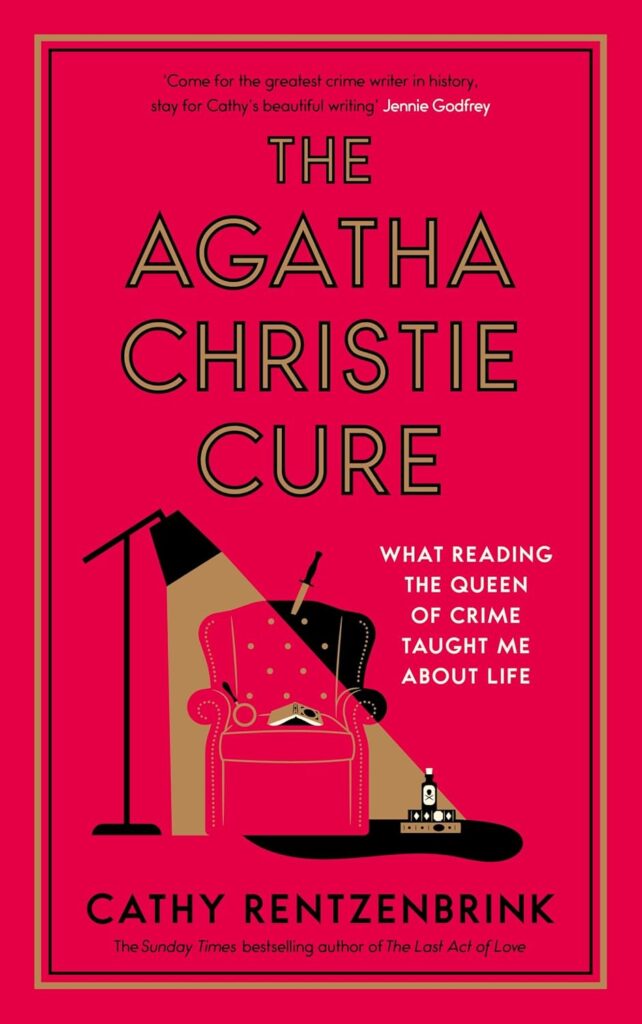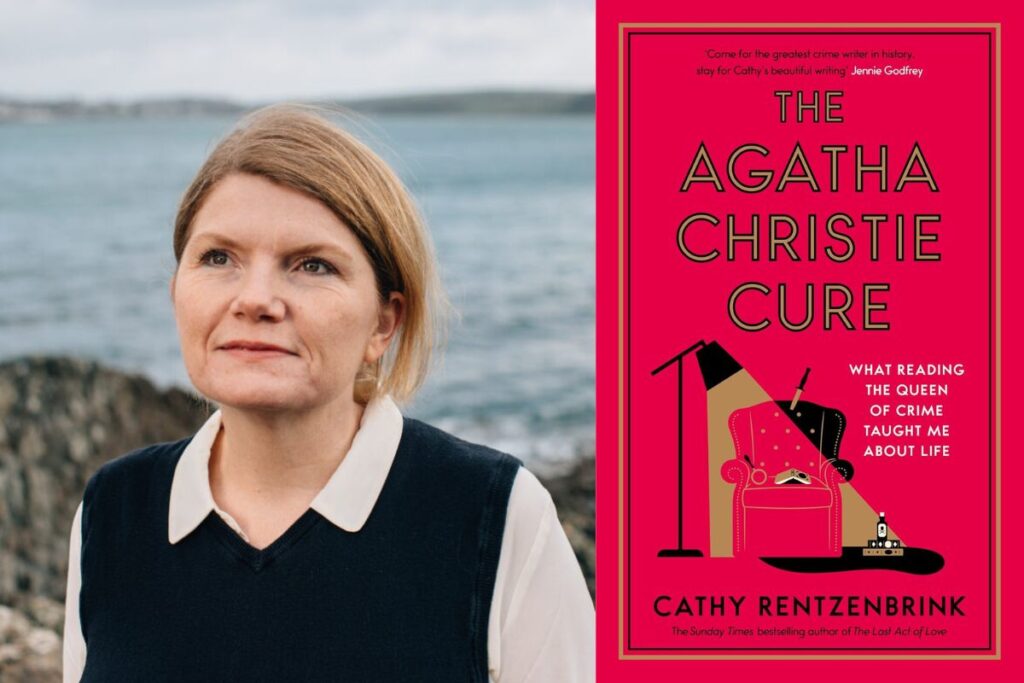
Part-memoir, part literary detective story, Cathy Rentzenbrink’s new book The Agatha Christie Cure charts how she found personal solace, hope and resilience through returning to her first literary love: Agatha Christie and delving into Agatha’s novels and life story. In this imagined interview, Cathy mines The Queen of Crime for writing advice.
I’m eating an apple in the bath thinking about Agatha Christie and the Women’s Prize. She died in 1976, long before it existed, but I’m wondering how she might have offered support if their lifespans had overlapped. I don’t think she’d have wanted to be a judge because although she was ferociously bright and extremely well read, she described herself as low-brow and didn’t like parties or having her photo taken. And no panel events or workshops as she hated public speaking. She might have donated, silently and without fuss. And she might have agreed to share her own story of how she became the most successful novelist in the world, outsold only by Shakespeare and the Bible, and still with a career that continues to flourish in new directions fifty years after her death. Yes, she might have agreed to be interviewed. She did like to be useful.
And then she’s sitting there. On the toilet. She often visits me while I’m in the bath. The first time I was disconcerted by my nudity, but she told me not to worry. ‘Humans are in such a pickle about their bodies, aren’t they? You must see how silly it is, that your first response to me turning up in your bathroom is to worry about your state of undress.’
And then we talked about Adam and Eve and apples and fig leaves and it was the start of a beautiful friendship. I’m constantly surprised by how much we have in common, even though she is older, posher and much more successful than I am. And, of course, not alive, though that has mattered less and less as time goes on.
AC: Did you eat apples in the bath before we knew each other?
CR: Can’t remember. It might be your influence. Can I interview you for my article for the Women’s Prize?
AC: We don’t have to discuss Harrogate, do we?
CR: Not at all. You’ve got lots of interesting things to say about writing. That’s what I’m after.
AC: Have I? I’m not sure I’ll be encouraging. Everyone thinks it is marvellous being a writer and they don’t understand the agony of being alone having to make things up. And boredom is so important. How can anyone be bored now? There’s too much to do.
CR: Maybe start by telling us why boredom is important.
AC: You need a bit of space. I wrote my first novel when I was recovering from flu. Not well enough to get up but too well to lie there and do nothing. It didn’t get published that novel, but I learned a lot. You could tell them that, not to expect to be brilliant straightaway. And not to take it to heart when people say you’re no good. A novelist friend of the family read that novel and said that I’d never be a published writer. Then Eden Philpotts gave me some good advice and told me I had the gifts sufficient. But he warned it was hard to write and live at the same time, and that’s what people don’t realise.
CR: Yes, but let’s not put everyone off. Tell us about the book that did get published.
AC: I’d always fancied having a crack at a detective novel, and my sister, Madge, poo pooed the idea, which rather spurred me on. And then the war came. Such a shock. Archie and I got married on Christmas Eve 1914 and he went straight back to France. I worked at the hospital in Torquay as a ward maid. I scrubbed a lot of floors, I can tell you. By 1916 I was in the dispensary and had long periods where I had to be there but all the jobs had been done so I started puzzling out my novel. I’d learned a lot about poisons which fed into the plot. And all the Belgian refugees inspired my detective.
CR: The famous Hercule Poirot.
AC: Yes, I had no idea I’d be stuck with him forever or I might have chosen someone with fewer annoying mannerisms.
CR: People love him.
AC: People can be very silly. The writing wasn’t easy. My mother suggested I spend my holiday at a hotel to finish it so I went to Dartmoor and wrote and walked and slept. I did get most of it done and I could still see that it wasn’t quite right but couldn’t see what else to do. That was rejected a lot too. But I didn’t worry too much about it. It was good to have something to distract me from the war.
CR: And that was The Mysterious Affair at Styles.
AC: Yes, and it was in 1919 that John Lane asked me to call at his office. And another two years before it was on the shelves.
CR: It always feels to me that you enjoyed your early career, even the press.
AC: I did! There were so few ways that women could earn money then. Interviews and having my photo taken and being asked to write short stories for The Sketch; it was all rather intoxicating. I bought my first car with the serial money I got for The Man in the Brown Suit. Later, when everything had gone wrong, I regretted letting them photograph me with Rosalind. I’d never have agreed if I’d known we’d be plastered all over the papers during that horrible time. But that’s it. You can’t know what will happen. I learned the hard way that any degree of attention, any fame whatsoever makes people feel they have a right to you. It’s a Faustian pact that you can’t control. So tell them to be careful but also tell them that just because they publish books does not mean they owe everyone the whole truth about themselves and their lives. They are entitled to their privacy.
CR: That’s very good advice. What else?
AC: You do have to give yourself to a book. Rosalind never liked not having my full attention. Later, I regretted not giving more of myself to her in her early years. And Archie was what people now would describe now as supportive, but only to a point. I’m not sure how much he enjoyed his wife being the centre of attention. What man does?
CR: Your second husband seemed to cope well with that.
AC: Yes, Max knew what he was getting, of course, because I was already established then. We both learned to play the game of it, and the book money helped finance Max’s digs so that all felt good.
CR: You enjoyed the archaeology and got a few novel settings out of it. Was it also helpful to have something to do that wasn’t writing?
AC: Absolutely. I loved cleaning the finds and doing the photography. The desert gives you a great sense of perspective. And no writer should spend too much time stuck in morbid introspection.
CR: It often sounds like you wish you’d chosen a different profession.
AC: It’s an odd thing, writing. I’d liked to have studied mathematics. Or been a hospital nurse.
CR: The hospital nurse would probably not have been invited for dinner with the Queen.
AC: (Laughing) Yes, that was a high point. Some soot came down the chimney, and I thought how royal life wasn’t that different from everyone else’s, really. Tell them that. Tell them people are pretty much the same, though they don’t realise it. And tell them that they will remain the same, no matter what happens or how successful they are. Other people might call you the Queen of Crime, or the Duchess of Death, but you always know that you’re just an ordinary human being, no better or worse than any other.
CR: That is worth knowing. Anything else?
AC: They should join The Society of Authors. I don’t know how well publishers behave themselves these days, but my first one took advantage of my innocence. And tell them to be careful who they let dramatise their work. That awful man who wanted to give poor Poirot a love interest…
CR: You did get revenge on him, in Mrs. McGinty’s Dead.
AC: Ha! Yes. One of the best things about writing books is you’ve got an avenue to make use of all the aggravations you encounter.
CR: Thank you so much. You’ve been very generous. Would you have been so accommodating in life?
AC: Hard to tell. Once I managed to get going on a book I never dared look up until it was done. But if you’d asked when I was stuck you might have benefitted from the writer’s natural urge to do anything except get on with what they’re supposed to be doing. Speaking of which, shouldn’t you get out of the bath and write some of this down before you forget it?
CR: Probably. I’d rather carry on chatting.
AC: I could tell you all the things that look awful about being a writer now. Those horrible computers. This terrible business of having to do ‘blurbs’ for each other’s work. Presumably one can’t easily say no. It must lead to all sorts of ill feeling. We didn’t have to do that in my day. We wrote to each other privately. Dorothy Sayers sent me a very nice letter about The Murder at the Vicarage. I wrote to Daphne du Maurier about Rebecca. Now that was a good book. But we didn’t have to tolerate the pressure of publicly opining about each other. Oh, and education, tell them not to bother too much about it; more important they think for themselves. How one thing leads to another. I could go on and on. I’m feeling unusually talkative today. I’d better leave you to it.
CR: Before you go, tell me, what are the best things about being a writer?
AC: Being paid. New experiences and opportunities to learn. That time I was the answer to a crossword clue in the Times. That felt like high fame.
CR: You’re the answer to lots of crossword clues now. And they make T-shirts and mugs and tote bags about you.
AC: Life is strange. You never know what’s going to happen. That’s something to hang on to. It’s never the end. If you stick with it, if you stick with life, who knows what good things might happen in the future? It’s important to have hope, tell them that. Be hopeful. Even in the midst of darkness and despair, try to leave a gap for a little bit of hope. It might make all the difference.
And she’s gone. My apple is finished. Time to get out.